

404
6 Applications: Two-Region Pebble Beds
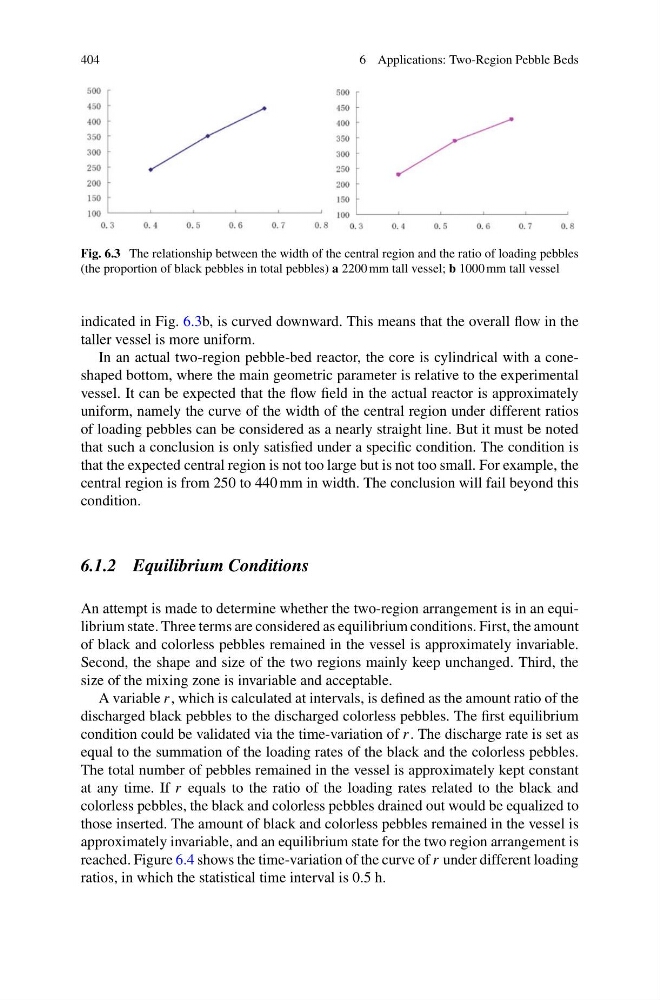
Fig. 6.3 The relationship between the width of the central region and the ratio of loading pebbles
(the proportion of black pebbles in total pebbles) a 2200 mm tall vessel; b 1000 mm tall vessel
indicated in Fig. 6.3b, is curved downward. This means that the overall flow in the
taller vessel is more uniform.
In an actual two-region pebble-bed reactor, the core is cylindrical with a coneshaped bottom, where the main geometric parameter is relative to the experimental
vessel. It can be expected that the flow field in the actual reactor is approximately
uniform, namely the curve of the width of the central region under different ratios
of loading pebbles can be considered as a nearly straight line. But it must be noted
that such a conclusion is only satisfied under a specific condition. The condition is
that the expected central region is not too large but is not too small. For example, the
central region is from 250 to 440 mm in width. The conclusion will fail beyond this
condition.
6.1.2 Equilibrium Conditions
An attempt is made to determine whether the two-region arrangement is in an equilibrium state. Three terms are considered as equilibrium conditions. First, the amount
of black and colorless pebbles remained in the vessel is approximately invariable.
Second, the shape and size of the two regions mainly keep unchanged. Third, the
size of the mixing zone is invariable and acceptable.
A variable r , which is calculated at intervals, is defined as the amount ratio of the
discharged black pebbles to the discharged colorless pebbles. The first equilibrium
condition could be validated via the time-variation of r . The discharge rate is set as
equal to the summation of the loading rates of the black and the colorless pebbles.
The total number of pebbles remained in the vessel is approximately kept constant
at any time. If r equals to the ratio of the loading rates related to the black and
colorless pebbles, the black and colorless pebbles drained out would be equalized to
those inserted. The amount of black and colorless pebbles remained in the vessel is
approximately invariable, and an equilibrium state for the two region arrangement is
reached. Figure 6.4 shows the time-variation of the curve of r under different loading
ratios, in which the statistical time interval is 0.5 h.
6 Applications: Two-Region Pebble Beds
Fig. 6.3 The relationship between the width of the central region and the ratio of loading pebbles
(the proportion of black pebbles in total pebbles) a 2200 mm tall vessel; b 1000 mm tall vessel
indicated in Fig. 6.3b, is curved downward. This means that the overall flow in the
taller vessel is more uniform.
In an actual two-region pebble-bed reactor, the core is cylindrical with a coneshaped bottom, where the main geometric parameter is relative to the experimental
vessel. It can be expected that the flow field in the actual reactor is approximately
uniform, namely the curve of the width of the central region under different ratios
of loading pebbles can be considered as a nearly straight line. But it must be noted
that such a conclusion is only satisfied under a specific condition. The condition is
that the expected central region is not too large but is not too small. For example, the
central region is from 250 to 440 mm in width. The conclusion will fail beyond this
condition.
6.1.2 Equilibrium Conditions
An attempt is made to determine whether the two-region arrangement is in an equilibrium state. Three terms are considered as equilibrium conditions. First, the amount
of black and colorless pebbles remained in the vessel is approximately invariable.
Second, the shape and size of the two regions mainly keep unchanged. Third, the
size of the mixing zone is invariable and acceptable.
A variable r , which is calculated at intervals, is defined as the amount ratio of the
discharged black pebbles to the discharged colorless pebbles. The first equilibrium
condition could be validated via the time-variation of r . The discharge rate is set as
equal to the summation of the loading rates of the black and the colorless pebbles.
The total number of pebbles remained in the vessel is approximately kept constant
at any time. If r equals to the ratio of the loading rates related to the black and
colorless pebbles, the black and colorless pebbles drained out would be equalized to
those inserted. The amount of black and colorless pebbles remained in the vessel is
approximately invariable, and an equilibrium state for the two region arrangement is
reached. Figure 6.4 shows the time-variation of the curve of r under different loading
ratios, in which the statistical time interval is 0.5 h.