

6.1 Experimental Measurements
405
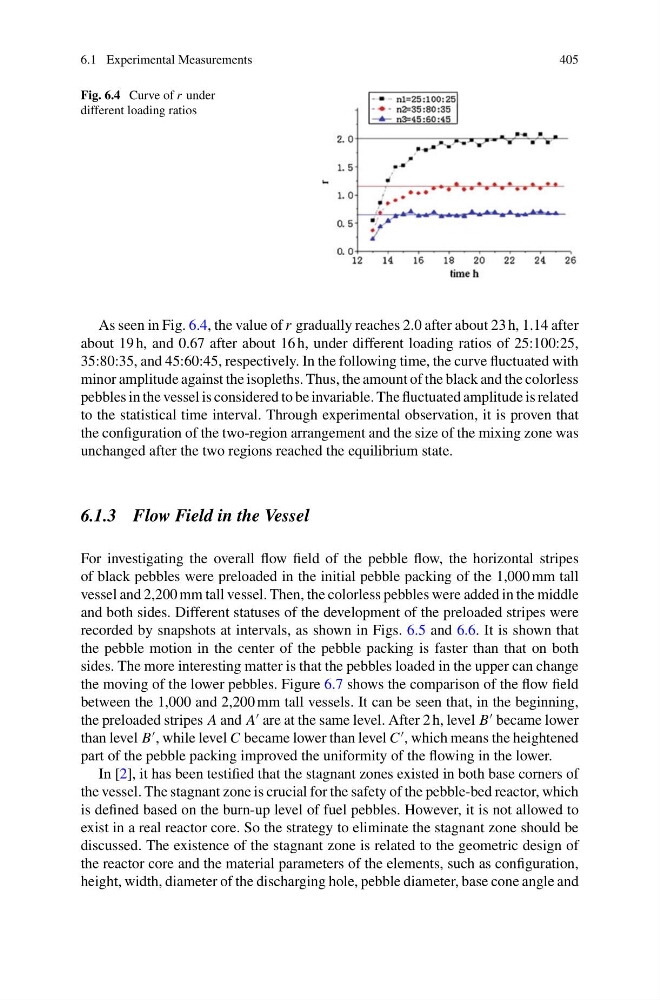
Fig. 6.4 Curve of r under
different loading ratios
As seen in Fig. 6.4, the value of r gradually reaches 2.0 after about 23 h, 1.14 after
about 19 h, and 0.67 after about 16 h, under different loading ratios of 25:100:25,
35:80:35, and 45:60:45, respectively. In the following time, the curve fluctuated with
minor amplitude against the isopleths. Thus, the amount of the black and the colorless
pebbles in the vessel is considered to be invariable. The fluctuated amplitude is related
to the statistical time interval. Through experimental observation, it is proven that
the configuration of the two-region arrangement and the size of the mixing zone was
unchanged after the two regions reached the equilibrium state.
6.1.3 Flow Field in the Vessel
For investigating the overall flow field of the pebble flow, the horizontal stripes
of black pebbles were preloaded in the initial pebble packing of the 1,000 mm tall
vessel and 2,200 mm tall vessel. Then, the colorless pebbles were added in the middle
and both sides. Different statuses of the development of the preloaded stripes were
recorded by snapshots at intervals, as shown in Figs. 6.5 and 6.6. It is shown that
the pebble motion in the center of the pebble packing is faster than that on both
sides. The more interesting matter is that the pebbles loaded in the upper can change
the moving of the lower pebbles. Figure 6.7 shows the comparison of the flow field
between the 1,000 and 2,200 mm tall vessels. It can be seen that, in the beginning,
the preloaded stripes A and A
are at the same level. After 2 h, level B
became lower
than level B
, while level C became lower than level C
, which means the heightened
part of the pebble packing improved the uniformity of the flowing in the lower.
In [2], it has been testified that the stagnant zones existed in both base corners of
the vessel. The stagnant zone is crucial for the safety of the pebble-bed reactor, which
is defined based on the burn-up level of fuel pebbles. However, it is not allowed to
exist in a real reactor core. So the strategy to eliminate the stagnant zone should be
discussed. The existence of the stagnant zone is related to the geometric design of
the reactor core and the material parameters of the elements, such as configuration,
height, width, diameter of the discharging hole, pebble diameter, base cone angle and
405
Fig. 6.4 Curve of r under
different loading ratios
As seen in Fig. 6.4, the value of r gradually reaches 2.0 after about 23 h, 1.14 after
about 19 h, and 0.67 after about 16 h, under different loading ratios of 25:100:25,
35:80:35, and 45:60:45, respectively. In the following time, the curve fluctuated with
minor amplitude against the isopleths. Thus, the amount of the black and the colorless
pebbles in the vessel is considered to be invariable. The fluctuated amplitude is related
to the statistical time interval. Through experimental observation, it is proven that
the configuration of the two-region arrangement and the size of the mixing zone was
unchanged after the two regions reached the equilibrium state.
6.1.3 Flow Field in the Vessel
For investigating the overall flow field of the pebble flow, the horizontal stripes
of black pebbles were preloaded in the initial pebble packing of the 1,000 mm tall
vessel and 2,200 mm tall vessel. Then, the colorless pebbles were added in the middle
and both sides. Different statuses of the development of the preloaded stripes were
recorded by snapshots at intervals, as shown in Figs. 6.5 and 6.6. It is shown that
the pebble motion in the center of the pebble packing is faster than that on both
sides. The more interesting matter is that the pebbles loaded in the upper can change
the moving of the lower pebbles. Figure 6.7 shows the comparison of the flow field
between the 1,000 and 2,200 mm tall vessels. It can be seen that, in the beginning,
the preloaded stripes A and A
are at the same level. After 2 h, level B
became lower
than level B
, while level C became lower than level C
, which means the heightened
part of the pebble packing improved the uniformity of the flowing in the lower.
In [2], it has been testified that the stagnant zones existed in both base corners of
the vessel. The stagnant zone is crucial for the safety of the pebble-bed reactor, which
is defined based on the burn-up level of fuel pebbles. However, it is not allowed to
exist in a real reactor core. So the strategy to eliminate the stagnant zone should be
discussed. The existence of the stagnant zone is related to the geometric design of
the reactor core and the material parameters of the elements, such as configuration,
height, width, diameter of the discharging hole, pebble diameter, base cone angle and