

5.5 Further Issues
385
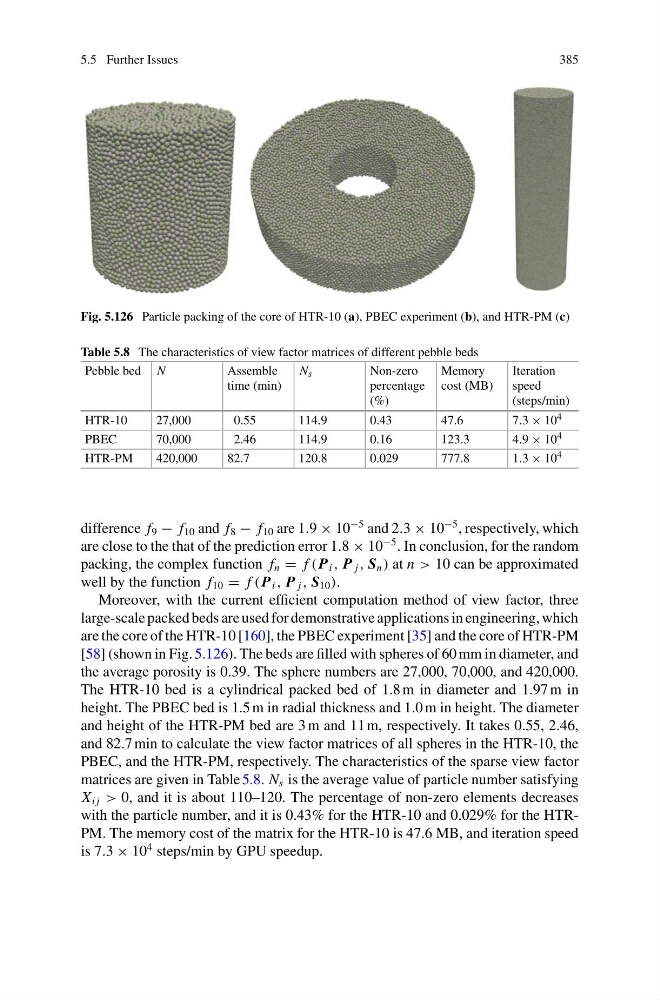
Fig. 5.126 Particle packing of the core of HTR-10 (a), PBEC experiment (b), and HTR-PM (c)
Table 5.8 The characteristics of view factor matrices of different pebble beds
Pebble bed N
Assemble
time (min)
N s
Non-zero
percentage
(%)
Memory
cost (MB)
Iteration
speed
(steps/min)
HTR-10
27,000
0.55
114.9
0.43
47.6
7.3 × 10 4
PBEC
70,000
2.46
114.9
0.16
123.3
4.9 × 10 4
HTR-PM
420,000
82.7
120.8
0.029
777.8
1.3 × 10 4
difference f 9 − f 10 and f 8 − f 10 are 1.9 × 10
−5 and 2.3 × 10
−5 , respectively, which
are close to the that of the prediction error 1.8 × 10
−5 . In conclusion, for the random
packing, the complex function f n = f ( P i , P j , S n ) at n > 10 can be approximated
well by the function f 10 = f ( P i , P j , S 10 ).
Moreover, with the current efficient computation method of view factor, three
large-scale packed beds are used for demonstrative applications in engineering, which
are the core of the HTR-10 [160], the PBEC experiment [35] and the core of HTR-PM
[58] (shown in Fig. 5.126). The beds are filled with spheres of 60 mm in diameter, and
the average porosity is 0.39. The sphere numbers are 27,000, 70,000, and 420,000.
The HTR-10 bed is a cylindrical packed bed of 1.8 m in diameter and 1.97 m in
height. The PBEC bed is 1.5 m in radial thickness and 1.0 m in height. The diameter
and height of the HTR-PM bed are 3 m and 11 m, respectively. It takes 0.55, 2.46,
and 82.7 min to calculate the view factor matrices of all spheres in the HTR-10, the
PBEC, and the HTR-PM, respectively. The characteristics of the sparse view factor
matrices are given in Table 5.8. N s is the average value of particle number satisfying
X i j > 0, and it is about 110–120. The percentage of non-zero elements decreases
with the particle number, and it is 0.43% for the HTR-10 and 0.029% for the HTRPM. The memory cost of the matrix for the HTR-10 is 47.6 MB, and iteration speed
is 7.3 × 10
4 steps/min by GPU speedup.
385
Fig. 5.126 Particle packing of the core of HTR-10 (a), PBEC experiment (b), and HTR-PM (c)
Table 5.8 The characteristics of view factor matrices of different pebble beds
Pebble bed N
Assemble
time (min)
N s
Non-zero
percentage
(%)
Memory
cost (MB)
Iteration
speed
(steps/min)
HTR-10
27,000
0.55
114.9
0.43
47.6
7.3 × 10 4
PBEC
70,000
2.46
114.9
0.16
123.3
4.9 × 10 4
HTR-PM
420,000
82.7
120.8
0.029
777.8
1.3 × 10 4
difference f 9 − f 10 and f 8 − f 10 are 1.9 × 10
−5 and 2.3 × 10
−5 , respectively, which
are close to the that of the prediction error 1.8 × 10
−5 . In conclusion, for the random
packing, the complex function f n = f ( P i , P j , S n ) at n > 10 can be approximated
well by the function f 10 = f ( P i , P j , S 10 ).
Moreover, with the current efficient computation method of view factor, three
large-scale packed beds are used for demonstrative applications in engineering, which
are the core of the HTR-10 [160], the PBEC experiment [35] and the core of HTR-PM
[58] (shown in Fig. 5.126). The beds are filled with spheres of 60 mm in diameter, and
the average porosity is 0.39. The sphere numbers are 27,000, 70,000, and 420,000.
The HTR-10 bed is a cylindrical packed bed of 1.8 m in diameter and 1.97 m in
height. The PBEC bed is 1.5 m in radial thickness and 1.0 m in height. The diameter
and height of the HTR-PM bed are 3 m and 11 m, respectively. It takes 0.55, 2.46,
and 82.7 min to calculate the view factor matrices of all spheres in the HTR-10, the
PBEC, and the HTR-PM, respectively. The characteristics of the sparse view factor
matrices are given in Table 5.8. N s is the average value of particle number satisfying
X i j > 0, and it is about 110–120. The percentage of non-zero elements decreases
with the particle number, and it is 0.43% for the HTR-10 and 0.029% for the HTRPM. The memory cost of the matrix for the HTR-10 is 47.6 MB, and iteration speed
is 7.3 × 10
4 steps/min by GPU speedup.