

386
5 Numerical Models for Pebble-Bed Heat Transfer
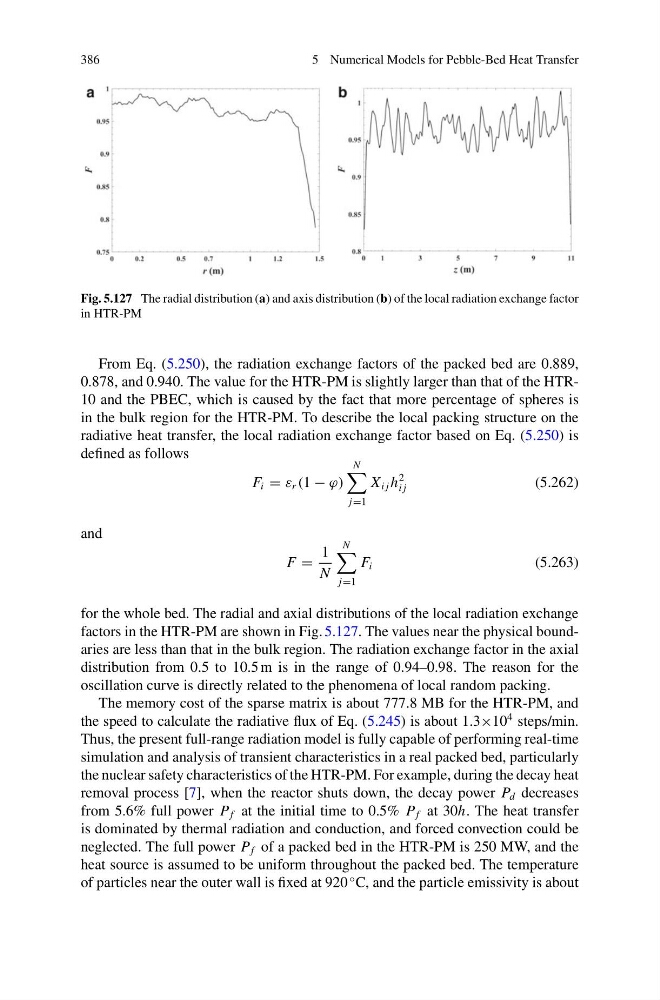
Fig. 5.127 The radial distribution (a) and axis distribution (b) of the local radiation exchange factor
in HTR-PM
From Eq. (5.250), the radiation exchange factors of the packed bed are 0.889,
0.878, and 0.940. The value for the HTR-PM is slightly larger than that of the HTR10 and the PBEC, which is caused by the fact that more percentage of spheres is
in the bulk region for the HTR-PM. To describe the local packing structure on the
radiative heat transfer, the local radiation exchange factor based on Eq. (5.250) is
defined as follows
F i = ε r (1 − ϕ)
N
j=1
X i j h
2
i j
(5.262)
and
F =
1
N
N
j=1
F i
(5.263)
for the whole bed. The radial and axial distributions of the local radiation exchange
factors in the HTR-PM are shown in Fig. 5.127. The values near the physical boundaries are less than that in the bulk region. The radiation exchange factor in the axial
distribution from 0.5 to 10.5 m is in the range of 0.94–0.98. The reason for the
oscillation curve is directly related to the phenomena of local random packing.
The memory cost of the sparse matrix is about 777.8 MB for the HTR-PM, and
the speed to calculate the radiative flux of Eq. (5.245) is about 1.3×10
4 steps/min.
Thus, the present full-range radiation model is fully capable of performing real-time
simulation and analysis of transient characteristics in a real packed bed, particularly
the nuclear safety characteristics of the HTR-PM. For example, during the decay heat
removal process [7], when the reactor shuts down, the decay power P d decreases
from 5.6% full power P f at the initial time to 0.5% P f at 30h. The heat transfer
is dominated by thermal radiation and conduction, and forced convection could be
neglected. The full power P f of a packed bed in the HTR-PM is 250 MW, and the
heat source is assumed to be uniform throughout the packed bed. The temperature
of particles near the outer wall is fixed at 920
◦ C, and the particle emissivity is about
5 Numerical Models for Pebble-Bed Heat Transfer
Fig. 5.127 The radial distribution (a) and axis distribution (b) of the local radiation exchange factor
in HTR-PM
From Eq. (5.250), the radiation exchange factors of the packed bed are 0.889,
0.878, and 0.940. The value for the HTR-PM is slightly larger than that of the HTR10 and the PBEC, which is caused by the fact that more percentage of spheres is
in the bulk region for the HTR-PM. To describe the local packing structure on the
radiative heat transfer, the local radiation exchange factor based on Eq. (5.250) is
defined as follows
F i = ε r (1 − ϕ)
N
j=1
X i j h
2
i j
(5.262)
and
F =
1
N
N
j=1
F i
(5.263)
for the whole bed. The radial and axial distributions of the local radiation exchange
factors in the HTR-PM are shown in Fig. 5.127. The values near the physical boundaries are less than that in the bulk region. The radiation exchange factor in the axial
distribution from 0.5 to 10.5 m is in the range of 0.94–0.98. The reason for the
oscillation curve is directly related to the phenomena of local random packing.
The memory cost of the sparse matrix is about 777.8 MB for the HTR-PM, and
the speed to calculate the radiative flux of Eq. (5.245) is about 1.3×10
4 steps/min.
Thus, the present full-range radiation model is fully capable of performing real-time
simulation and analysis of transient characteristics in a real packed bed, particularly
the nuclear safety characteristics of the HTR-PM. For example, during the decay heat
removal process [7], when the reactor shuts down, the decay power P d decreases
from 5.6% full power P f at the initial time to 0.5% P f at 30h. The heat transfer
is dominated by thermal radiation and conduction, and forced convection could be
neglected. The full power P f of a packed bed in the HTR-PM is 250 MW, and the
heat source is assumed to be uniform throughout the packed bed. The temperature
of particles near the outer wall is fixed at 920
◦ C, and the particle emissivity is about