

358
5 Numerical Models for Pebble-Bed Heat Transfer
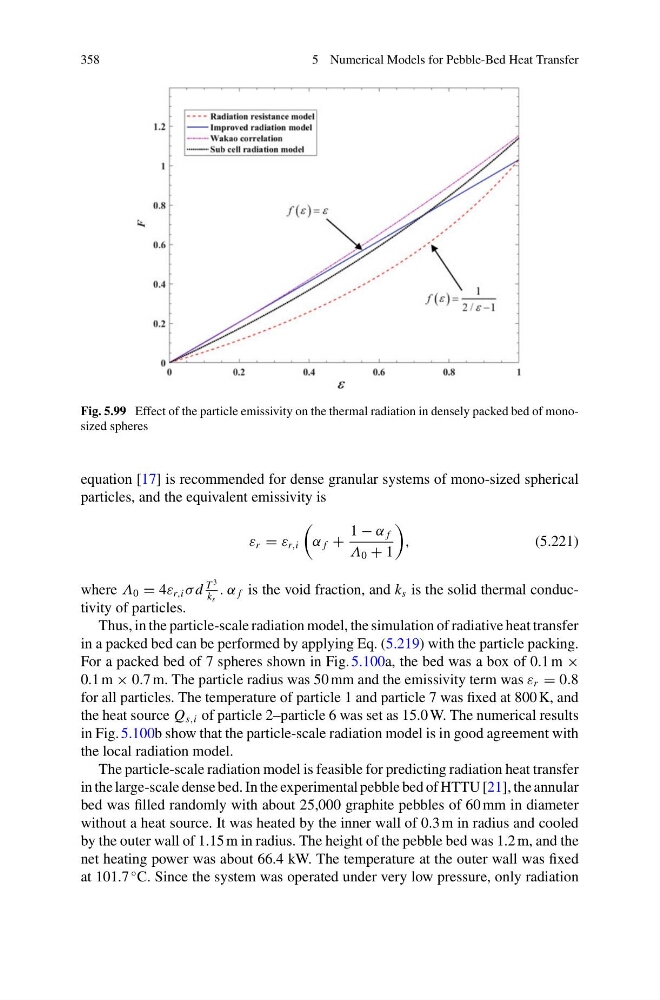
Fig. 5.99 Effect of the particle emissivity on the thermal radiation in densely packed bed of monosized spheres
equation [17] is recommended for dense granular systems of mono-sized spherical
particles, and the equivalent emissivity is
ε r = ε r,i
α f +
1 − α f
Λ 0 + 1
,
(5.221)
where Λ 0 = 4ε r,i σ d
T
3
k s
. α f is the void fraction, and k s is the solid thermal conductivity of particles.
Thus, in the particle-scale radiation model, the simulation of radiative heat transfer
in a packed bed can be performed by applying Eq. (5.219) with the particle packing.
For a packed bed of 7 spheres shown in Fig. 5.100a, the bed was a box of 0.1 m ×
0.1 m × 0.7 m. The particle radius was 50 mm and the emissivity term was ε r = 0.8
for all particles. The temperature of particle 1 and particle 7 was fixed at 800 K, and
the heat source Q s,i of particle 2–particle 6 was set as 15.0 W. The numerical results
in Fig. 5.100b show that the particle-scale radiation model is in good agreement with
the local radiation model.
The particle-scale radiation model is feasible for predicting radiation heat transfer
in the large-scale dense bed. In the experimental pebble bed of HTTU [21], the annular
bed was filled randomly with about 25,000 graphite pebbles of 60 mm in diameter
without a heat source. It was heated by the inner wall of 0.3 m in radius and cooled
by the outer wall of 1.15 m in radius. The height of the pebble bed was 1.2 m, and the
net heating power was about 66.4 kW. The temperature at the outer wall was fixed
at 101.7
◦ C. Since the system was operated under very low pressure, only radiation
5 Numerical Models for Pebble-Bed Heat Transfer
Fig. 5.99 Effect of the particle emissivity on the thermal radiation in densely packed bed of monosized spheres
equation [17] is recommended for dense granular systems of mono-sized spherical
particles, and the equivalent emissivity is
ε r = ε r,i
α f +
1 − α f
Λ 0 + 1
,
(5.221)
where Λ 0 = 4ε r,i σ d
T
3
k s
. α f is the void fraction, and k s is the solid thermal conductivity of particles.
Thus, in the particle-scale radiation model, the simulation of radiative heat transfer
in a packed bed can be performed by applying Eq. (5.219) with the particle packing.
For a packed bed of 7 spheres shown in Fig. 5.100a, the bed was a box of 0.1 m ×
0.1 m × 0.7 m. The particle radius was 50 mm and the emissivity term was ε r = 0.8
for all particles. The temperature of particle 1 and particle 7 was fixed at 800 K, and
the heat source Q s,i of particle 2–particle 6 was set as 15.0 W. The numerical results
in Fig. 5.100b show that the particle-scale radiation model is in good agreement with
the local radiation model.
The particle-scale radiation model is feasible for predicting radiation heat transfer
in the large-scale dense bed. In the experimental pebble bed of HTTU [21], the annular
bed was filled randomly with about 25,000 graphite pebbles of 60 mm in diameter
without a heat source. It was heated by the inner wall of 0.3 m in radius and cooled
by the outer wall of 1.15 m in radius. The height of the pebble bed was 1.2 m, and the
net heating power was about 66.4 kW. The temperature at the outer wall was fixed
at 101.7
◦ C. Since the system was operated under very low pressure, only radiation