

5.5 Further Issues
359
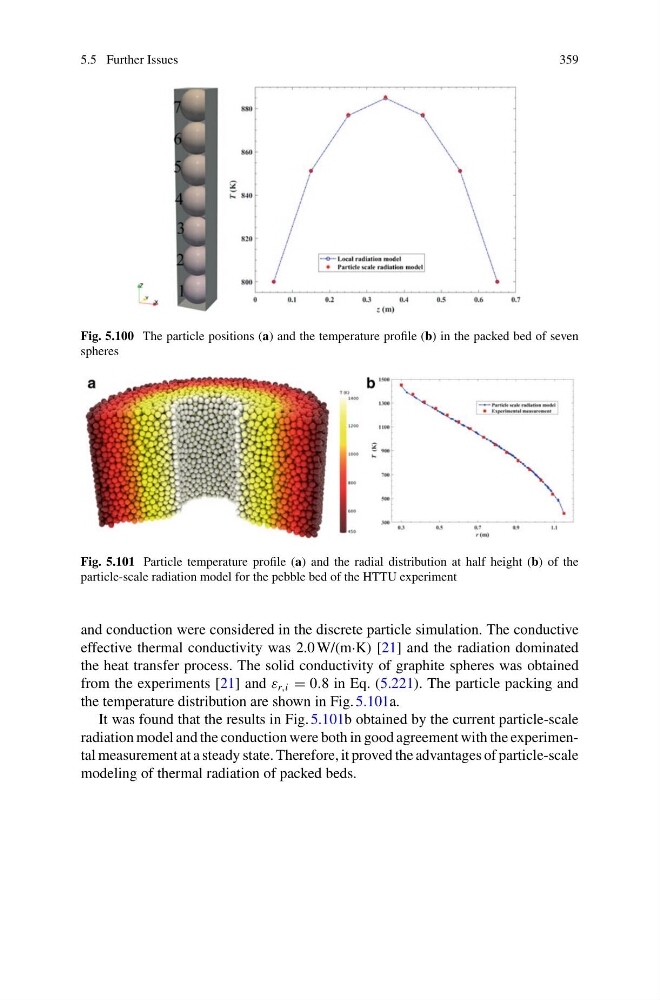
Fig. 5.100 The particle positions (a) and the temperature profile (b) in the packed bed of seven
spheres
Fig. 5.101 Particle temperature profile (a) and the radial distribution at half height (b) of the
particle-scale radiation model for the pebble bed of the HTTU experiment
and conduction were considered in the discrete particle simulation. The conductive
effective thermal conductivity was 2.0 W/(m·K) [21] and the radiation dominated
the heat transfer process. The solid conductivity of graphite spheres was obtained
from the experiments [21] and ε r,i = 0.8 in Eq. (5.221). The particle packing and
the temperature distribution are shown in Fig. 5.101a.
It was found that the results in Fig. 5.101b obtained by the current particle-scale
radiation model and the conduction were both in good agreement with the experimental measurement at a steady state. Therefore, it proved the advantages of particle-scale
modeling of thermal radiation of packed beds.
359
Fig. 5.100 The particle positions (a) and the temperature profile (b) in the packed bed of seven
spheres
Fig. 5.101 Particle temperature profile (a) and the radial distribution at half height (b) of the
particle-scale radiation model for the pebble bed of the HTTU experiment
and conduction were considered in the discrete particle simulation. The conductive
effective thermal conductivity was 2.0 W/(m·K) [21] and the radiation dominated
the heat transfer process. The solid conductivity of graphite spheres was obtained
from the experiments [21] and ε r,i = 0.8 in Eq. (5.221). The particle packing and
the temperature distribution are shown in Fig. 5.101a.
It was found that the results in Fig. 5.101b obtained by the current particle-scale
radiation model and the conduction were both in good agreement with the experimental measurement at a steady state. Therefore, it proved the advantages of particle-scale
modeling of thermal radiation of packed beds.