

5.5 Further Issues
357
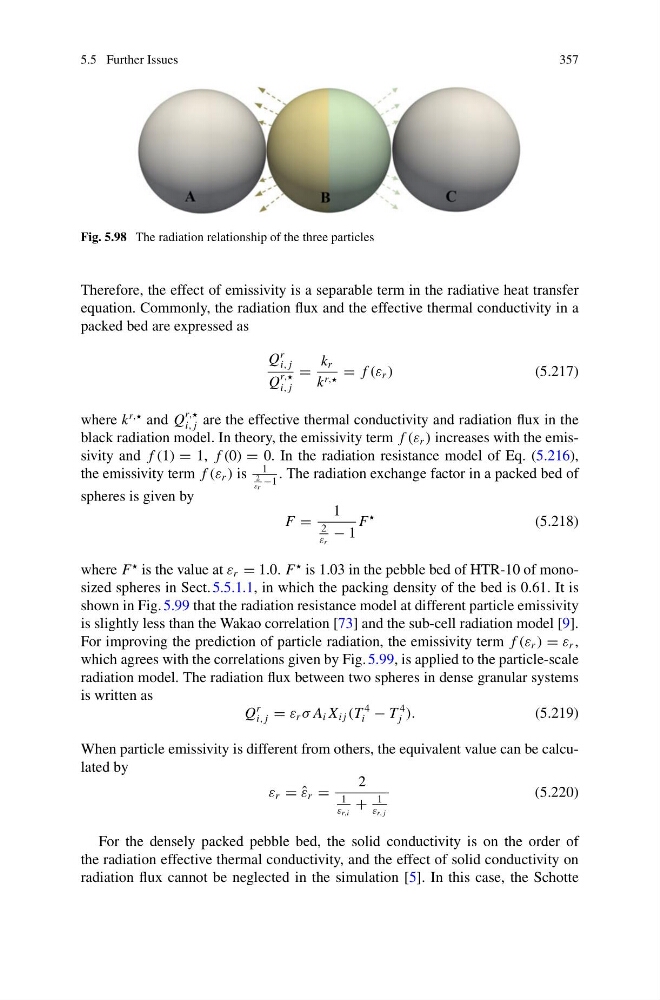
Fig. 5.98 The radiation relationship of the three particles
Therefore, the effect of emissivity is a separable term in the radiative heat transfer
equation. Commonly, the radiation flux and the effective thermal conductivity in a
packed bed are expressed as
Q
r
i, j
Q
r,,
i, j
=
k r
k r,, = f (ε r )
(5.217)
where k
r,, and Q
r,,
i, j are the effective thermal conductivity and radiation flux in the
black radiation model. In theory, the emissivity term f (ε r ) increases with the emissivity and f (1) = 1, f (0) = 0. In the radiation resistance model of Eq. (5.216),
the emissivity term f (ε r ) is
1
2
εr −1
. The radiation exchange factor in a packed bed of
spheres is given by
F =
1
2
ε r
− 1
F
(5.218)
where F
is the value at ε r = 1.0. F
is 1.03 in the pebble bed of HTR-10 of monosized spheres in Sect. 5.5.1.1, in which the packing density of the bed is 0.61. It is
shown in Fig. 5.99 that the radiation resistance model at different particle emissivity
is slightly less than the Wakao correlation [73] and the sub-cell radiation model [9].
For improving the prediction of particle radiation, the emissivity term f (ε r ) = ε r ,
which agrees with the correlations given by Fig. 5.99, is applied to the particle-scale
radiation model. The radiation flux between two spheres in dense granular systems
is written as
Q
r
i, j = ε r σ A i X i j (T
4
i − T
4
j ).
(5.219)
When particle emissivity is different from others, the equivalent value can be calculated by
ε r = ˆ
ε r =
2
1
ε r,i
+
1
ε r, j
(5.220)
For the densely packed pebble bed, the solid conductivity is on the order of
the radiation effective thermal conductivity, and the effect of solid conductivity on
radiation flux cannot be neglected in the simulation [5]. In this case, the Schotte
357
Fig. 5.98 The radiation relationship of the three particles
Therefore, the effect of emissivity is a separable term in the radiative heat transfer
equation. Commonly, the radiation flux and the effective thermal conductivity in a
packed bed are expressed as
Q
r
i, j
Q
r,,
i, j
=
k r
k r,, = f (ε r )
(5.217)
where k
r,, and Q
r,,
i, j are the effective thermal conductivity and radiation flux in the
black radiation model. In theory, the emissivity term f (ε r ) increases with the emissivity and f (1) = 1, f (0) = 0. In the radiation resistance model of Eq. (5.216),
the emissivity term f (ε r ) is
1
2
εr −1
. The radiation exchange factor in a packed bed of
spheres is given by
F =
1
2
ε r
− 1
F
(5.218)
where F
is the value at ε r = 1.0. F
is 1.03 in the pebble bed of HTR-10 of monosized spheres in Sect. 5.5.1.1, in which the packing density of the bed is 0.61. It is
shown in Fig. 5.99 that the radiation resistance model at different particle emissivity
is slightly less than the Wakao correlation [73] and the sub-cell radiation model [9].
For improving the prediction of particle radiation, the emissivity term f (ε r ) = ε r ,
which agrees with the correlations given by Fig. 5.99, is applied to the particle-scale
radiation model. The radiation flux between two spheres in dense granular systems
is written as
Q
r
i, j = ε r σ A i X i j (T
4
i − T
4
j ).
(5.219)
When particle emissivity is different from others, the equivalent value can be calculated by
ε r = ˆ
ε r =
2
1
ε r,i
+
1
ε r, j
(5.220)
For the densely packed pebble bed, the solid conductivity is on the order of
the radiation effective thermal conductivity, and the effect of solid conductivity on
radiation flux cannot be neglected in the simulation [5]. In this case, the Schotte