

356
5 Numerical Models for Pebble-Bed Heat Transfer
It obeys R v,i→ j = R v, j→i .
For the gray particle–particle radiation shown in Fig. 5.98, only the left half of the
particle B may contribute to radiation for particle A and the right half to particle C.
Therefore, the surface resistance from particle B to particle A is related to the view
factor from B to A. Generally, the surface resistance of a packed bed is given as
R s,i→ j =
1 − ε r,i
ε r,i
u i→ j
(5.211)
where u i→ j is related to the partial surface area. When the surface emissivity is
0, there is no thermal radiation in the systems, and the surface resistance becomes
infinity. For the whole surface of particle i, all sub-surface resistances are in parallel,
and the relationship between the whole resistance and the sub-ones is
n
j=1
1
R s,i→ j
=
1
R s,i
=
1
1−ε r,i
ε r,i A i
(5.212)
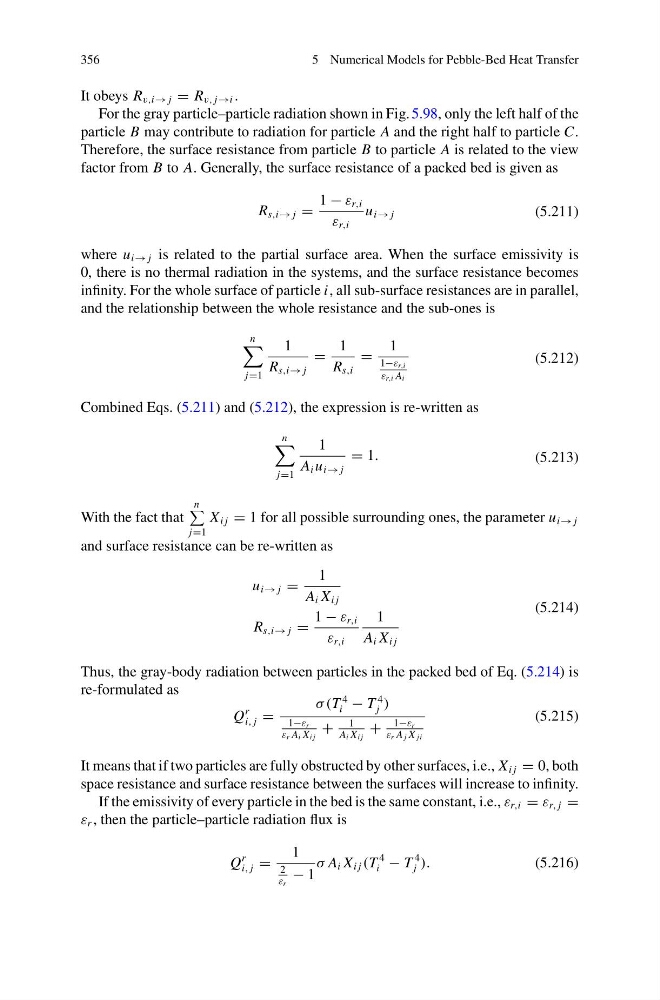
Combined Eqs. (5.211) and (5.212), the expression is re-written as
n
j=1
1
A i u i→ j
= 1.
(5.213)
With the fact that
n
j=1
X i j = 1 for all possible surrounding ones, the parameter u i→ j
and surface resistance can be re-written as
u i→ j =
1
A i X i j
R s,i→ j =
1 − ε r,i
ε r,i
1
A i X i j
(5.214)
Thus, the gray-body radiation between particles in the packed bed of Eq. (5.214) is
re-formulated as
Q
r
i, j =
σ (T
4
i − T
4
j )
1−ε r
ε r A i X i j
+
1
A i X i j
+
1−ε r
ε r A j X ji
(5.215)
It means that if two particles are fully obstructed by other surfaces, i.e., X i j = 0, both
space resistance and surface resistance between the surfaces will increase to infinity.
If the emissivity of every particle in the bed is the same constant, i.e., ε r,i = ε r, j =
ε r , then the particle–particle radiation flux is
Q
r
i, j =
1
2
ε r
− 1
σ A i X i j (T
4
i − T
4
j ).
(5.216)
5 Numerical Models for Pebble-Bed Heat Transfer
It obeys R v,i→ j = R v, j→i .
For the gray particle–particle radiation shown in Fig. 5.98, only the left half of the
particle B may contribute to radiation for particle A and the right half to particle C.
Therefore, the surface resistance from particle B to particle A is related to the view
factor from B to A. Generally, the surface resistance of a packed bed is given as
R s,i→ j =
1 − ε r,i
ε r,i
u i→ j
(5.211)
where u i→ j is related to the partial surface area. When the surface emissivity is
0, there is no thermal radiation in the systems, and the surface resistance becomes
infinity. For the whole surface of particle i, all sub-surface resistances are in parallel,
and the relationship between the whole resistance and the sub-ones is
n
j=1
1
R s,i→ j
=
1
R s,i
=
1
1−ε r,i
ε r,i A i
(5.212)
Combined Eqs. (5.211) and (5.212), the expression is re-written as
n
j=1
1
A i u i→ j
= 1.
(5.213)
With the fact that
n
j=1
X i j = 1 for all possible surrounding ones, the parameter u i→ j
and surface resistance can be re-written as
u i→ j =
1
A i X i j
R s,i→ j =
1 − ε r,i
ε r,i
1
A i X i j
(5.214)
Thus, the gray-body radiation between particles in the packed bed of Eq. (5.214) is
re-formulated as
Q
r
i, j =
σ (T
4
i − T
4
j )
1−ε r
ε r A i X i j
+
1
A i X i j
+
1−ε r
ε r A j X ji
(5.215)
It means that if two particles are fully obstructed by other surfaces, i.e., X i j = 0, both
space resistance and surface resistance between the surfaces will increase to infinity.
If the emissivity of every particle in the bed is the same constant, i.e., ε r,i = ε r, j =
ε r , then the particle–particle radiation flux is
Q
r
i, j =
1
2
ε r
− 1
σ A i X i j (T
4
i − T
4
j ).
(5.216)