

5.5 Further Issues
355
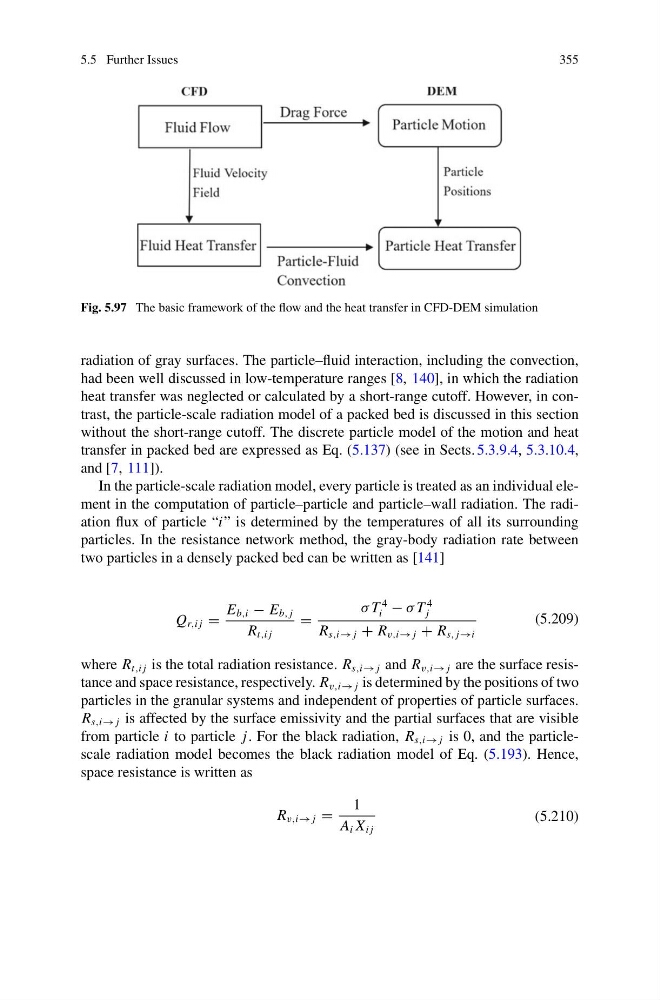
Fig. 5.97 The basic framework of the flow and the heat transfer in CFD-DEM simulation
radiation of gray surfaces. The particle–fluid interaction, including the convection,
had been well discussed in low-temperature ranges [8, 140], in which the radiation
heat transfer was neglected or calculated by a short-range cutoff. However, in contrast, the particle-scale radiation model of a packed bed is discussed in this section
without the short-range cutoff. The discrete particle model of the motion and heat
transfer in packed bed are expressed as Eq. (5.137) (see in Sects. 5.3.9.4, 5.3.10.4,
and [7, 111]).
In the particle-scale radiation model, every particle is treated as an individual element in the computation of particle–particle and particle–wall radiation. The radiation flux of particle “i” is determined by the temperatures of all its surrounding
particles. In the resistance network method, the gray-body radiation rate between
two particles in a densely packed bed can be written as [141]
Q r,i j =
E b,i − E b, j
R t,i j
=
σ T
4
i − σ T
4
j
R s,i→ j + R v,i→ j + R s, j→i
(5.209)
where R t,i j is the total radiation resistance. R s,i→ j and R v,i→ j are the surface resistance and space resistance, respectively. R v,i→ j is determined by the positions of two
particles in the granular systems and independent of properties of particle surfaces.
R s,i→ j is affected by the surface emissivity and the partial surfaces that are visible
from particle i to particle j. For the black radiation, R s,i→ j is 0, and the particlescale radiation model becomes the black radiation model of Eq. (5.193). Hence,
space resistance is written as
R v,i→ j =
1
A i X i j
(5.210)
355
Fig. 5.97 The basic framework of the flow and the heat transfer in CFD-DEM simulation
radiation of gray surfaces. The particle–fluid interaction, including the convection,
had been well discussed in low-temperature ranges [8, 140], in which the radiation
heat transfer was neglected or calculated by a short-range cutoff. However, in contrast, the particle-scale radiation model of a packed bed is discussed in this section
without the short-range cutoff. The discrete particle model of the motion and heat
transfer in packed bed are expressed as Eq. (5.137) (see in Sects. 5.3.9.4, 5.3.10.4,
and [7, 111]).
In the particle-scale radiation model, every particle is treated as an individual element in the computation of particle–particle and particle–wall radiation. The radiation flux of particle “i” is determined by the temperatures of all its surrounding
particles. In the resistance network method, the gray-body radiation rate between
two particles in a densely packed bed can be written as [141]
Q r,i j =
E b,i − E b, j
R t,i j
=
σ T
4
i − σ T
4
j
R s,i→ j + R v,i→ j + R s, j→i
(5.209)
where R t,i j is the total radiation resistance. R s,i→ j and R v,i→ j are the surface resistance and space resistance, respectively. R v,i→ j is determined by the positions of two
particles in the granular systems and independent of properties of particle surfaces.
R s,i→ j is affected by the surface emissivity and the partial surfaces that are visible
from particle i to particle j. For the black radiation, R s,i→ j is 0, and the particlescale radiation model becomes the black radiation model of Eq. (5.193). Hence,
space resistance is written as
R v,i→ j =
1
A i X i j
(5.210)