

354
5 Numerical Models for Pebble-Bed Heat Transfer
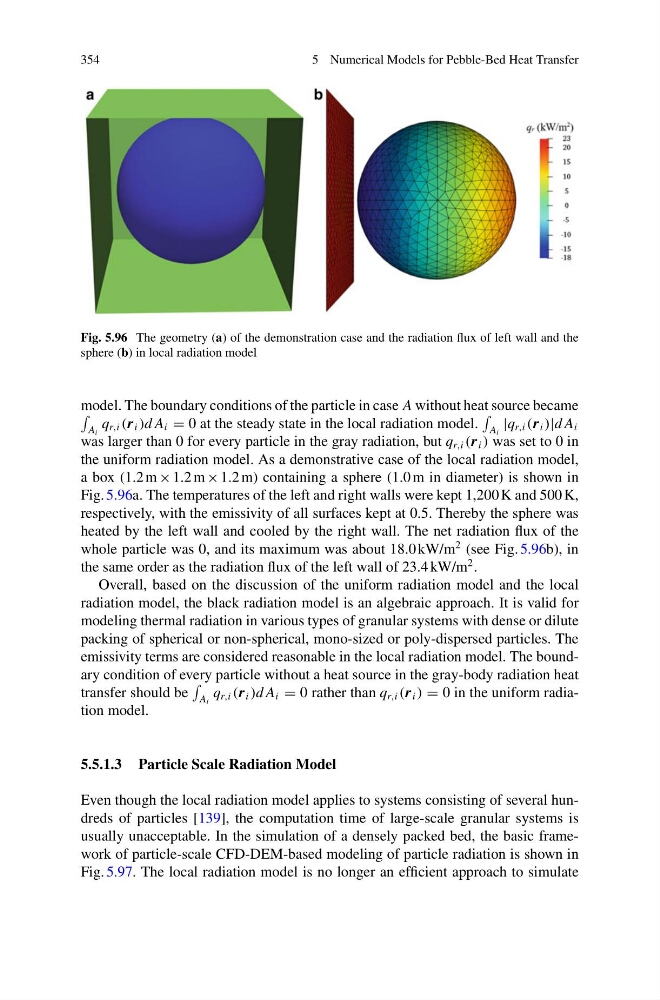
Fig. 5.96 The geometry (a) of the demonstration case and the radiation flux of left wall and the
sphere (b) in local radiation model
model. The boundary conditions of the particle in case A without heat source became
A i
q r,i (r i )d A i = 0 at the steady state in the local radiation model.
A i
|q r,i (r i )|d A i
was larger than 0 for every particle in the gray radiation, but q r,i (r i ) was set to 0 in
the uniform radiation model. As a demonstrative case of the local radiation model,
a box (1.2 m × 1.2 m × 1.2 m) containing a sphere (1.0 m in diameter) is shown in
Fig. 5.96a. The temperatures of the left and right walls were kept 1,200 K and 500 K,
respectively, with the emissivity of all surfaces kept at 0.5. Thereby the sphere was
heated by the left wall and cooled by the right wall. The net radiation flux of the
whole particle was 0, and its maximum was about 18.0 kW/m
2 (see Fig. 5.96b), in
the same order as the radiation flux of the left wall of 23.4 kW/m
2 .
Overall, based on the discussion of the uniform radiation model and the local
radiation model, the black radiation model is an algebraic approach. It is valid for
modeling thermal radiation in various types of granular systems with dense or dilute
packing of spherical or non-spherical, mono-sized or poly-dispersed particles. The
emissivity terms are considered reasonable in the local radiation model. The boundary condition of every particle without a heat source in the gray-body radiation heat
transfer should be
A i
q r,i (r i )d A i = 0 rather than q r,i (r i ) = 0 in the uniform radiation model.
5.5.1.3 Particle Scale Radiation Model
Even though the local radiation model applies to systems consisting of several hundreds of particles [139], the computation time of large-scale granular systems is
usually unacceptable. In the simulation of a densely packed bed, the basic framework of particle-scale CFD-DEM-based modeling of particle radiation is shown in
Fig. 5.97. The local radiation model is no longer an efficient approach to simulate
5 Numerical Models for Pebble-Bed Heat Transfer
Fig. 5.96 The geometry (a) of the demonstration case and the radiation flux of left wall and the
sphere (b) in local radiation model
model. The boundary conditions of the particle in case A without heat source became
A i
q r,i (r i )d A i = 0 at the steady state in the local radiation model.
A i
|q r,i (r i )|d A i
was larger than 0 for every particle in the gray radiation, but q r,i (r i ) was set to 0 in
the uniform radiation model. As a demonstrative case of the local radiation model,
a box (1.2 m × 1.2 m × 1.2 m) containing a sphere (1.0 m in diameter) is shown in
Fig. 5.96a. The temperatures of the left and right walls were kept 1,200 K and 500 K,
respectively, with the emissivity of all surfaces kept at 0.5. Thereby the sphere was
heated by the left wall and cooled by the right wall. The net radiation flux of the
whole particle was 0, and its maximum was about 18.0 kW/m
2 (see Fig. 5.96b), in
the same order as the radiation flux of the left wall of 23.4 kW/m
2 .
Overall, based on the discussion of the uniform radiation model and the local
radiation model, the black radiation model is an algebraic approach. It is valid for
modeling thermal radiation in various types of granular systems with dense or dilute
packing of spherical or non-spherical, mono-sized or poly-dispersed particles. The
emissivity terms are considered reasonable in the local radiation model. The boundary condition of every particle without a heat source in the gray-body radiation heat
transfer should be
A i
q r,i (r i )d A i = 0 rather than q r,i (r i ) = 0 in the uniform radiation model.
5.5.1.3 Particle Scale Radiation Model
Even though the local radiation model applies to systems consisting of several hundreds of particles [139], the computation time of large-scale granular systems is
usually unacceptable. In the simulation of a densely packed bed, the basic framework of particle-scale CFD-DEM-based modeling of particle radiation is shown in
Fig. 5.97. The local radiation model is no longer an efficient approach to simulate