

5.5 Further Issues
353
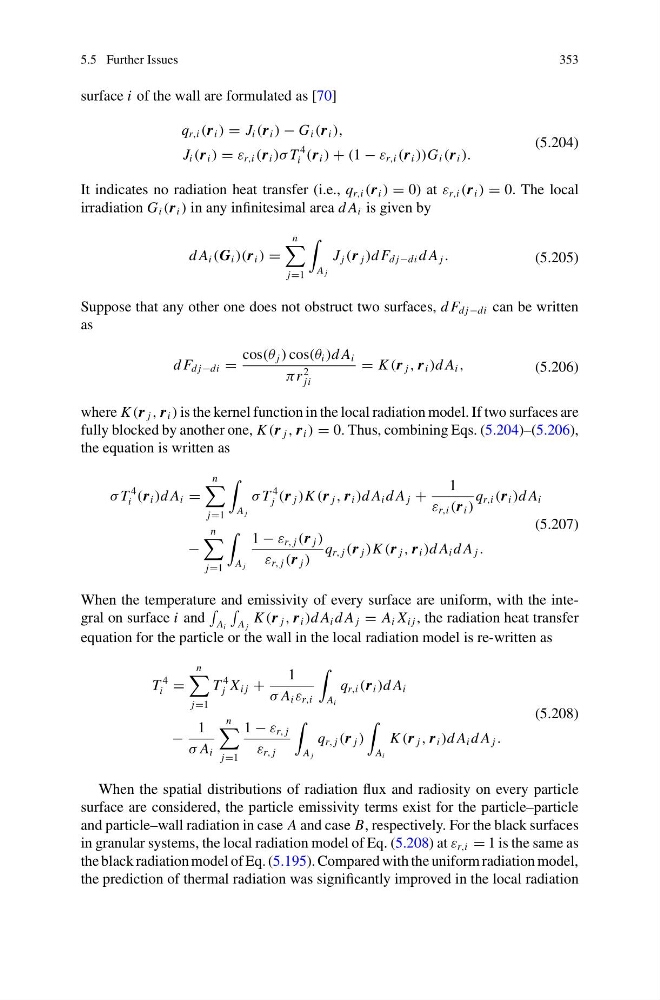
surface i of the wall are formulated as [70]
q r,i (r i ) = J i (r i ) − G i (r i ),
J i (r i ) = ε r,i (r i )σ T
4
i (r i ) + (1 − ε r,i (r i ))G i (r i ).
(5.204)
It indicates no radiation heat transfer (i.e., q r,i (r i ) = 0) at ε r,i (r i ) = 0. The local
irradiation G i (r i ) in any infinitesimal area d A i is given by
d A i (G i )(r i ) =
n
j=1
A j
J j (r j )d F d j−di d A j .
(5.205)
Suppose that any other one does not obstruct two surfaces, d F d j−di can be written
as
d F d j−di =
cos(θ j ) cos(θ i )d A i
πr
2
ji
= K (r j , r i )d A i ,
(5.206)
where K (r j , r i ) is the kernel function in the local radiation model. If two surfaces are
fully blocked by another one, K (r j , r i ) = 0. Thus, combining Eqs. (5.204)–(5.206),
the equation is written as
σ T
4
i (r i )d A i =
n
j=1
A j
σ T
4
j (r j )K (r j , r i )d A i d A j +
1
ε r,i (r i )
q r,i (r i )d A i
−
n
j=1
A j
1 − ε r, j (r j )
ε r, j (r j )
q r, j (r j )K (r j , r i )d A i d A j .
(5.207)
When the temperature and emissivity of every surface are uniform, with the integral on surface i and
A i
A j
K (r j , r i )d A i d A j = A i X i j , the radiation heat transfer
equation for the particle or the wall in the local radiation model is re-written as
T
4
i =
n
j=1
T
4
j X i j +
1
σ A i ε r,i
A i
q r,i (r i )d A i
−
1
σ A i
n
j=1
1 − ε r, j
ε r, j
A j
q r, j (r j )
A i
K (r j , r i )d A i d A j .
(5.208)
When the spatial distributions of radiation flux and radiosity on every particle
surface are considered, the particle emissivity terms exist for the particle–particle
and particle–wall radiation in case A and case B, respectively. For the black surfaces
in granular systems, the local radiation model of Eq. (5.208) at ε r,i = 1 is the same as
the black radiation model of Eq. (5.195). Compared with the uniform radiation model,
the prediction of thermal radiation was significantly improved in the local radiation
353
surface i of the wall are formulated as [70]
q r,i (r i ) = J i (r i ) − G i (r i ),
J i (r i ) = ε r,i (r i )σ T
4
i (r i ) + (1 − ε r,i (r i ))G i (r i ).
(5.204)
It indicates no radiation heat transfer (i.e., q r,i (r i ) = 0) at ε r,i (r i ) = 0. The local
irradiation G i (r i ) in any infinitesimal area d A i is given by
d A i (G i )(r i ) =
n
j=1
A j
J j (r j )d F d j−di d A j .
(5.205)
Suppose that any other one does not obstruct two surfaces, d F d j−di can be written
as
d F d j−di =
cos(θ j ) cos(θ i )d A i
πr
2
ji
= K (r j , r i )d A i ,
(5.206)
where K (r j , r i ) is the kernel function in the local radiation model. If two surfaces are
fully blocked by another one, K (r j , r i ) = 0. Thus, combining Eqs. (5.204)–(5.206),
the equation is written as
σ T
4
i (r i )d A i =
n
j=1
A j
σ T
4
j (r j )K (r j , r i )d A i d A j +
1
ε r,i (r i )
q r,i (r i )d A i
−
n
j=1
A j
1 − ε r, j (r j )
ε r, j (r j )
q r, j (r j )K (r j , r i )d A i d A j .
(5.207)
When the temperature and emissivity of every surface are uniform, with the integral on surface i and
A i
A j
K (r j , r i )d A i d A j = A i X i j , the radiation heat transfer
equation for the particle or the wall in the local radiation model is re-written as
T
4
i =
n
j=1
T
4
j X i j +
1
σ A i ε r,i
A i
q r,i (r i )d A i
−
1
σ A i
n
j=1
1 − ε r, j
ε r, j
A j
q r, j (r j )
A i
K (r j , r i )d A i d A j .
(5.208)
When the spatial distributions of radiation flux and radiosity on every particle
surface are considered, the particle emissivity terms exist for the particle–particle
and particle–wall radiation in case A and case B, respectively. For the black surfaces
in granular systems, the local radiation model of Eq. (5.208) at ε r,i = 1 is the same as
the black radiation model of Eq. (5.195). Compared with the uniform radiation model,
the prediction of thermal radiation was significantly improved in the local radiation