

352
5 Numerical Models for Pebble-Bed Heat Transfer
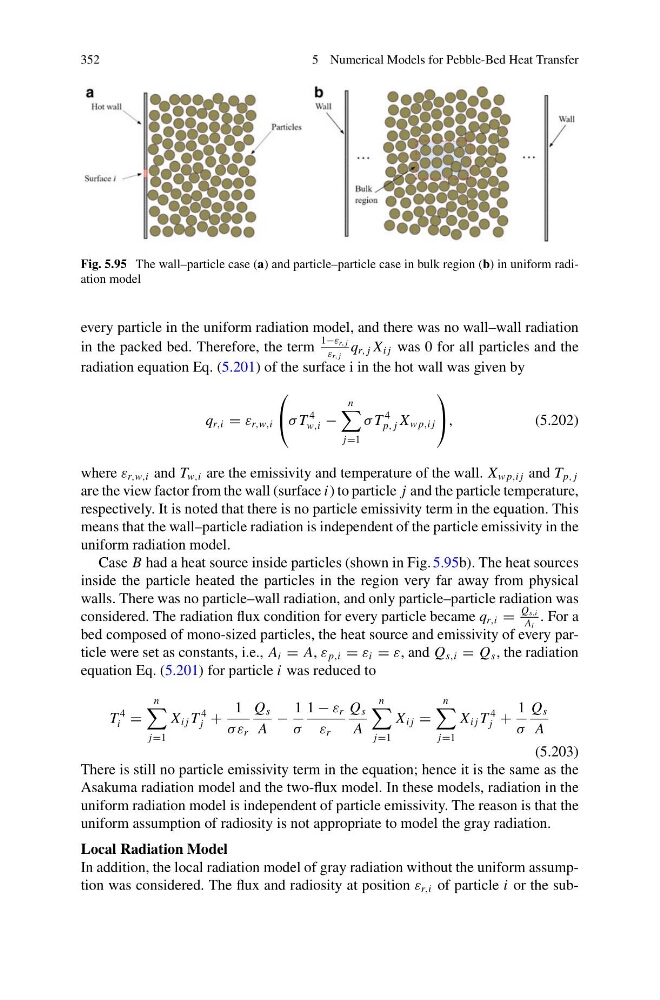
Fig. 5.95 The wall–particle case (a) and particle–particle case in bulk region (b) in uniform radiation model
every particle in the uniform radiation model, and there was no wall–wall radiation
in the packed bed. Therefore, the term
1−ε r, j
ε r, j
q r, j X i j was 0 for all particles and the
radiation equation Eq. (5.201) of the surface i in the hot wall was given by
q r,i = ε r,w,i
⎛
⎝ σ T
4
w,i −
n
j=1
σ T
4
p, j X w p,i j
⎞
⎠ ,
(5.202)
where ε r,w,i and T w,i are the emissivity and temperature of the wall. X w p,i j and T p, j
are the view factor from the wall (surface i) to particle j and the particle temperature,
respectively. It is noted that there is no particle emissivity term in the equation. This
means that the wall–particle radiation is independent of the particle emissivity in the
uniform radiation model.
Case B had a heat source inside particles (shown in Fig. 5.95b). The heat sources
inside the particle heated the particles in the region very far away from physical
walls. There was no particle–wall radiation, and only particle–particle radiation was
considered. The radiation flux condition for every particle became q r,i =
Q s,i
A i
. For a
bed composed of mono-sized particles, the heat source and emissivity of every particle were set as constants, i.e., A i = A, ε p,i = ε i = ε, and Q s,i = Q s , the radiation
equation Eq. (5.201) for particle i was reduced to
T
4
i =
n
j=1
X i j T
4
j +
1
σ ε r
Q s
A
−
1
σ
1 − ε r
ε r
Q s
A
n
j=1
X i j =
n
j=1
X i j T
4
j +
1
σ
Q s
A
(5.203)
There is still no particle emissivity term in the equation; hence it is the same as the
Asakuma radiation model and the two-flux model. In these models, radiation in the
uniform radiation model is independent of particle emissivity. The reason is that the
uniform assumption of radiosity is not appropriate to model the gray radiation.
Local Radiation Model
In addition, the local radiation model of gray radiation without the uniform assumption was considered. The flux and radiosity at position ε r,i of particle i or the sub-
5 Numerical Models for Pebble-Bed Heat Transfer
Fig. 5.95 The wall–particle case (a) and particle–particle case in bulk region (b) in uniform radiation model
every particle in the uniform radiation model, and there was no wall–wall radiation
in the packed bed. Therefore, the term
1−ε r, j
ε r, j
q r, j X i j was 0 for all particles and the
radiation equation Eq. (5.201) of the surface i in the hot wall was given by
q r,i = ε r,w,i
⎛
⎝ σ T
4
w,i −
n
j=1
σ T
4
p, j X w p,i j
⎞
⎠ ,
(5.202)
where ε r,w,i and T w,i are the emissivity and temperature of the wall. X w p,i j and T p, j
are the view factor from the wall (surface i) to particle j and the particle temperature,
respectively. It is noted that there is no particle emissivity term in the equation. This
means that the wall–particle radiation is independent of the particle emissivity in the
uniform radiation model.
Case B had a heat source inside particles (shown in Fig. 5.95b). The heat sources
inside the particle heated the particles in the region very far away from physical
walls. There was no particle–wall radiation, and only particle–particle radiation was
considered. The radiation flux condition for every particle became q r,i =
Q s,i
A i
. For a
bed composed of mono-sized particles, the heat source and emissivity of every particle were set as constants, i.e., A i = A, ε p,i = ε i = ε, and Q s,i = Q s , the radiation
equation Eq. (5.201) for particle i was reduced to
T
4
i =
n
j=1
X i j T
4
j +
1
σ ε r
Q s
A
−
1
σ
1 − ε r
ε r
Q s
A
n
j=1
X i j =
n
j=1
X i j T
4
j +
1
σ
Q s
A
(5.203)
There is still no particle emissivity term in the equation; hence it is the same as the
Asakuma radiation model and the two-flux model. In these models, radiation in the
uniform radiation model is independent of particle emissivity. The reason is that the
uniform assumption of radiosity is not appropriate to model the gray radiation.
Local Radiation Model
In addition, the local radiation model of gray radiation without the uniform assumption was considered. The flux and radiosity at position ε r,i of particle i or the sub-