

5.5 Further Issues
351
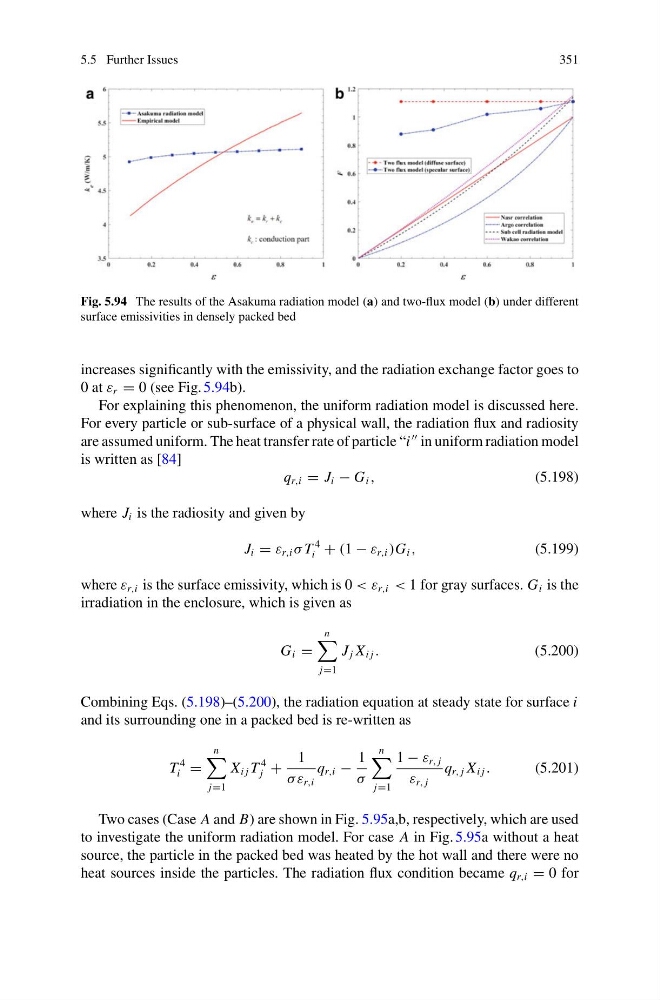
Fig. 5.94 The results of the Asakuma radiation model (a) and two-flux model (b) under different
surface emissivities in densely packed bed
increases significantly with the emissivity, and the radiation exchange factor goes to
0 at ε r = 0 (see Fig. 5.94b).
For explaining this phenomenon, the uniform radiation model is discussed here.
For every particle or sub-surface of a physical wall, the radiation flux and radiosity
are assumed uniform. The heat transfer rate of particle “i
in uniform radiation model
is written as [84]
q r,i = J i − G i ,
(5.198)
where J i is the radiosity and given by
J i = ε r,i σ T
4
i + (1 − ε r,i )G i ,
(5.199)
where ε r,i is the surface emissivity, which is 0 < ε r,i < 1 for gray surfaces. G i is the
irradiation in the enclosure, which is given as
G i =
n
j=1
J j X i j .
(5.200)
Combining Eqs. (5.198)–(5.200), the radiation equation at steady state for surface i
and its surrounding one in a packed bed is re-written as
T
4
i =
n
j=1
X i j T
4
j +
1
σ ε r,i
q r,i −
1
σ
n
j=1
1 − ε r, j
ε r, j
q r, j X i j .
(5.201)
Two cases (Case A and B) are shown in Fig. 5.95a,b, respectively, which are used
to investigate the uniform radiation model. For case A in Fig. 5.95a without a heat
source, the particle in the packed bed was heated by the hot wall and there were no
heat sources inside the particles. The radiation flux condition became q r,i = 0 for
351
Fig. 5.94 The results of the Asakuma radiation model (a) and two-flux model (b) under different
surface emissivities in densely packed bed
increases significantly with the emissivity, and the radiation exchange factor goes to
0 at ε r = 0 (see Fig. 5.94b).
For explaining this phenomenon, the uniform radiation model is discussed here.
For every particle or sub-surface of a physical wall, the radiation flux and radiosity
are assumed uniform. The heat transfer rate of particle “i
in uniform radiation model
is written as [84]
q r,i = J i − G i ,
(5.198)
where J i is the radiosity and given by
J i = ε r,i σ T
4
i + (1 − ε r,i )G i ,
(5.199)
where ε r,i is the surface emissivity, which is 0 < ε r,i < 1 for gray surfaces. G i is the
irradiation in the enclosure, which is given as
G i =
n
j=1
J j X i j .
(5.200)
Combining Eqs. (5.198)–(5.200), the radiation equation at steady state for surface i
and its surrounding one in a packed bed is re-written as
T
4
i =
n
j=1
X i j T
4
j +
1
σ ε r,i
q r,i −
1
σ
n
j=1
1 − ε r, j
ε r, j
q r, j X i j .
(5.201)
Two cases (Case A and B) are shown in Fig. 5.95a,b, respectively, which are used
to investigate the uniform radiation model. For case A in Fig. 5.95a without a heat
source, the particle in the packed bed was heated by the hot wall and there were no
heat sources inside the particles. The radiation flux condition became q r,i = 0 for