

350
5 Numerical Models for Pebble-Bed Heat Transfer
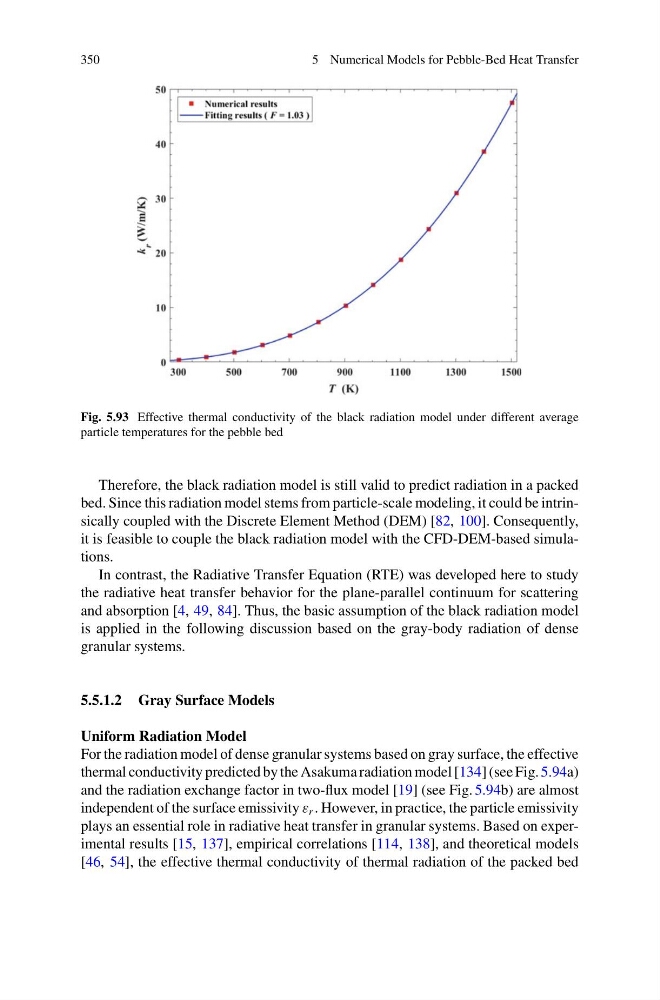
Fig. 5.93 Effective thermal conductivity of the black radiation model under different average
particle temperatures for the pebble bed
Therefore, the black radiation model is still valid to predict radiation in a packed
bed. Since this radiation model stems from particle-scale modeling, it could be intrinsically coupled with the Discrete Element Method (DEM) [82, 100]. Consequently,
it is feasible to couple the black radiation model with the CFD-DEM-based simulations.
In contrast, the Radiative Transfer Equation (RTE) was developed here to study
the radiative heat transfer behavior for the plane-parallel continuum for scattering
and absorption [4, 49, 84]. Thus, the basic assumption of the black radiation model
is applied in the following discussion based on the gray-body radiation of dense
granular systems.
5.5.1.2 Gray Surface Models
Uniform Radiation Model
For the radiation model of dense granular systems based on gray surface, the effective
thermal conductivity predicted by the Asakuma radiation model [134] (see Fig. 5.94a)
and the radiation exchange factor in two-flux model [19] (see Fig. 5.94b) are almost
independent of the surface emissivity ε r . However, in practice, the particle emissivity
plays an essential role in radiative heat transfer in granular systems. Based on experimental results [15, 137], empirical correlations [114, 138], and theoretical models
[46, 54], the effective thermal conductivity of thermal radiation of the packed bed
5 Numerical Models for Pebble-Bed Heat Transfer
Fig. 5.93 Effective thermal conductivity of the black radiation model under different average
particle temperatures for the pebble bed
Therefore, the black radiation model is still valid to predict radiation in a packed
bed. Since this radiation model stems from particle-scale modeling, it could be intrinsically coupled with the Discrete Element Method (DEM) [82, 100]. Consequently,
it is feasible to couple the black radiation model with the CFD-DEM-based simulations.
In contrast, the Radiative Transfer Equation (RTE) was developed here to study
the radiative heat transfer behavior for the plane-parallel continuum for scattering
and absorption [4, 49, 84]. Thus, the basic assumption of the black radiation model
is applied in the following discussion based on the gray-body radiation of dense
granular systems.
5.5.1.2 Gray Surface Models
Uniform Radiation Model
For the radiation model of dense granular systems based on gray surface, the effective
thermal conductivity predicted by the Asakuma radiation model [134] (see Fig. 5.94a)
and the radiation exchange factor in two-flux model [19] (see Fig. 5.94b) are almost
independent of the surface emissivity ε r . However, in practice, the particle emissivity
plays an essential role in radiative heat transfer in granular systems. Based on experimental results [15, 137], empirical correlations [114, 138], and theoretical models
[46, 54], the effective thermal conductivity of thermal radiation of the packed bed