

342
5 Numerical Models for Pebble-Bed Heat Transfer
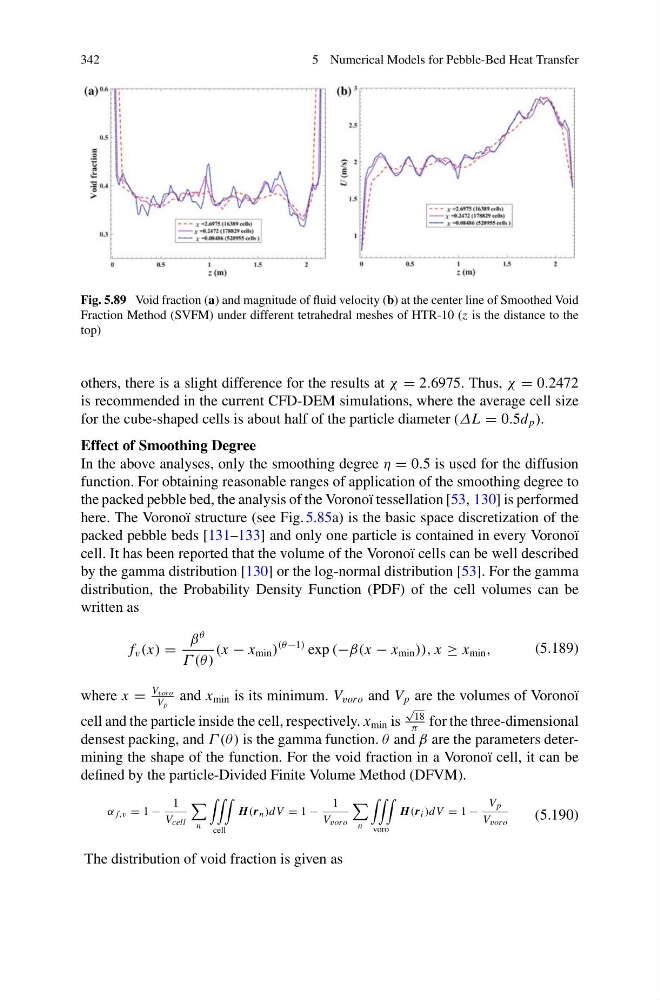
Fig. 5.89 Void fraction (a) and magnitude of fluid velocity (b) at the center line of Smoothed Void
Fraction Method (SVFM) under different tetrahedral meshes of HTR-10 (z is the distance to the
top)
others, there is a slight difference for the results at χ = 2.6975. Thus, χ = 0.2472
is recommended in the current CFD-DEM simulations, where the average cell size
for the cube-shaped cells is about half of the particle diameter (ΔL = 0.5d p ).
Effect of Smoothing Degree
In the above analyses, only the smoothing degree η = 0.5 is used for the diffusion
function. For obtaining reasonable ranges of application of the smoothing degree to
the packed pebble bed, the analysis of the Voronoï tessellation [53, 130] is performed
here. The Voronoï structure (see Fig. 5.85a) is the basic space discretization of the
packed pebble beds [131–133] and only one particle is contained in every Voronoï
cell. It has been reported that the volume of the Voronoï cells can be well described
by the gamma distribution [130] or the log-normal distribution [53]. For the gamma
distribution, the Probability Density Function (PDF) of the cell volumes can be
written as
f v (x) =
β
θ
Γ (θ)
(x − x min )
(θ−1) exp (−β(x − x min )), x ≥ x min ,
(5.189)
where x =
V vor o
V p
and x min is its minimum. V vor o and V p are the volumes of Voronoï
cell and the particle inside the cell, respectively. x min is
√
18
π
for the three-dimensional
densest packing, and Γ (θ) is the gamma function. θ and β are the parameters determining the shape of the function. For the void fraction in a Voronoï cell, it can be
defined by the particle-Divided Finite Volume Method (DFVM).
α f,v = 1 −
1
V cell
n
cell
H(r n )dV = 1 −
1
V vor o
n
voro
H(r i )dV = 1 −
V p
V vor o
(5.190)
The distribution of void fraction is given as
5 Numerical Models for Pebble-Bed Heat Transfer
Fig. 5.89 Void fraction (a) and magnitude of fluid velocity (b) at the center line of Smoothed Void
Fraction Method (SVFM) under different tetrahedral meshes of HTR-10 (z is the distance to the
top)
others, there is a slight difference for the results at χ = 2.6975. Thus, χ = 0.2472
is recommended in the current CFD-DEM simulations, where the average cell size
for the cube-shaped cells is about half of the particle diameter (ΔL = 0.5d p ).
Effect of Smoothing Degree
In the above analyses, only the smoothing degree η = 0.5 is used for the diffusion
function. For obtaining reasonable ranges of application of the smoothing degree to
the packed pebble bed, the analysis of the Voronoï tessellation [53, 130] is performed
here. The Voronoï structure (see Fig. 5.85a) is the basic space discretization of the
packed pebble beds [131–133] and only one particle is contained in every Voronoï
cell. It has been reported that the volume of the Voronoï cells can be well described
by the gamma distribution [130] or the log-normal distribution [53]. For the gamma
distribution, the Probability Density Function (PDF) of the cell volumes can be
written as
f v (x) =
β
θ
Γ (θ)
(x − x min )
(θ−1) exp (−β(x − x min )), x ≥ x min ,
(5.189)
where x =
V vor o
V p
and x min is its minimum. V vor o and V p are the volumes of Voronoï
cell and the particle inside the cell, respectively. x min is
√
18
π
for the three-dimensional
densest packing, and Γ (θ) is the gamma function. θ and β are the parameters determining the shape of the function. For the void fraction in a Voronoï cell, it can be
defined by the particle-Divided Finite Volume Method (DFVM).
α f,v = 1 −
1
V cell
n
cell
H(r n )dV = 1 −
1
V vor o
n
voro
H(r i )dV = 1 −
V p
V vor o
(5.190)
The distribution of void fraction is given as