

5.4 CFD-DEM Coupled Simulation and Development
341
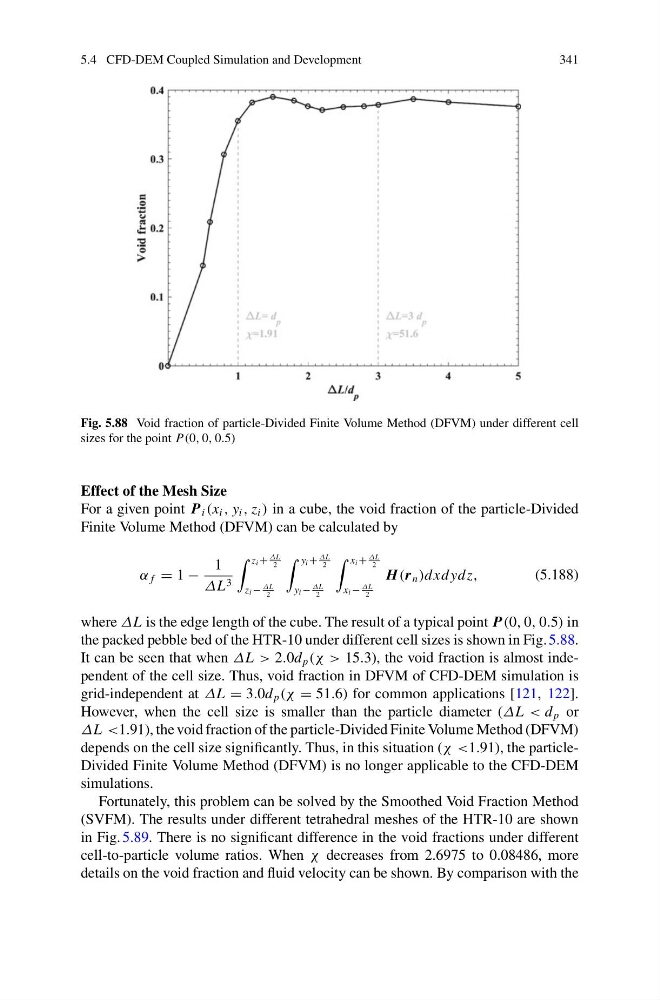
Fig. 5.88 Void fraction of particle-Divided Finite Volume Method (DFVM) under different cell
sizes for the point P(0, 0, 0.5)
Effect of the Mesh Size
For a given point P i (x i , y i , z i ) in a cube, the void fraction of the particle-Divided
Finite Volume Method (DFVM) can be calculated by
α f = 1 −
1
ΔL 3
z i +
ΔL
2
z i −
ΔL
2
y i +
ΔL
2
y i −
ΔL
2
x i +
ΔL
2
x i −
ΔL
2
H(r n )dxdydz,
(5.188)
where ΔL is the edge length of the cube. The result of a typical point P(0, 0, 0.5) in
the packed pebble bed of the HTR-10 under different cell sizes is shown in Fig. 5.88.
It can be seen that when ΔL > 2.0d p (χ > 15.3), the void fraction is almost independent of the cell size. Thus, void fraction in DFVM of CFD-DEM simulation is
grid-independent at ΔL = 3.0d p (χ = 51.6) for common applications [121, 122].
However, when the cell size is smaller than the particle diameter (ΔL < d p or
ΔL <1.91), the void fraction of the particle-Divided Finite Volume Method (DFVM)
depends on the cell size significantly. Thus, in this situation (χ <1.91), the particleDivided Finite Volume Method (DFVM) is no longer applicable to the CFD-DEM
simulations.
Fortunately, this problem can be solved by the Smoothed Void Fraction Method
(SVFM). The results under different tetrahedral meshes of the HTR-10 are shown
in Fig. 5.89. There is no significant difference in the void fractions under different
cell-to-particle volume ratios. When χ decreases from 2.6975 to 0.08486, more
details on the void fraction and fluid velocity can be shown. By comparison with the
341
Fig. 5.88 Void fraction of particle-Divided Finite Volume Method (DFVM) under different cell
sizes for the point P(0, 0, 0.5)
Effect of the Mesh Size
For a given point P i (x i , y i , z i ) in a cube, the void fraction of the particle-Divided
Finite Volume Method (DFVM) can be calculated by
α f = 1 −
1
ΔL 3
z i +
ΔL
2
z i −
ΔL
2
y i +
ΔL
2
y i −
ΔL
2
x i +
ΔL
2
x i −
ΔL
2
H(r n )dxdydz,
(5.188)
where ΔL is the edge length of the cube. The result of a typical point P(0, 0, 0.5) in
the packed pebble bed of the HTR-10 under different cell sizes is shown in Fig. 5.88.
It can be seen that when ΔL > 2.0d p (χ > 15.3), the void fraction is almost independent of the cell size. Thus, void fraction in DFVM of CFD-DEM simulation is
grid-independent at ΔL = 3.0d p (χ = 51.6) for common applications [121, 122].
However, when the cell size is smaller than the particle diameter (ΔL < d p or
ΔL <1.91), the void fraction of the particle-Divided Finite Volume Method (DFVM)
depends on the cell size significantly. Thus, in this situation (χ <1.91), the particleDivided Finite Volume Method (DFVM) is no longer applicable to the CFD-DEM
simulations.
Fortunately, this problem can be solved by the Smoothed Void Fraction Method
(SVFM). The results under different tetrahedral meshes of the HTR-10 are shown
in Fig. 5.89. There is no significant difference in the void fractions under different
cell-to-particle volume ratios. When χ decreases from 2.6975 to 0.08486, more
details on the void fraction and fluid velocity can be shown. By comparison with the