

334
5 Numerical Models for Pebble-Bed Heat Transfer
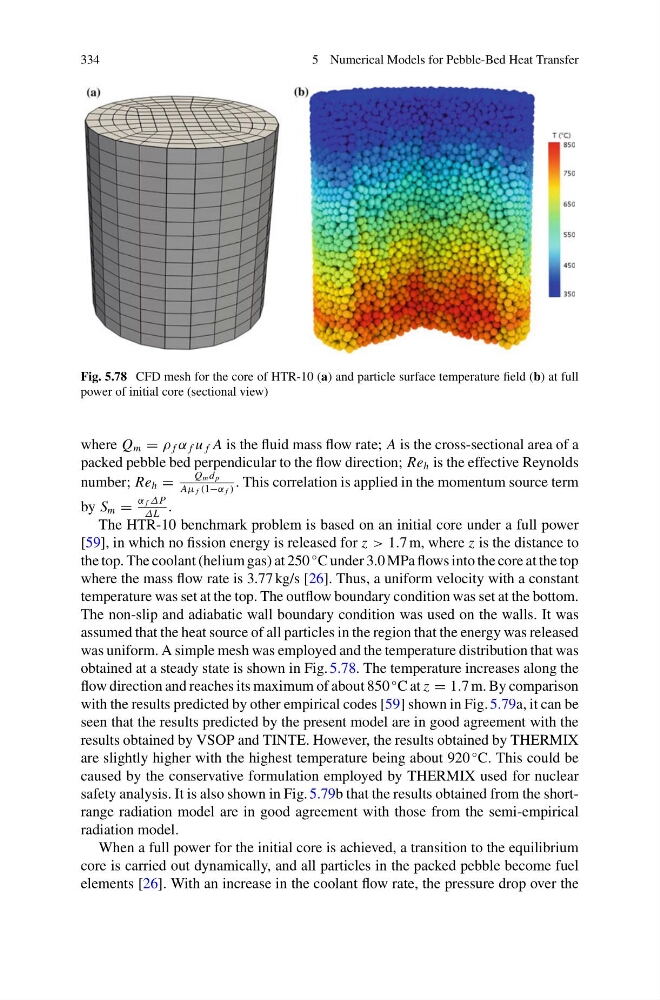
Fig. 5.78 CFD mesh for the core of HTR-10 (a) and particle surface temperature field (b) at full
power of initial core (sectional view)
where Q m = ρ f α f u f A is the fluid mass flow rate; A is the cross-sectional area of a
packed pebble bed perpendicular to the flow direction; Re h is the effective Reynolds
number; Re h =
Q m d p
Aμ f (1−α f )
. This correlation is applied in the momentum source term
by S m =
α f ΔP
ΔL
.
The HTR-10 benchmark problem is based on an initial core under a full power
[59], in which no fission energy is released for z > 1.7 m, where z is the distance to
the top. The coolant (helium gas) at 250
◦ C under 3.0 MPa flows into the core at the top
where the mass flow rate is 3.77 kg/s [26]. Thus, a uniform velocity with a constant
temperature was set at the top. The outflow boundary condition was set at the bottom.
The non-slip and adiabatic wall boundary condition was used on the walls. It was
assumed that the heat source of all particles in the region that the energy was released
was uniform. A simple mesh was employed and the temperature distribution that was
obtained at a steady state is shown in Fig. 5.78. The temperature increases along the
flow direction and reaches its maximum of about 850
◦ C at z = 1.7 m. By comparison
with the results predicted by other empirical codes [59] shown in Fig. 5.79a, it can be
seen that the results predicted by the present model are in good agreement with the
results obtained by VSOP and TINTE. However, the results obtained by THERMIX
are slightly higher with the highest temperature being about 920
◦ C. This could be
caused by the conservative formulation employed by THERMIX used for nuclear
safety analysis. It is also shown in Fig. 5.79b that the results obtained from the shortrange radiation model are in good agreement with those from the semi-empirical
radiation model.
When a full power for the initial core is achieved, a transition to the equilibrium
core is carried out dynamically, and all particles in the packed pebble become fuel
elements [26]. With an increase in the coolant flow rate, the pressure drop over the
5 Numerical Models for Pebble-Bed Heat Transfer
Fig. 5.78 CFD mesh for the core of HTR-10 (a) and particle surface temperature field (b) at full
power of initial core (sectional view)
where Q m = ρ f α f u f A is the fluid mass flow rate; A is the cross-sectional area of a
packed pebble bed perpendicular to the flow direction; Re h is the effective Reynolds
number; Re h =
Q m d p
Aμ f (1−α f )
. This correlation is applied in the momentum source term
by S m =
α f ΔP
ΔL
.
The HTR-10 benchmark problem is based on an initial core under a full power
[59], in which no fission energy is released for z > 1.7 m, where z is the distance to
the top. The coolant (helium gas) at 250
◦ C under 3.0 MPa flows into the core at the top
where the mass flow rate is 3.77 kg/s [26]. Thus, a uniform velocity with a constant
temperature was set at the top. The outflow boundary condition was set at the bottom.
The non-slip and adiabatic wall boundary condition was used on the walls. It was
assumed that the heat source of all particles in the region that the energy was released
was uniform. A simple mesh was employed and the temperature distribution that was
obtained at a steady state is shown in Fig. 5.78. The temperature increases along the
flow direction and reaches its maximum of about 850
◦ C at z = 1.7 m. By comparison
with the results predicted by other empirical codes [59] shown in Fig. 5.79a, it can be
seen that the results predicted by the present model are in good agreement with the
results obtained by VSOP and TINTE. However, the results obtained by THERMIX
are slightly higher with the highest temperature being about 920
◦ C. This could be
caused by the conservative formulation employed by THERMIX used for nuclear
safety analysis. It is also shown in Fig. 5.79b that the results obtained from the shortrange radiation model are in good agreement with those from the semi-empirical
radiation model.
When a full power for the initial core is achieved, a transition to the equilibrium
core is carried out dynamically, and all particles in the packed pebble become fuel
elements [26]. With an increase in the coolant flow rate, the pressure drop over the