

5.4 CFD-DEM Coupled Simulation and Development
333
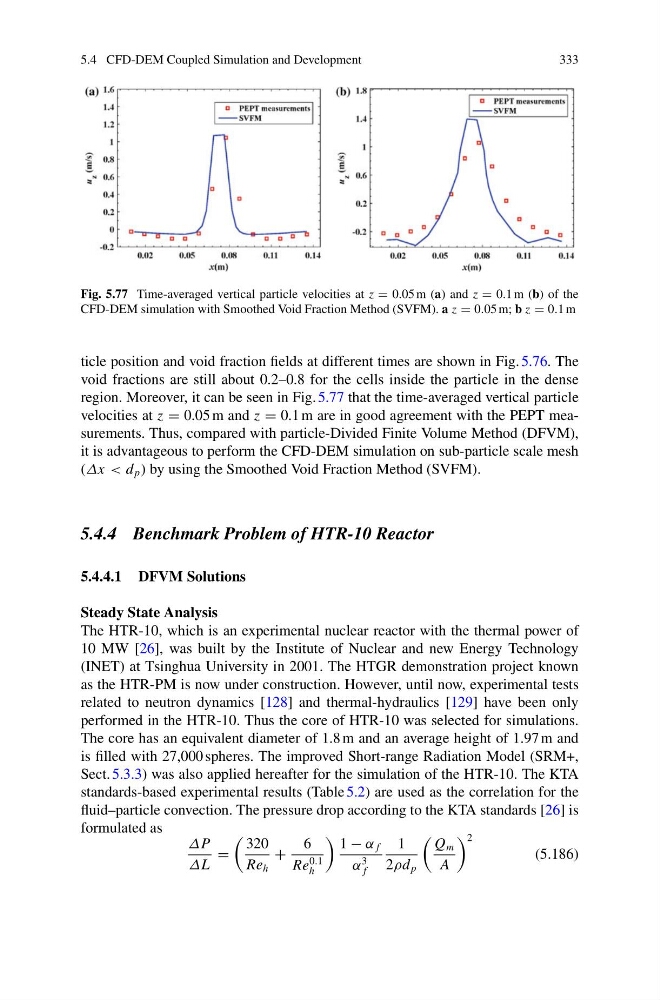
Fig. 5.77 Time-averaged vertical particle velocities at z = 0.05 m (a) and z = 0.1 m (b) of the
CFD-DEM simulation with Smoothed Void Fraction Method (SVFM). a z = 0.05 m; b z = 0.1 m
ticle position and void fraction fields at different times are shown in Fig. 5.76. The
void fractions are still about 0.2–0.8 for the cells inside the particle in the dense
region. Moreover, it can be seen in Fig. 5.77 that the time-averaged vertical particle
velocities at z = 0.05 m and z = 0.1 m are in good agreement with the PEPT measurements. Thus, compared with particle-Divided Finite Volume Method (DFVM),
it is advantageous to perform the CFD-DEM simulation on sub-particle scale mesh
(Δx < d p ) by using the Smoothed Void Fraction Method (SVFM).
5.4.4 Benchmark Problem of HTR-10 Reactor
5.4.4.1 DFVM Solutions
Steady State Analysis
The HTR-10, which is an experimental nuclear reactor with the thermal power of
10 MW [26], was built by the Institute of Nuclear and new Energy Technology
(INET) at Tsinghua University in 2001. The HTGR demonstration project known
as the HTR-PM is now under construction. However, until now, experimental tests
related to neutron dynamics [128] and thermal-hydraulics [129] have been only
performed in the HTR-10. Thus the core of HTR-10 was selected for simulations.
The core has an equivalent diameter of 1.8 m and an average height of 1.97 m and
is filled with 27,000 spheres. The improved Short-range Radiation Model (SRM+,
Sect. 5.3.3) was also applied hereafter for the simulation of the HTR-10. The KTA
standards-based experimental results (Table 5.2) are used as the correlation for the
fluid–particle convection. The pressure drop according to the KTA standards [26] is
formulated as
ΔP
ΔL
=
320
Re h
+
6
Re
0.1
h
1 − α f
α
3
f
1
2ρd p
Q m
A
2
(5.186)
333
Fig. 5.77 Time-averaged vertical particle velocities at z = 0.05 m (a) and z = 0.1 m (b) of the
CFD-DEM simulation with Smoothed Void Fraction Method (SVFM). a z = 0.05 m; b z = 0.1 m
ticle position and void fraction fields at different times are shown in Fig. 5.76. The
void fractions are still about 0.2–0.8 for the cells inside the particle in the dense
region. Moreover, it can be seen in Fig. 5.77 that the time-averaged vertical particle
velocities at z = 0.05 m and z = 0.1 m are in good agreement with the PEPT measurements. Thus, compared with particle-Divided Finite Volume Method (DFVM),
it is advantageous to perform the CFD-DEM simulation on sub-particle scale mesh
(Δx < d p ) by using the Smoothed Void Fraction Method (SVFM).
5.4.4 Benchmark Problem of HTR-10 Reactor
5.4.4.1 DFVM Solutions
Steady State Analysis
The HTR-10, which is an experimental nuclear reactor with the thermal power of
10 MW [26], was built by the Institute of Nuclear and new Energy Technology
(INET) at Tsinghua University in 2001. The HTGR demonstration project known
as the HTR-PM is now under construction. However, until now, experimental tests
related to neutron dynamics [128] and thermal-hydraulics [129] have been only
performed in the HTR-10. Thus the core of HTR-10 was selected for simulations.
The core has an equivalent diameter of 1.8 m and an average height of 1.97 m and
is filled with 27,000 spheres. The improved Short-range Radiation Model (SRM+,
Sect. 5.3.3) was also applied hereafter for the simulation of the HTR-10. The KTA
standards-based experimental results (Table 5.2) are used as the correlation for the
fluid–particle convection. The pressure drop according to the KTA standards [26] is
formulated as
ΔP
ΔL
=
320
Re h
+
6
Re
0.1
h
1 − α f
α
3
f
1
2ρd p
Q m
A
2
(5.186)