

332
5 Numerical Models for Pebble-Bed Heat Transfer
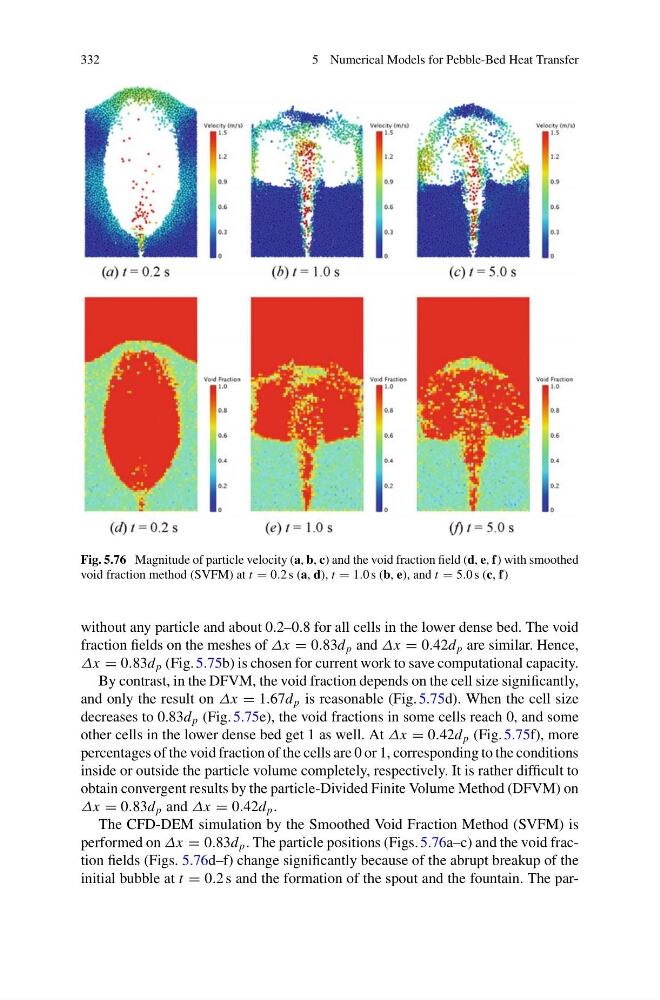
Fig. 5.76 Magnitude of particle velocity (a, b, c) and the void fraction field (d, e, f) with smoothed
void fraction method (SVFM) at t = 0.2 s (a, d), t = 1.0 s (b, e), and t = 5.0 s (c, f)
without any particle and about 0.2–0.8 for all cells in the lower dense bed. The void
fraction fields on the meshes of Δx = 0.83d p and Δx = 0.42d p are similar. Hence,
Δx = 0.83d p (Fig. 5.75b) is chosen for current work to save computational capacity.
By contrast, in the DFVM, the void fraction depends on the cell size significantly,
and only the result on Δx = 1.67d p is reasonable (Fig. 5.75d). When the cell size
decreases to 0.83d p (Fig. 5.75e), the void fractions in some cells reach 0, and some
other cells in the lower dense bed get 1 as well. At Δx = 0.42d p (Fig. 5.75f), more
percentages of the void fraction of the cells are 0 or 1, corresponding to the conditions
inside or outside the particle volume completely, respectively. It is rather difficult to
obtain convergent results by the particle-Divided Finite Volume Method (DFVM) on
Δx = 0.83d p and Δx = 0.42d p .
The CFD-DEM simulation by the Smoothed Void Fraction Method (SVFM) is
performed on Δx = 0.83d p . The particle positions (Figs. 5.76a–c) and the void fraction fields (Figs. 5.76d–f) change significantly because of the abrupt breakup of the
initial bubble at t = 0.2 s and the formation of the spout and the fountain. The par-
5 Numerical Models for Pebble-Bed Heat Transfer
Fig. 5.76 Magnitude of particle velocity (a, b, c) and the void fraction field (d, e, f) with smoothed
void fraction method (SVFM) at t = 0.2 s (a, d), t = 1.0 s (b, e), and t = 5.0 s (c, f)
without any particle and about 0.2–0.8 for all cells in the lower dense bed. The void
fraction fields on the meshes of Δx = 0.83d p and Δx = 0.42d p are similar. Hence,
Δx = 0.83d p (Fig. 5.75b) is chosen for current work to save computational capacity.
By contrast, in the DFVM, the void fraction depends on the cell size significantly,
and only the result on Δx = 1.67d p is reasonable (Fig. 5.75d). When the cell size
decreases to 0.83d p (Fig. 5.75e), the void fractions in some cells reach 0, and some
other cells in the lower dense bed get 1 as well. At Δx = 0.42d p (Fig. 5.75f), more
percentages of the void fraction of the cells are 0 or 1, corresponding to the conditions
inside or outside the particle volume completely, respectively. It is rather difficult to
obtain convergent results by the particle-Divided Finite Volume Method (DFVM) on
Δx = 0.83d p and Δx = 0.42d p .
The CFD-DEM simulation by the Smoothed Void Fraction Method (SVFM) is
performed on Δx = 0.83d p . The particle positions (Figs. 5.76a–c) and the void fraction fields (Figs. 5.76d–f) change significantly because of the abrupt breakup of the
initial bubble at t = 0.2 s and the formation of the spout and the fountain. The par-