

5.4 CFD-DEM Coupled Simulation and Development
335
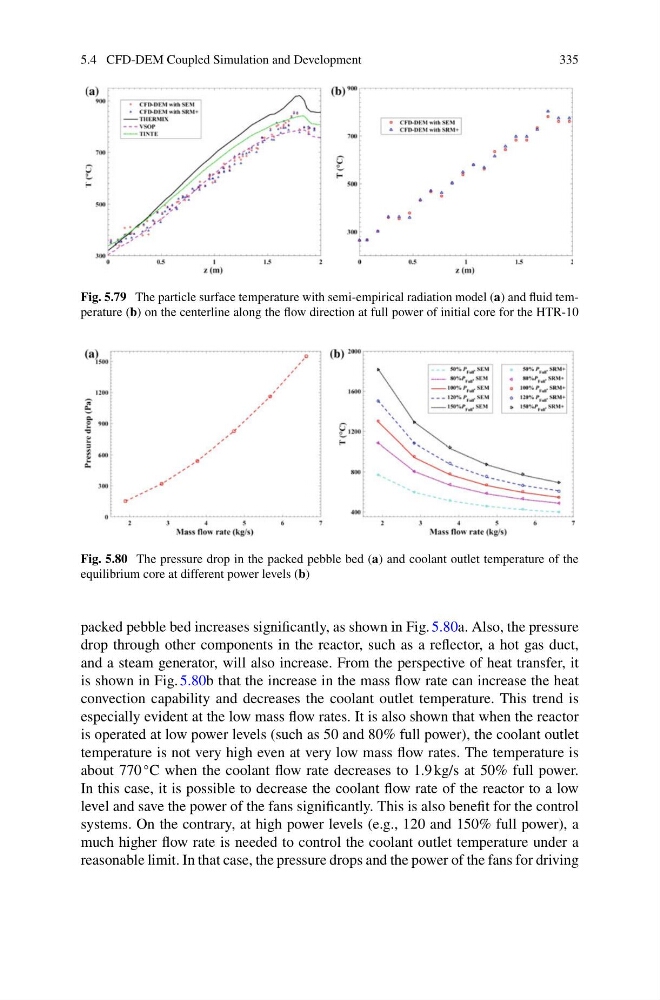
Fig. 5.79 The particle surface temperature with semi-empirical radiation model (a) and fluid temperature (b) on the centerline along the flow direction at full power of initial core for the HTR-10
Fig. 5.80 The pressure drop in the packed pebble bed (a) and coolant outlet temperature of the
equilibrium core at different power levels (b)
packed pebble bed increases significantly, as shown in Fig. 5.80a. Also, the pressure
drop through other components in the reactor, such as a reflector, a hot gas duct,
and a steam generator, will also increase. From the perspective of heat transfer, it
is shown in Fig. 5.80b that the increase in the mass flow rate can increase the heat
convection capability and decreases the coolant outlet temperature. This trend is
especially evident at the low mass flow rates. It is also shown that when the reactor
is operated at low power levels (such as 50 and 80% full power), the coolant outlet
temperature is not very high even at very low mass flow rates. The temperature is
about 770
◦ C when the coolant flow rate decreases to 1.9 kg/s at 50% full power.
In this case, it is possible to decrease the coolant flow rate of the reactor to a low
level and save the power of the fans significantly. This is also benefit for the control
systems. On the contrary, at high power levels (e.g., 120 and 150% full power), a
much higher flow rate is needed to control the coolant outlet temperature under a
reasonable limit. In that case, the pressure drops and the power of the fans for driving
335
Fig. 5.79 The particle surface temperature with semi-empirical radiation model (a) and fluid temperature (b) on the centerline along the flow direction at full power of initial core for the HTR-10
Fig. 5.80 The pressure drop in the packed pebble bed (a) and coolant outlet temperature of the
equilibrium core at different power levels (b)
packed pebble bed increases significantly, as shown in Fig. 5.80a. Also, the pressure
drop through other components in the reactor, such as a reflector, a hot gas duct,
and a steam generator, will also increase. From the perspective of heat transfer, it
is shown in Fig. 5.80b that the increase in the mass flow rate can increase the heat
convection capability and decreases the coolant outlet temperature. This trend is
especially evident at the low mass flow rates. It is also shown that when the reactor
is operated at low power levels (such as 50 and 80% full power), the coolant outlet
temperature is not very high even at very low mass flow rates. The temperature is
about 770
◦ C when the coolant flow rate decreases to 1.9 kg/s at 50% full power.
In this case, it is possible to decrease the coolant flow rate of the reactor to a low
level and save the power of the fans significantly. This is also benefit for the control
systems. On the contrary, at high power levels (e.g., 120 and 150% full power), a
much higher flow rate is needed to control the coolant outlet temperature under a
reasonable limit. In that case, the pressure drops and the power of the fans for driving