

316
5 Numerical Models for Pebble-Bed Heat Transfer
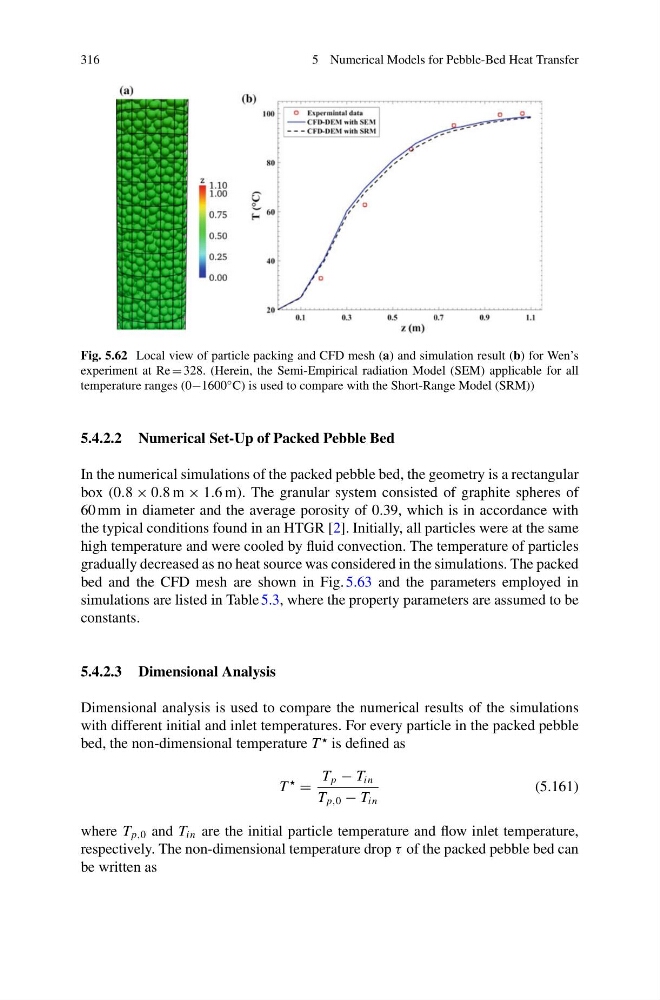
Fig. 5.62 Local view of particle packing and CFD mesh (a) and simulation result (b) for Wen’s
experiment at Re = 328. (Herein, the Semi-Empirical radiation Model (SEM) applicable for all
temperature ranges (0−1600 ◦ C) is used to compare with the Short-Range Model (SRM))
5.4.2.2 Numerical Set-Up of Packed Pebble Bed
In the numerical simulations of the packed pebble bed, the geometry is a rectangular
box (0.8 × 0.8 m × 1.6 m). The granular system consisted of graphite spheres of
60 mm in diameter and the average porosity of 0.39, which is in accordance with
the typical conditions found in an HTGR [2]. Initially, all particles were at the same
high temperature and were cooled by fluid convection. The temperature of particles
gradually decreased as no heat source was considered in the simulations. The packed
bed and the CFD mesh are shown in Fig. 5.63 and the parameters employed in
simulations are listed in Table 5.3, where the property parameters are assumed to be
constants.
5.4.2.3 Dimensional Analysis
Dimensional analysis is used to compare the numerical results of the simulations
with different initial and inlet temperatures. For every particle in the packed pebble
bed, the non-dimensional temperature T
is defined as
T
=
T p − T in
T p,0 − T in
(5.161)
where T p,0 and T in are the initial particle temperature and flow inlet temperature,
respectively. The non-dimensional temperature drop τ of the packed pebble bed can
be written as
5 Numerical Models for Pebble-Bed Heat Transfer
Fig. 5.62 Local view of particle packing and CFD mesh (a) and simulation result (b) for Wen’s
experiment at Re = 328. (Herein, the Semi-Empirical radiation Model (SEM) applicable for all
temperature ranges (0−1600 ◦ C) is used to compare with the Short-Range Model (SRM))
5.4.2.2 Numerical Set-Up of Packed Pebble Bed
In the numerical simulations of the packed pebble bed, the geometry is a rectangular
box (0.8 × 0.8 m × 1.6 m). The granular system consisted of graphite spheres of
60 mm in diameter and the average porosity of 0.39, which is in accordance with
the typical conditions found in an HTGR [2]. Initially, all particles were at the same
high temperature and were cooled by fluid convection. The temperature of particles
gradually decreased as no heat source was considered in the simulations. The packed
bed and the CFD mesh are shown in Fig. 5.63 and the parameters employed in
simulations are listed in Table 5.3, where the property parameters are assumed to be
constants.
5.4.2.3 Dimensional Analysis
Dimensional analysis is used to compare the numerical results of the simulations
with different initial and inlet temperatures. For every particle in the packed pebble
bed, the non-dimensional temperature T
is defined as
T
=
T p − T in
T p,0 − T in
(5.161)
where T p,0 and T in are the initial particle temperature and flow inlet temperature,
respectively. The non-dimensional temperature drop τ of the packed pebble bed can
be written as