

314
5 Numerical Models for Pebble-Bed Heat Transfer
neighbors in the current work can be simplified as
H i j =
k c A 0
L 0
(5.155)
where L 0 is defined as the distance between the particle centers enclosed by neighboring cells, and A 0 is the cross-sectional area of the connected cells (see Fig. 5.61b).
Although H i j can be obtained from Eq. (5.153), the use of Eq. (5.155) is preferred
since the effective thermal conductivity of particle–particle conduction (k c ) can be
obtained from the experimental data [10].
The porosity, momentum source term and the particle–fluid interaction force in a
CFD cell can be written as
α f = 1 −
V p
V cell
S m = −
n
i=1
F f,i
V cell
F f,i = γ p f (u f − V p ),
(5.156)
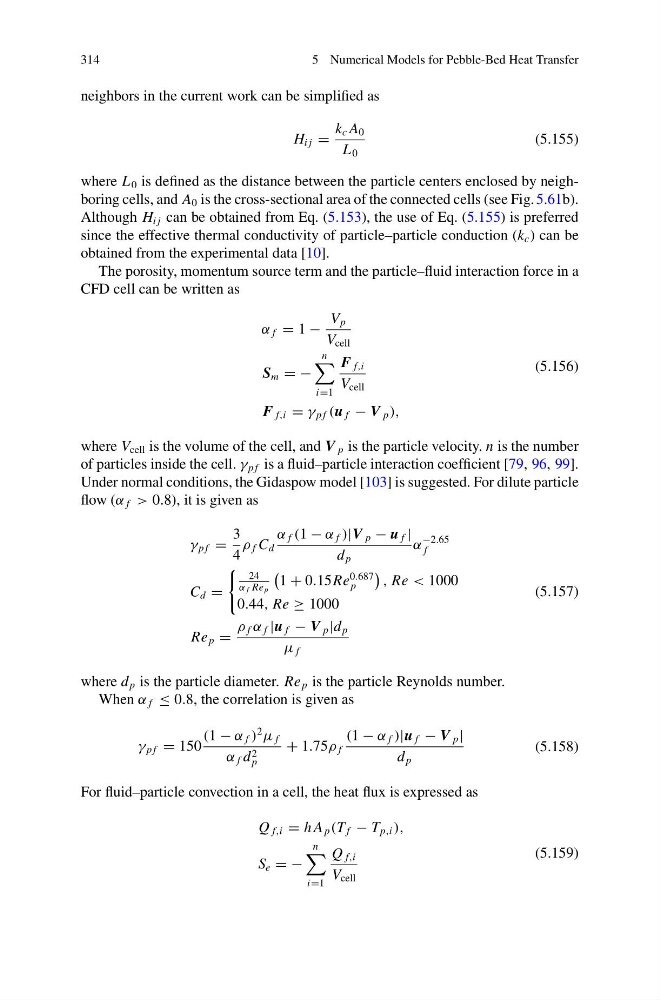
where V cell is the volume of the cell, and V p is the particle velocity. n is the number
of particles inside the cell. γ p f is a fluid–particle interaction coefficient [79, 96, 99].
Under normal conditions, the Gidaspow model [103] is suggested. For dilute particle
flow (α f > 0.8), it is given as
γ p f =
3
4
ρ f C d
α f (1 − α f )|V p − u f |
d p
α
−2.65
f
C d =
24
α f Re p
1 + 0.15Re
0.687
p
, Re < 1000
0.44, Re ≥ 1000
Re p =
ρ f α f |u f − V p |d p
μ f
(5.157)
where d p is the particle diameter. Re p is the particle Reynolds number.
When α f ≤ 0.8, the correlation is given as
γ p f = 150
(1 − α f )
2
μ f
α f d 2
p
+ 1.75ρ f
(1 − α f )|u f − V p |
d p
(5.158)
For fluid–particle convection in a cell, the heat flux is expressed as
Q f,i = h A p (T f − T p,i ),
S e = −
n
i=1
Q f,i
V cell
(5.159)
5 Numerical Models for Pebble-Bed Heat Transfer
neighbors in the current work can be simplified as
H i j =
k c A 0
L 0
(5.155)
where L 0 is defined as the distance between the particle centers enclosed by neighboring cells, and A 0 is the cross-sectional area of the connected cells (see Fig. 5.61b).
Although H i j can be obtained from Eq. (5.153), the use of Eq. (5.155) is preferred
since the effective thermal conductivity of particle–particle conduction (k c ) can be
obtained from the experimental data [10].
The porosity, momentum source term and the particle–fluid interaction force in a
CFD cell can be written as
α f = 1 −
V p
V cell
S m = −
n
i=1
F f,i
V cell
F f,i = γ p f (u f − V p ),
(5.156)
where V cell is the volume of the cell, and V p is the particle velocity. n is the number
of particles inside the cell. γ p f is a fluid–particle interaction coefficient [79, 96, 99].
Under normal conditions, the Gidaspow model [103] is suggested. For dilute particle
flow (α f > 0.8), it is given as
γ p f =
3
4
ρ f C d
α f (1 − α f )|V p − u f |
d p
α
−2.65
f
C d =
24
α f Re p
1 + 0.15Re
0.687
p
, Re < 1000
0.44, Re ≥ 1000
Re p =
ρ f α f |u f − V p |d p
μ f
(5.157)
where d p is the particle diameter. Re p is the particle Reynolds number.
When α f ≤ 0.8, the correlation is given as
γ p f = 150
(1 − α f )
2
μ f
α f d 2
p
+ 1.75ρ f
(1 − α f )|u f − V p |
d p
(5.158)
For fluid–particle convection in a cell, the heat flux is expressed as
Q f,i = h A p (T f − T p,i ),
S e = −
n
i=1
Q f,i
V cell
(5.159)