

5.4 CFD-DEM Coupled Simulation and Development
313
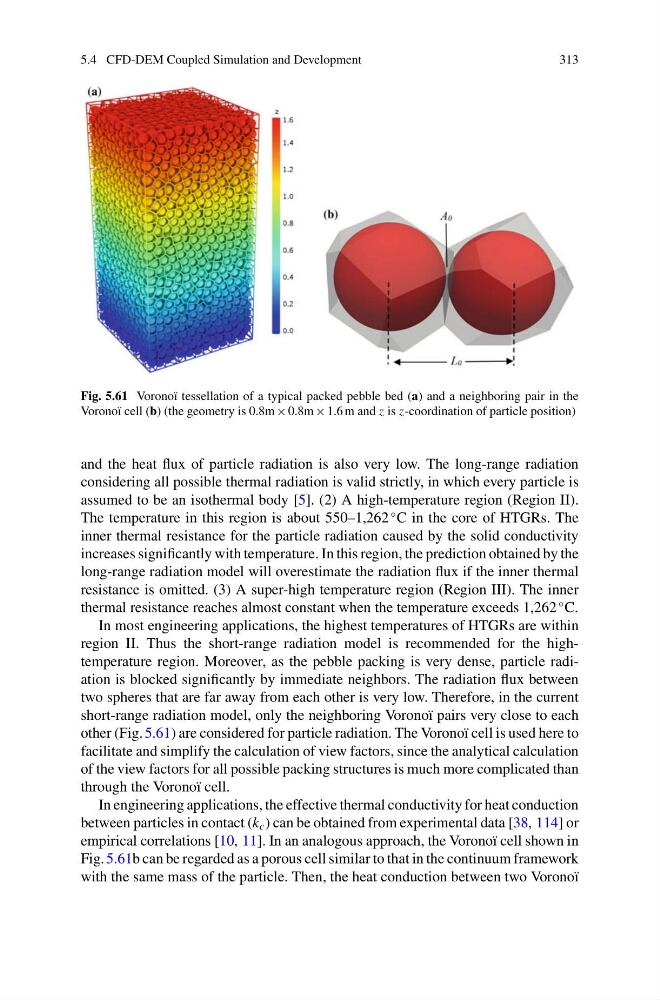
Fig. 5.61 Voronoï tessellation of a typical packed pebble bed (a) and a neighboring pair in the
Voronoï cell (b) (the geometry is 0.8m × 0.8m × 1.6 m and z is z-coordination of particle position)
and the heat flux of particle radiation is also very low. The long-range radiation
considering all possible thermal radiation is valid strictly, in which every particle is
assumed to be an isothermal body [5]. (2) A high-temperature region (Region II).
The temperature in this region is about 550–1,262
◦ C in the core of HTGRs. The
inner thermal resistance for the particle radiation caused by the solid conductivity
increases significantly with temperature. In this region, the prediction obtained by the
long-range radiation model will overestimate the radiation flux if the inner thermal
resistance is omitted. (3) A super-high temperature region (Region III). The inner
thermal resistance reaches almost constant when the temperature exceeds 1,262
◦ C.
In most engineering applications, the highest temperatures of HTGRs are within
region II. Thus the short-range radiation model is recommended for the hightemperature region. Moreover, as the pebble packing is very dense, particle radiation is blocked significantly by immediate neighbors. The radiation flux between
two spheres that are far away from each other is very low. Therefore, in the current
short-range radiation model, only the neighboring Voronoï pairs very close to each
other (Fig. 5.61) are considered for particle radiation. The Voronoï cell is used here to
facilitate and simplify the calculation of view factors, since the analytical calculation
of the view factors for all possible packing structures is much more complicated than
through the Voronoï cell.
In engineering applications, the effective thermal conductivity for heat conduction
between particles in contact (k c ) can be obtained from experimental data [38, 114] or
empirical correlations [10, 11]. In an analogous approach, the Voronoï cell shown in
Fig. 5.61b can be regarded as a porous cell similar to that in the continuum framework
with the same mass of the particle. Then, the heat conduction between two Voronoï
313
Fig. 5.61 Voronoï tessellation of a typical packed pebble bed (a) and a neighboring pair in the
Voronoï cell (b) (the geometry is 0.8m × 0.8m × 1.6 m and z is z-coordination of particle position)
and the heat flux of particle radiation is also very low. The long-range radiation
considering all possible thermal radiation is valid strictly, in which every particle is
assumed to be an isothermal body [5]. (2) A high-temperature region (Region II).
The temperature in this region is about 550–1,262
◦ C in the core of HTGRs. The
inner thermal resistance for the particle radiation caused by the solid conductivity
increases significantly with temperature. In this region, the prediction obtained by the
long-range radiation model will overestimate the radiation flux if the inner thermal
resistance is omitted. (3) A super-high temperature region (Region III). The inner
thermal resistance reaches almost constant when the temperature exceeds 1,262
◦ C.
In most engineering applications, the highest temperatures of HTGRs are within
region II. Thus the short-range radiation model is recommended for the hightemperature region. Moreover, as the pebble packing is very dense, particle radiation is blocked significantly by immediate neighbors. The radiation flux between
two spheres that are far away from each other is very low. Therefore, in the current
short-range radiation model, only the neighboring Voronoï pairs very close to each
other (Fig. 5.61) are considered for particle radiation. The Voronoï cell is used here to
facilitate and simplify the calculation of view factors, since the analytical calculation
of the view factors for all possible packing structures is much more complicated than
through the Voronoï cell.
In engineering applications, the effective thermal conductivity for heat conduction
between particles in contact (k c ) can be obtained from experimental data [38, 114] or
empirical correlations [10, 11]. In an analogous approach, the Voronoï cell shown in
Fig. 5.61b can be regarded as a porous cell similar to that in the continuum framework
with the same mass of the particle. Then, the heat conduction between two Voronoï