

312
5 Numerical Models for Pebble-Bed Heat Transfer
For particle heat conduction, the heat flux between two particles in contact is
calculated as [8, 96, 112]
Q c,i j = H i j (T j − T i ),
(5.152)
where H i j is the heat transfer coefficient, which is determined by the physical properties of the particles, surface roughness, and relative position to particle j [113]. H i j
can be obtained from experimental measurements or the equation, which is written
as [103].
H i j =
4
1
λ i
+
1
λ j
A c,i j ,
(5.153)
where λ i and λ j are thermal conductivities of particles i and j, respectively. A c,i j is
the contact area between the pair.
By contrast, the particle thermal radiation in a packed pebble bed of dense packing
consists of non-contact and long-range interactions. It was proven by theoretical
calculation [46] and experimental results [10] that the solid conductivity (λ s ) of
particle material plays an essential role in the particle thermal radiation exchange of
the packed pebble beds. The non-dimensional solid conductivity is defined as
Λ =
λ s
4σ d p T 3
s
(5.154)
where σ is Stefan–Boltzmann constant. d p and T s are the diameter and temperature
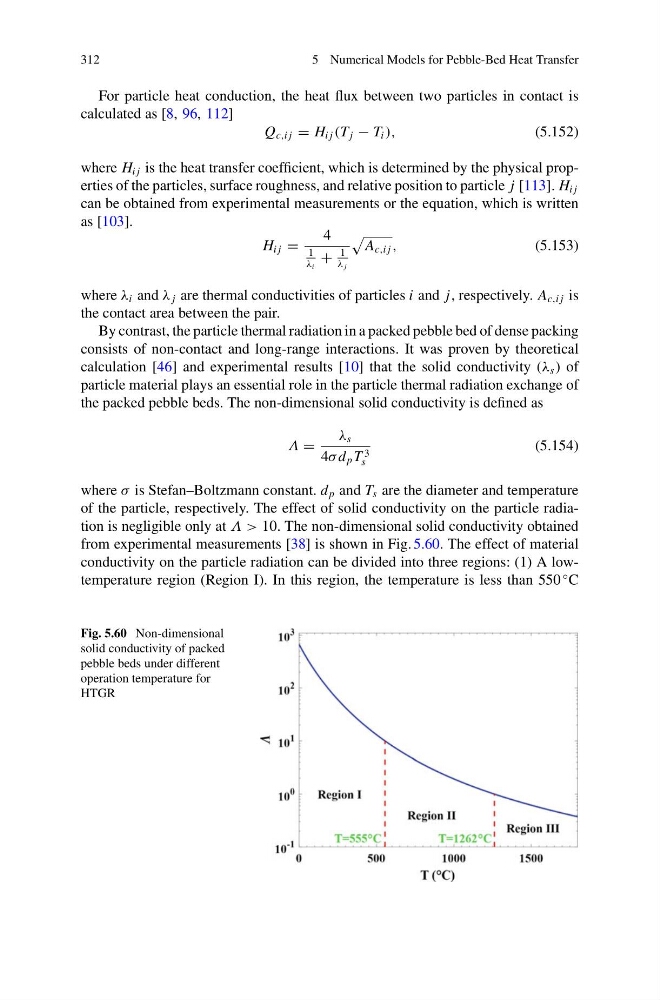
of the particle, respectively. The effect of solid conductivity on the particle radiation is negligible only at Λ > 10. The non-dimensional solid conductivity obtained
from experimental measurements [38] is shown in Fig. 5.60. The effect of material
conductivity on the particle radiation can be divided into three regions: (1) A lowtemperature region (Region I). In this region, the temperature is less than 550
◦ C
Fig. 5.60 Non-dimensional
solid conductivity of packed
pebble beds under different
operation temperature for
HTGR
5 Numerical Models for Pebble-Bed Heat Transfer
For particle heat conduction, the heat flux between two particles in contact is
calculated as [8, 96, 112]
Q c,i j = H i j (T j − T i ),
(5.152)
where H i j is the heat transfer coefficient, which is determined by the physical properties of the particles, surface roughness, and relative position to particle j [113]. H i j
can be obtained from experimental measurements or the equation, which is written
as [103].
H i j =
4
1
λ i
+
1
λ j
A c,i j ,
(5.153)
where λ i and λ j are thermal conductivities of particles i and j, respectively. A c,i j is
the contact area between the pair.
By contrast, the particle thermal radiation in a packed pebble bed of dense packing
consists of non-contact and long-range interactions. It was proven by theoretical
calculation [46] and experimental results [10] that the solid conductivity (λ s ) of
particle material plays an essential role in the particle thermal radiation exchange of
the packed pebble beds. The non-dimensional solid conductivity is defined as
Λ =
λ s
4σ d p T 3
s
(5.154)
where σ is Stefan–Boltzmann constant. d p and T s are the diameter and temperature
of the particle, respectively. The effect of solid conductivity on the particle radiation is negligible only at Λ > 10. The non-dimensional solid conductivity obtained
from experimental measurements [38] is shown in Fig. 5.60. The effect of material
conductivity on the particle radiation can be divided into three regions: (1) A lowtemperature region (Region I). In this region, the temperature is less than 550
◦ C
Fig. 5.60 Non-dimensional
solid conductivity of packed
pebble beds under different
operation temperature for
HTGR