

5.4 CFD-DEM Coupled Simulation and Development
311
k n =
4
3
E
R δn i j ,
k t = 8G
R δn i j ,
ω n = −2
5
6
β
3
2
k n m ,
ω t = −2
5
6
β
k t m ,
(5.148)
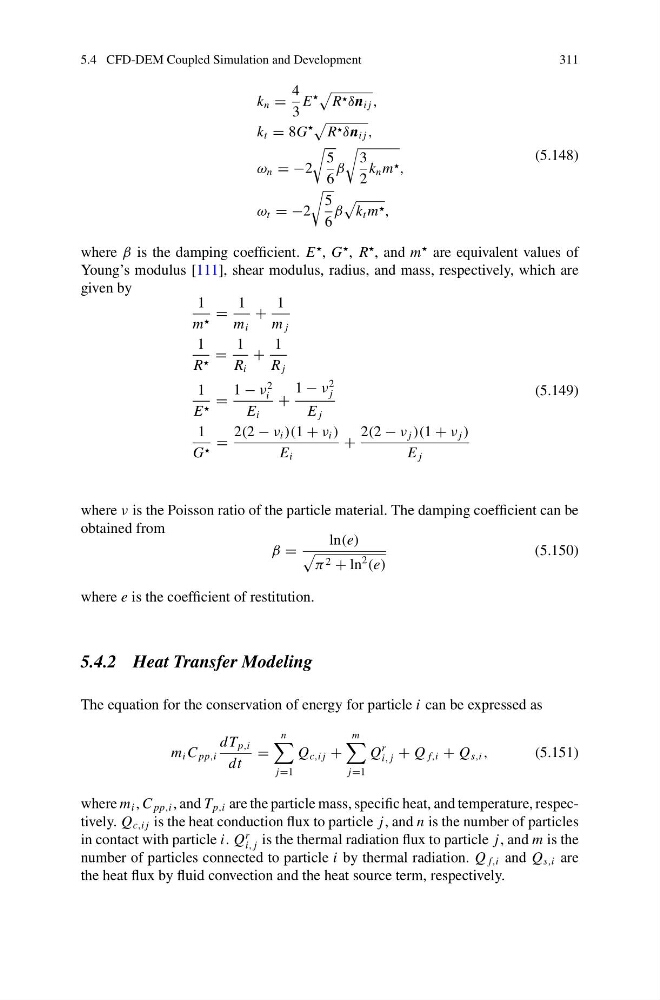
where β is the damping coefficient. E
, G
, R
, and m
are equivalent values of
Young’s modulus [111], shear modulus, radius, and mass, respectively, which are
given by
1
m =
1
m i
+
1
m j
1
R =
1
R i
+
1
R j
1
E =
1 − ν
2
i
E i
+
1 − ν
2
j
E j
1
G =
2(2 − ν i )(1 + ν i )
E i
+
2(2 − ν j )(1 + ν j )
E j
(5.149)
where ν is the Poisson ratio of the particle material. The damping coefficient can be
obtained from
β =
ln(e)
π 2 + ln
2
(e)
(5.150)
where e is the coefficient of restitution.
5.4.2 Heat Transfer Modeling
The equation for the conservation of energy for particle i can be expressed as
m i C pp,i
dT p,i
dt
=
n
j=1
Q c,i j +
m
j=1
Q
r
i, j + Q f,i + Q s,i ,
(5.151)
where m i , C pp,i , and T p,i are the particle mass, specific heat, and temperature, respectively. Q c,i j is the heat conduction flux to particle j, and n is the number of particles
in contact with particle i. Q
r
i, j is the thermal radiation flux to particle j, and m is the
number of particles connected to particle i by thermal radiation. Q f,i and Q s,i are
the heat flux by fluid convection and the heat source term, respectively.
311
k n =
4
3
E
R δn i j ,
k t = 8G
R δn i j ,
ω n = −2
5
6
β
3
2
k n m ,
ω t = −2
5
6
β
k t m ,
(5.148)
where β is the damping coefficient. E
, G
, R
, and m
are equivalent values of
Young’s modulus [111], shear modulus, radius, and mass, respectively, which are
given by
1
m =
1
m i
+
1
m j
1
R =
1
R i
+
1
R j
1
E =
1 − ν
2
i
E i
+
1 − ν
2
j
E j
1
G =
2(2 − ν i )(1 + ν i )
E i
+
2(2 − ν j )(1 + ν j )
E j
(5.149)
where ν is the Poisson ratio of the particle material. The damping coefficient can be
obtained from
β =
ln(e)
π 2 + ln
2
(e)
(5.150)
where e is the coefficient of restitution.
5.4.2 Heat Transfer Modeling
The equation for the conservation of energy for particle i can be expressed as
m i C pp,i
dT p,i
dt
=
n
j=1
Q c,i j +
m
j=1
Q
r
i, j + Q f,i + Q s,i ,
(5.151)
where m i , C pp,i , and T p,i are the particle mass, specific heat, and temperature, respectively. Q c,i j is the heat conduction flux to particle j, and n is the number of particles
in contact with particle i. Q
r
i, j is the thermal radiation flux to particle j, and m is the
number of particles connected to particle i by thermal radiation. Q f,i and Q s,i are
the heat flux by fluid convection and the heat source term, respectively.