

5.3 Discrete Modeling of Pebble Radiation
273
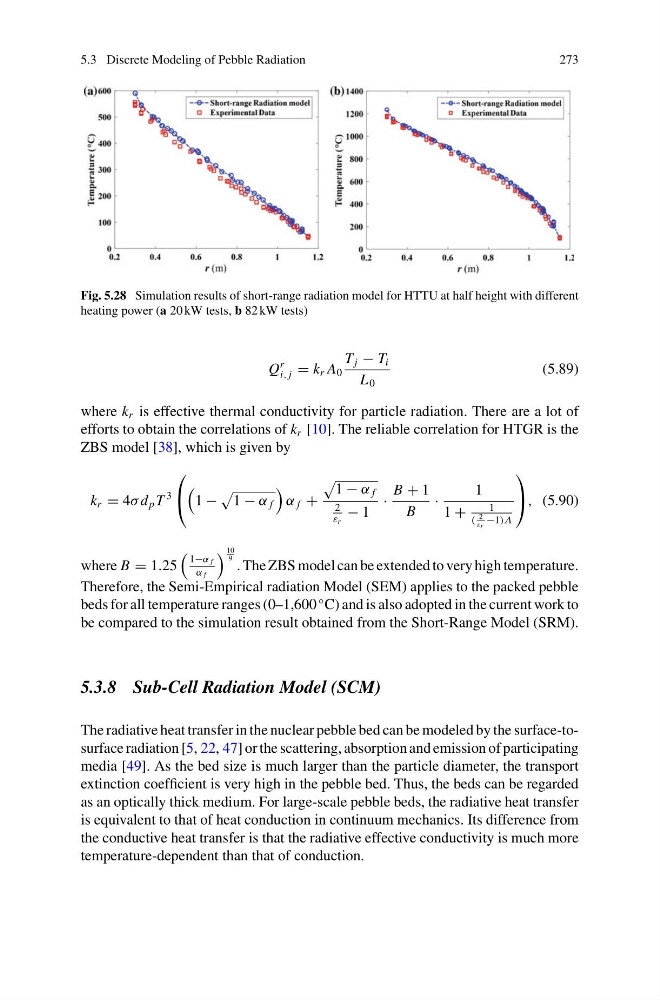
Fig. 5.28 Simulation results of short-range radiation model for HTTU at half height with different
heating power (a 20 kW tests, b 82 kW tests)
Q
r
i, j = k r A 0
T j − T i
L 0
(5.89)
where k r is effective thermal conductivity for particle radiation. There are a lot of
efforts to obtain the correlations of k r [10]. The reliable correlation for HTGR is the
ZBS model [38], which is given by
k r = 4σ d p T
3
⎛
⎝
1 −
1 − α f
α f +
1 − α f
2
ε r
− 1
·
B + 1
B
·
1
1 +
1
(
2
εr −1)Λ
⎞
⎠ , (5.90)
where B = 1.25
1−α f
α f
10
9 . The ZBS model can be extended to very high temperature.
Therefore, the Semi-Empirical radiation Model (SEM) applies to the packed pebble
beds for all temperature ranges (0–1,600
◦ C) and is also adopted in the current work to
be compared to the simulation result obtained from the Short-Range Model (SRM).
5.3.8 Sub-Cell Radiation Model (SCM)
The radiative heat transfer in the nuclear pebble bed can be modeled by the surface-tosurface radiation [5, 22, 47] or the scattering, absorption and emission of participating
media [49]. As the bed size is much larger than the particle diameter, the transport
extinction coefficient is very high in the pebble bed. Thus, the beds can be regarded
as an optically thick medium. For large-scale pebble beds, the radiative heat transfer
is equivalent to that of heat conduction in continuum mechanics. Its difference from
the conductive heat transfer is that the radiative effective conductivity is much more
temperature-dependent than that of conduction.
273
Fig. 5.28 Simulation results of short-range radiation model for HTTU at half height with different
heating power (a 20 kW tests, b 82 kW tests)
Q
r
i, j = k r A 0
T j − T i
L 0
(5.89)
where k r is effective thermal conductivity for particle radiation. There are a lot of
efforts to obtain the correlations of k r [10]. The reliable correlation for HTGR is the
ZBS model [38], which is given by
k r = 4σ d p T
3
⎛
⎝
1 −
1 − α f
α f +
1 − α f
2
ε r
− 1
·
B + 1
B
·
1
1 +
1
(
2
εr −1)Λ
⎞
⎠ , (5.90)
where B = 1.25
1−α f
α f
10
9 . The ZBS model can be extended to very high temperature.
Therefore, the Semi-Empirical radiation Model (SEM) applies to the packed pebble
beds for all temperature ranges (0–1,600
◦ C) and is also adopted in the current work to
be compared to the simulation result obtained from the Short-Range Model (SRM).
5.3.8 Sub-Cell Radiation Model (SCM)
The radiative heat transfer in the nuclear pebble bed can be modeled by the surface-tosurface radiation [5, 22, 47] or the scattering, absorption and emission of participating
media [49]. As the bed size is much larger than the particle diameter, the transport
extinction coefficient is very high in the pebble bed. Thus, the beds can be regarded
as an optically thick medium. For large-scale pebble beds, the radiative heat transfer
is equivalent to that of heat conduction in continuum mechanics. Its difference from
the conductive heat transfer is that the radiative effective conductivity is much more
temperature-dependent than that of conduction.