

272
5 Numerical Models for Pebble-Bed Heat Transfer
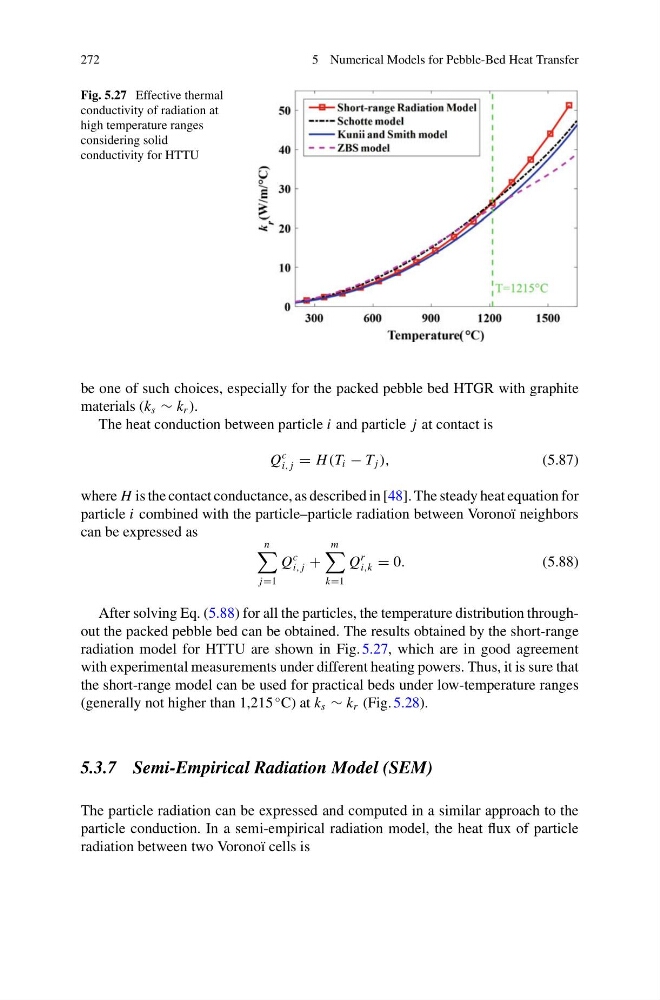
Fig. 5.27 Effective thermal
conductivity of radiation at
high temperature ranges
considering solid
conductivity for HTTU
be one of such choices, especially for the packed pebble bed HTGR with graphite
materials (k s ∼ k r ).
The heat conduction between particle i and particle j at contact is
Q
c
i, j = H (T i − T j ),
(5.87)
where H is the contact conductance, as described in [48]. The steady heat equation for
particle i combined with the particle–particle radiation between Voronoï neighbors
can be expressed as
n
j=1
Q
c
i, j +
m
k=1
Q
r
i,k = 0.
(5.88)
After solving Eq. (5.88) for all the particles, the temperature distribution throughout the packed pebble bed can be obtained. The results obtained by the short-range
radiation model for HTTU are shown in Fig. 5.27, which are in good agreement
with experimental measurements under different heating powers. Thus, it is sure that
the short-range model can be used for practical beds under low-temperature ranges
(generally not higher than 1,215
◦ C) at k s ∼ k r (Fig. 5.28).
5.3.7 Semi-Empirical Radiation Model (SEM)
The particle radiation can be expressed and computed in a similar approach to the
particle conduction. In a semi-empirical radiation model, the heat flux of particle
radiation between two Voronoï cells is
5 Numerical Models for Pebble-Bed Heat Transfer
Fig. 5.27 Effective thermal
conductivity of radiation at
high temperature ranges
considering solid
conductivity for HTTU
be one of such choices, especially for the packed pebble bed HTGR with graphite
materials (k s ∼ k r ).
The heat conduction between particle i and particle j at contact is
Q
c
i, j = H (T i − T j ),
(5.87)
where H is the contact conductance, as described in [48]. The steady heat equation for
particle i combined with the particle–particle radiation between Voronoï neighbors
can be expressed as
n
j=1
Q
c
i, j +
m
k=1
Q
r
i,k = 0.
(5.88)
After solving Eq. (5.88) for all the particles, the temperature distribution throughout the packed pebble bed can be obtained. The results obtained by the short-range
radiation model for HTTU are shown in Fig. 5.27, which are in good agreement
with experimental measurements under different heating powers. Thus, it is sure that
the short-range model can be used for practical beds under low-temperature ranges
(generally not higher than 1,215
◦ C) at k s ∼ k r (Fig. 5.28).
5.3.7 Semi-Empirical Radiation Model (SEM)
The particle radiation can be expressed and computed in a similar approach to the
particle conduction. In a semi-empirical radiation model, the heat flux of particle
radiation between two Voronoï cells is