

5.3 Discrete Modeling of Pebble Radiation
271
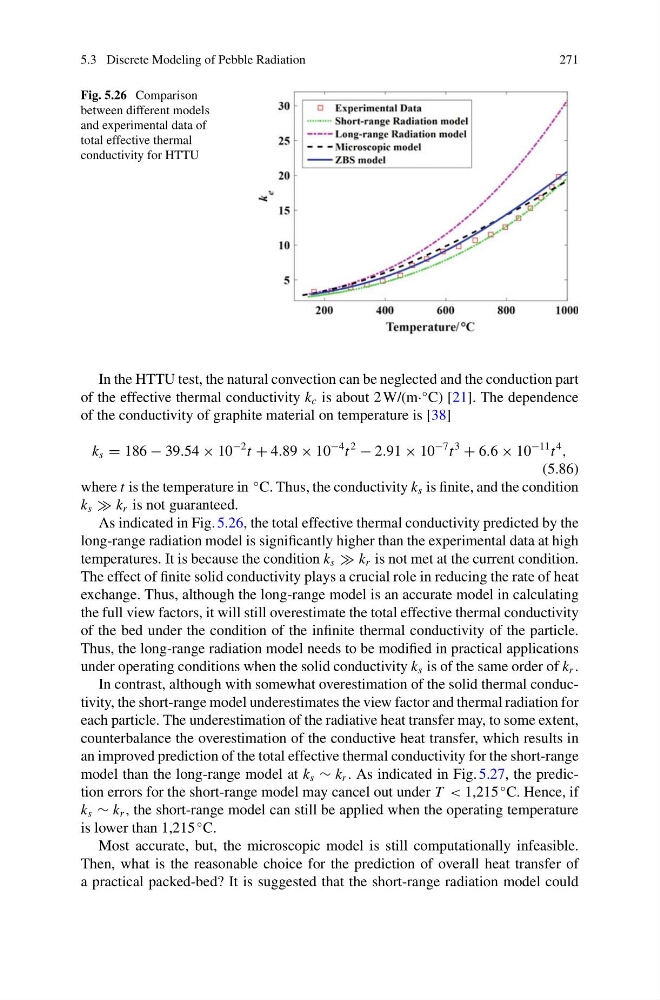
Fig. 5.26 Comparison
between different models
and experimental data of
total effective thermal
conductivity for HTTU
In the HTTU test, the natural convection can be neglected and the conduction part
of the effective thermal conductivity k c is about 2 W/(m·
◦ C) [21]. The dependence
of the conductivity of graphite material on temperature is [38]
k s = 186 − 39.54 × 10
−2 t + 4.89 × 10
−4 t
2
− 2.91 × 10
−7 t
3
+ 6.6 × 10
−11 t
4
,
(5.86)
where t is the temperature in
◦ C. Thus, the conductivity k s is finite, and the condition
k s k r is not guaranteed.
As indicated in Fig. 5.26, the total effective thermal conductivity predicted by the
long-range radiation model is significantly higher than the experimental data at high
temperatures. It is because the condition k s k r is not met at the current condition.
The effect of finite solid conductivity plays a crucial role in reducing the rate of heat
exchange. Thus, although the long-range model is an accurate model in calculating
the full view factors, it will still overestimate the total effective thermal conductivity
of the bed under the condition of the infinite thermal conductivity of the particle.
Thus, the long-range radiation model needs to be modified in practical applications
under operating conditions when the solid conductivity k s is of the same order of k r .
In contrast, although with somewhat overestimation of the solid thermal conductivity, the short-range model underestimates the view factor and thermal radiation for
each particle. The underestimation of the radiative heat transfer may, to some extent,
counterbalance the overestimation of the conductive heat transfer, which results in
an improved prediction of the total effective thermal conductivity for the short-range
model than the long-range model at k s ∼ k r . As indicated in Fig. 5.27, the prediction errors for the short-range model may cancel out under T < 1,215
◦ C. Hence, if
k s ∼ k r , the short-range model can still be applied when the operating temperature
is lower than 1,215
◦ C.
Most accurate, but, the microscopic model is still computationally infeasible.
Then, what is the reasonable choice for the prediction of overall heat transfer of
a practical packed-bed? It is suggested that the short-range radiation model could
271
Fig. 5.26 Comparison
between different models
and experimental data of
total effective thermal
conductivity for HTTU
In the HTTU test, the natural convection can be neglected and the conduction part
of the effective thermal conductivity k c is about 2 W/(m·
◦ C) [21]. The dependence
of the conductivity of graphite material on temperature is [38]
k s = 186 − 39.54 × 10
−2 t + 4.89 × 10
−4 t
2
− 2.91 × 10
−7 t
3
+ 6.6 × 10
−11 t
4
,
(5.86)
where t is the temperature in
◦ C. Thus, the conductivity k s is finite, and the condition
k s k r is not guaranteed.
As indicated in Fig. 5.26, the total effective thermal conductivity predicted by the
long-range radiation model is significantly higher than the experimental data at high
temperatures. It is because the condition k s k r is not met at the current condition.
The effect of finite solid conductivity plays a crucial role in reducing the rate of heat
exchange. Thus, although the long-range model is an accurate model in calculating
the full view factors, it will still overestimate the total effective thermal conductivity
of the bed under the condition of the infinite thermal conductivity of the particle.
Thus, the long-range radiation model needs to be modified in practical applications
under operating conditions when the solid conductivity k s is of the same order of k r .
In contrast, although with somewhat overestimation of the solid thermal conductivity, the short-range model underestimates the view factor and thermal radiation for
each particle. The underestimation of the radiative heat transfer may, to some extent,
counterbalance the overestimation of the conductive heat transfer, which results in
an improved prediction of the total effective thermal conductivity for the short-range
model than the long-range model at k s ∼ k r . As indicated in Fig. 5.27, the prediction errors for the short-range model may cancel out under T < 1,215
◦ C. Hence, if
k s ∼ k r , the short-range model can still be applied when the operating temperature
is lower than 1,215
◦ C.
Most accurate, but, the microscopic model is still computationally infeasible.
Then, what is the reasonable choice for the prediction of overall heat transfer of
a practical packed-bed? It is suggested that the short-range radiation model could