

274
5 Numerical Models for Pebble-Bed Heat Transfer
It is shown that the SRM prediction of the effective heat transfer cells is in good
agreement with the numerical simulations of random packing, and it is only slightly
higher than empirical correlations when the temperature exceeds 1,200
◦ C. For developing a general theoretical approach of modeling ETC, the Sub-Cell radiation Model
(SCM) is needed, which may gain good agreement with Kunii–Smith correlation,
especially at very high-temperature ranges (over 1,500
◦ C). The Sub-Cell radiation
Model is a general theoretical approach for modeling ETC of thermal radiation in
nuclear-packed pebble beds. Moreover, based on SCM, a one-dimensional radial
heat transfer model is applied for the analysis of the HTTU experiments. The results
of the effective thermal conductivity and radial temperature distribution are in good
agreement with the experimental data.
5.3.8.1 Effective Heat Transfer Cell
In packed pebble beds, the heat flux of the thermal radiation between two adjacent
Voronoï cells is written as [5, 7]
Q r,i j = k r A
T j − T i
L 0
(5.91)
where T i and T j are the temperatures of the particles inside the two cells. A
is the
area of the surface connected to the two cells, and L 0 is the distance between two
cells. k r is the Effective Thermal Conductivity (ETC) of thermal radiation, which
is a lumped parameter quantifying the capability of the radiation heat transfer for
nuclear-packed pebble beds.
For nuclear-packed pebble beds, the Voronoï cells of random packing are different
to each other. For analyzing the effective heat transfer cell, the packed pebble beds of
the structured packing, including Simple Cubic (SC), Body-Centered Cubic (BCC),
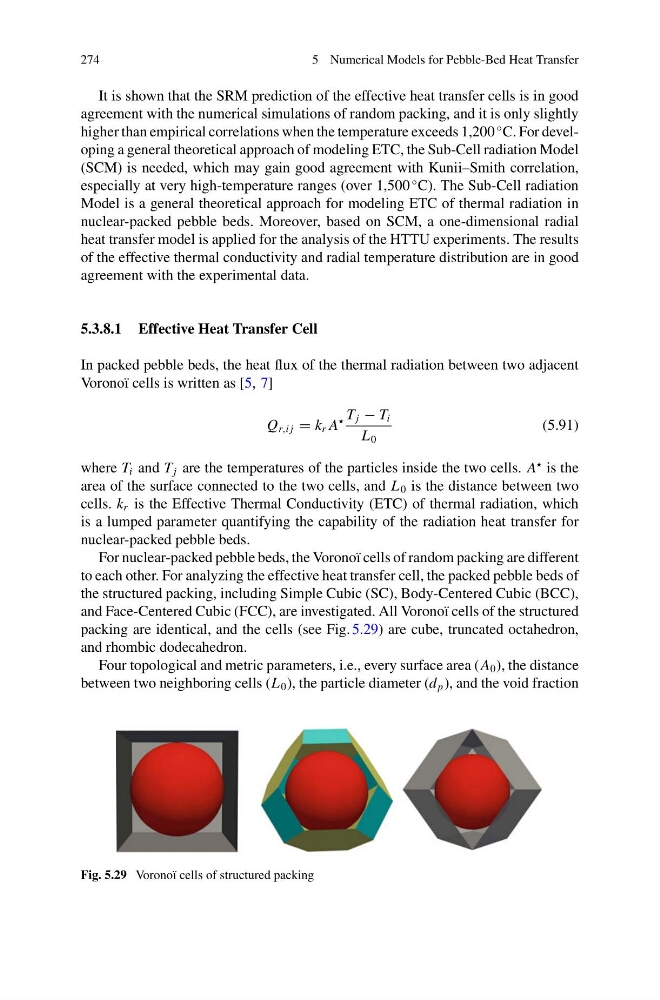
and Face-Centered Cubic (FCC), are investigated. All Voronoï cells of the structured
packing are identical, and the cells (see Fig. 5.29) are cube, truncated octahedron,
and rhombic dodecahedron.
Four topological and metric parameters, i.e., every surface area (A 0 ), the distance
between two neighboring cells (L 0 ), the particle diameter (d p ), and the void fraction
Fig. 5.29 Voronoï cells of structured packing
5 Numerical Models for Pebble-Bed Heat Transfer
It is shown that the SRM prediction of the effective heat transfer cells is in good
agreement with the numerical simulations of random packing, and it is only slightly
higher than empirical correlations when the temperature exceeds 1,200
◦ C. For developing a general theoretical approach of modeling ETC, the Sub-Cell radiation Model
(SCM) is needed, which may gain good agreement with Kunii–Smith correlation,
especially at very high-temperature ranges (over 1,500
◦ C). The Sub-Cell radiation
Model is a general theoretical approach for modeling ETC of thermal radiation in
nuclear-packed pebble beds. Moreover, based on SCM, a one-dimensional radial
heat transfer model is applied for the analysis of the HTTU experiments. The results
of the effective thermal conductivity and radial temperature distribution are in good
agreement with the experimental data.
5.3.8.1 Effective Heat Transfer Cell
In packed pebble beds, the heat flux of the thermal radiation between two adjacent
Voronoï cells is written as [5, 7]
Q r,i j = k r A
T j − T i
L 0
(5.91)
where T i and T j are the temperatures of the particles inside the two cells. A
is the
area of the surface connected to the two cells, and L 0 is the distance between two
cells. k r is the Effective Thermal Conductivity (ETC) of thermal radiation, which
is a lumped parameter quantifying the capability of the radiation heat transfer for
nuclear-packed pebble beds.
For nuclear-packed pebble beds, the Voronoï cells of random packing are different
to each other. For analyzing the effective heat transfer cell, the packed pebble beds of
the structured packing, including Simple Cubic (SC), Body-Centered Cubic (BCC),
and Face-Centered Cubic (FCC), are investigated. All Voronoï cells of the structured
packing are identical, and the cells (see Fig. 5.29) are cube, truncated octahedron,
and rhombic dodecahedron.
Four topological and metric parameters, i.e., every surface area (A 0 ), the distance
between two neighboring cells (L 0 ), the particle diameter (d p ), and the void fraction
Fig. 5.29 Voronoï cells of structured packing