

5.3 Discrete Modeling of Pebble Radiation
269
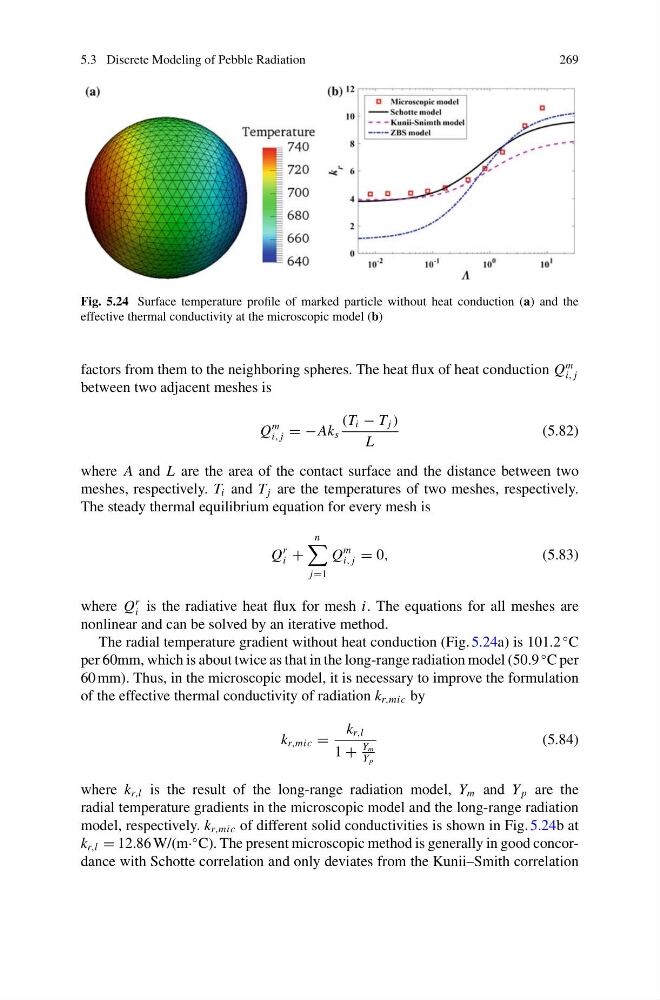
Fig. 5.24 Surface temperature profile of marked particle without heat conduction (a) and the
effective thermal conductivity at the microscopic model (b)
factors from them to the neighboring spheres. The heat flux of heat conduction Q
m
i, j
between two adjacent meshes is
Q
m
i, j = −Ak s
(T i − T j )
L
(5.82)
where A and L are the area of the contact surface and the distance between two
meshes, respectively. T i and T j are the temperatures of two meshes, respectively.
The steady thermal equilibrium equation for every mesh is
Q
r
i +
n
j=1
Q
m
i, j = 0,
(5.83)
where Q
r
i is the radiative heat flux for mesh i. The equations for all meshes are
nonlinear and can be solved by an iterative method.
The radial temperature gradient without heat conduction (Fig. 5.24a) is 101.2
◦ C
per 60mm, which is about twice as that in the long-range radiation model (50.9
◦ C per
60 mm). Thus, in the microscopic model, it is necessary to improve the formulation
of the effective thermal conductivity of radiation k r,mic by
k r,mic =
k r,l
1 +
Y m
Y p
(5.84)
where k r,l is the result of the long-range radiation model, Y m and Y p are the
radial temperature gradients in the microscopic model and the long-range radiation
model, respectively. k r,mic of different solid conductivities is shown in Fig. 5.24b at
k r,l = 12.86 W/(m·
◦ C). The present microscopic method is generally in good concordance with Schotte correlation and only deviates from the Kunii–Smith correlation
269
Fig. 5.24 Surface temperature profile of marked particle without heat conduction (a) and the
effective thermal conductivity at the microscopic model (b)
factors from them to the neighboring spheres. The heat flux of heat conduction Q
m
i, j
between two adjacent meshes is
Q
m
i, j = −Ak s
(T i − T j )
L
(5.82)
where A and L are the area of the contact surface and the distance between two
meshes, respectively. T i and T j are the temperatures of two meshes, respectively.
The steady thermal equilibrium equation for every mesh is
Q
r
i +
n
j=1
Q
m
i, j = 0,
(5.83)
where Q
r
i is the radiative heat flux for mesh i. The equations for all meshes are
nonlinear and can be solved by an iterative method.
The radial temperature gradient without heat conduction (Fig. 5.24a) is 101.2
◦ C
per 60mm, which is about twice as that in the long-range radiation model (50.9
◦ C per
60 mm). Thus, in the microscopic model, it is necessary to improve the formulation
of the effective thermal conductivity of radiation k r,mic by
k r,mic =
k r,l
1 +
Y m
Y p
(5.84)
where k r,l is the result of the long-range radiation model, Y m and Y p are the
radial temperature gradients in the microscopic model and the long-range radiation
model, respectively. k r,mic of different solid conductivities is shown in Fig. 5.24b at
k r,l = 12.86 W/(m·
◦ C). The present microscopic method is generally in good concordance with Schotte correlation and only deviates from the Kunii–Smith correlation