

268
5 Numerical Models for Pebble-Bed Heat Transfer
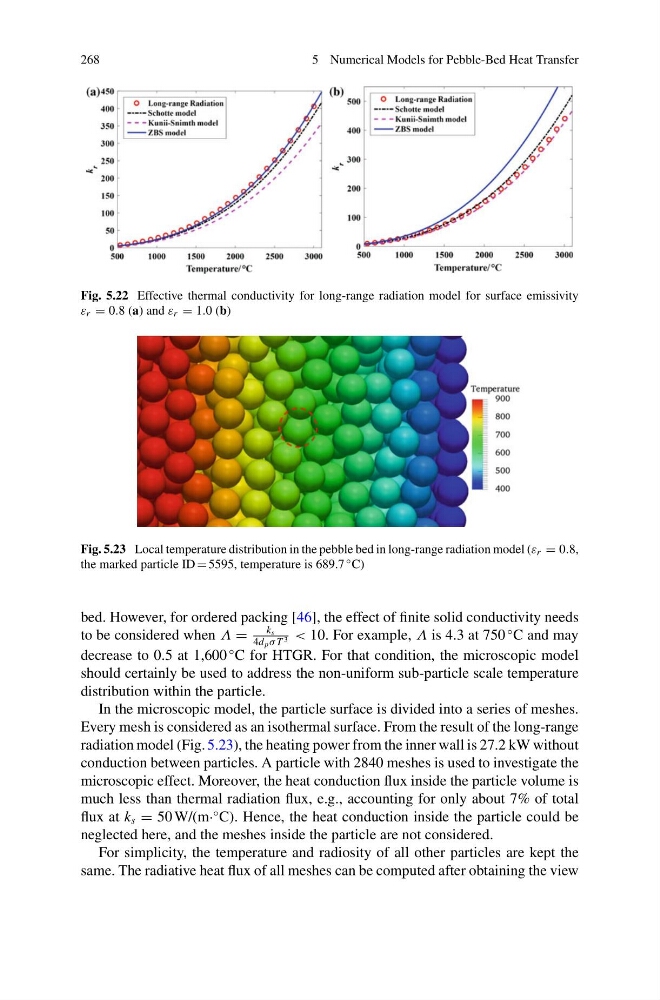
Fig. 5.22 Effective thermal conductivity for long-range radiation model for surface emissivity
ε r = 0.8 (a) and ε r = 1.0 (b)
Fig. 5.23 Local temperature distribution in the pebble bed in long-range radiation model (ε r = 0.8,
the marked particle ID = 5595, temperature is 689.7 ◦ C)
bed. However, for ordered packing [46], the effect of finite solid conductivity needs
to be considered when Λ =
k s
4d p σ T 3 < 10. For example, Λ is 4.3 at 750
◦ C and may
decrease to 0.5 at 1,600
◦ C for HTGR. For that condition, the microscopic model
should certainly be used to address the non-uniform sub-particle scale temperature
distribution within the particle.
In the microscopic model, the particle surface is divided into a series of meshes.
Every mesh is considered as an isothermal surface. From the result of the long-range
radiation model (Fig. 5.23), the heating power from the inner wall is 27.2 kW without
conduction between particles. A particle with 2840 meshes is used to investigate the
microscopic effect. Moreover, the heat conduction flux inside the particle volume is
much less than thermal radiation flux, e.g., accounting for only about 7% of total
flux at k s = 50 W/(m·
◦ C). Hence, the heat conduction inside the particle could be
neglected here, and the meshes inside the particle are not considered.
For simplicity, the temperature and radiosity of all other particles are kept the
same. The radiative heat flux of all meshes can be computed after obtaining the view
5 Numerical Models for Pebble-Bed Heat Transfer
Fig. 5.22 Effective thermal conductivity for long-range radiation model for surface emissivity
ε r = 0.8 (a) and ε r = 1.0 (b)
Fig. 5.23 Local temperature distribution in the pebble bed in long-range radiation model (ε r = 0.8,
the marked particle ID = 5595, temperature is 689.7 ◦ C)
bed. However, for ordered packing [46], the effect of finite solid conductivity needs
to be considered when Λ =
k s
4d p σ T 3 < 10. For example, Λ is 4.3 at 750
◦ C and may
decrease to 0.5 at 1,600
◦ C for HTGR. For that condition, the microscopic model
should certainly be used to address the non-uniform sub-particle scale temperature
distribution within the particle.
In the microscopic model, the particle surface is divided into a series of meshes.
Every mesh is considered as an isothermal surface. From the result of the long-range
radiation model (Fig. 5.23), the heating power from the inner wall is 27.2 kW without
conduction between particles. A particle with 2840 meshes is used to investigate the
microscopic effect. Moreover, the heat conduction flux inside the particle volume is
much less than thermal radiation flux, e.g., accounting for only about 7% of total
flux at k s = 50 W/(m·
◦ C). Hence, the heat conduction inside the particle could be
neglected here, and the meshes inside the particle are not considered.
For simplicity, the temperature and radiosity of all other particles are kept the
same. The radiative heat flux of all meshes can be computed after obtaining the view