

5.3 Discrete Modeling of Pebble Radiation
267
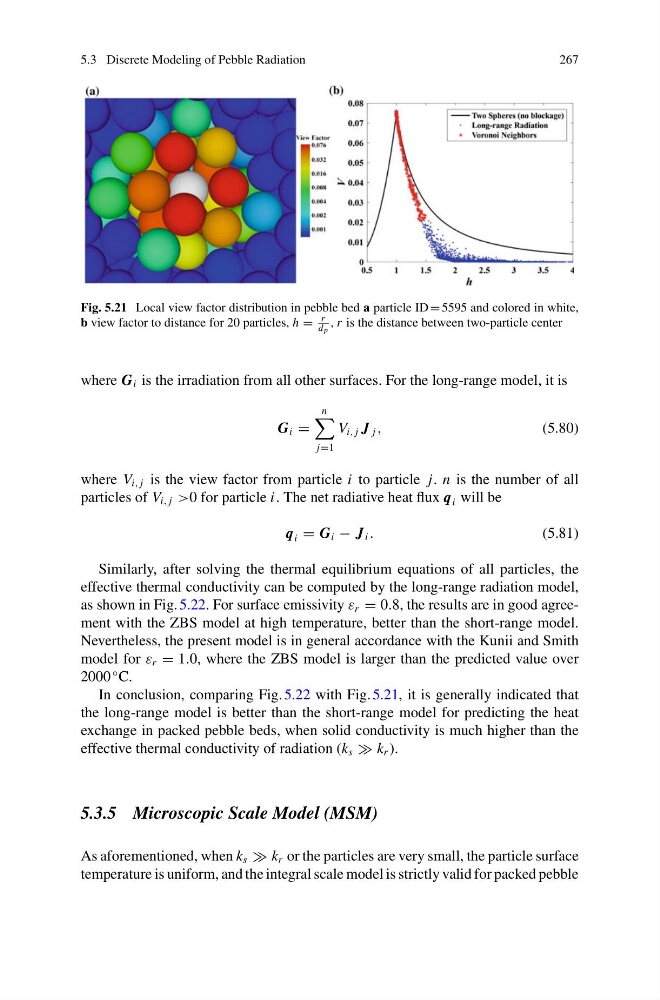
Fig. 5.21 Local view factor distribution in pebble bed a particle ID = 5595 and colored in white,
b view factor to distance for 20 particles, h =
r
dp , r is the distance between two-particle center
where G i is the irradiation from all other surfaces. For the long-range model, it is
G i =
n
j=1
V i, j J j ,
(5.80)
where V i, j is the view factor from particle i to particle j. n is the number of all
particles of V i, j >0 for particle i. The net radiative heat flux q i will be
q i = G i − J i .
(5.81)
Similarly, after solving the thermal equilibrium equations of all particles, the
effective thermal conductivity can be computed by the long-range radiation model,
as shown in Fig. 5.22. For surface emissivity ε r = 0.8, the results are in good agreement with the ZBS model at high temperature, better than the short-range model.
Nevertheless, the present model is in general accordance with the Kunii and Smith
model for ε r = 1.0, where the ZBS model is larger than the predicted value over
2000
◦ C.
In conclusion, comparing Fig. 5.22 with Fig. 5.21, it is generally indicated that
the long-range model is better than the short-range model for predicting the heat
exchange in packed pebble beds, when solid conductivity is much higher than the
effective thermal conductivity of radiation (k s k r ).
5.3.5 Microscopic Scale Model (MSM)
As aforementioned, when k s k r or the particles are very small, the particle surface
temperature is uniform, and the integral scale model is strictly valid for packed pebble
267
Fig. 5.21 Local view factor distribution in pebble bed a particle ID = 5595 and colored in white,
b view factor to distance for 20 particles, h =
r
dp , r is the distance between two-particle center
where G i is the irradiation from all other surfaces. For the long-range model, it is
G i =
n
j=1
V i, j J j ,
(5.80)
where V i, j is the view factor from particle i to particle j. n is the number of all
particles of V i, j >0 for particle i. The net radiative heat flux q i will be
q i = G i − J i .
(5.81)
Similarly, after solving the thermal equilibrium equations of all particles, the
effective thermal conductivity can be computed by the long-range radiation model,
as shown in Fig. 5.22. For surface emissivity ε r = 0.8, the results are in good agreement with the ZBS model at high temperature, better than the short-range model.
Nevertheless, the present model is in general accordance with the Kunii and Smith
model for ε r = 1.0, where the ZBS model is larger than the predicted value over
2000
◦ C.
In conclusion, comparing Fig. 5.22 with Fig. 5.21, it is generally indicated that
the long-range model is better than the short-range model for predicting the heat
exchange in packed pebble beds, when solid conductivity is much higher than the
effective thermal conductivity of radiation (k s k r ).
5.3.5 Microscopic Scale Model (MSM)
As aforementioned, when k s k r or the particles are very small, the particle surface
temperature is uniform, and the integral scale model is strictly valid for packed pebble