

264
5 Numerical Models for Pebble-Bed Heat Transfer
5.3.2.2 Existing Correlation
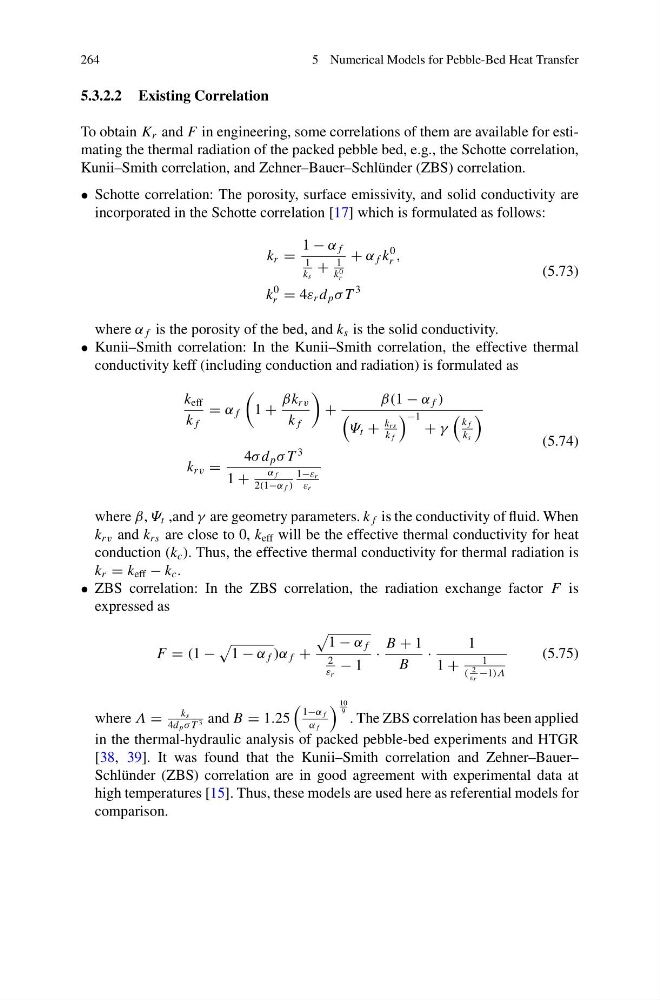
To obtain K r and F in engineering, some correlations of them are available for estimating the thermal radiation of the packed pebble bed, e.g., the Schotte correlation,
Kunii–Smith correlation, and Zehner–Bauer–Schlünder (ZBS) correlation.
• Schotte correlation: The porosity, surface emissivity, and solid conductivity are
incorporated in the Schotte correlation [17] which is formulated as follows:
k r =
1 − α f
1
k s
+
1
k 0
r
+ α f k
0
r ,
k
0
r = 4ε r d p σ T
3
(5.73)
where α f is the porosity of the bed, and k s is the solid conductivity.
• Kunii–Smith correlation: In the Kunii–Smith correlation, the effective thermal
conductivity keff (including conduction and radiation) is formulated as
k eff
k f
= α f
1 +
βk r v
k f
+
β(1 − α f )
Ψ t +
k rs
k f
−1 + γ
k f
k s
k r v =
4σ d p σ T
3
1 +
α f
2(1−α f )
1−ε r
ε r
(5.74)
where β, Ψ t ,and γ are geometry parameters. k f is the conductivity of fluid. When
k r v and k rs are close to 0, k eff will be the effective thermal conductivity for heat
conduction (k c ). Thus, the effective thermal conductivity for thermal radiation is
k r = k eff − k c .
• ZBS correlation: In the ZBS correlation, the radiation exchange factor F is
expressed as
F = (1 −
1 − α f )α f +
1 − α f
2
ε r
− 1
·
B + 1
B
·
1
1 +
1
(
2
εr −1)Λ
(5.75)
where Λ =
k s
4d p σ T 3 and B = 1.25
1−α f
α f
10
9 . The ZBS correlation has been applied
in the thermal-hydraulic analysis of packed pebble-bed experiments and HTGR
[38, 39]. It was found that the Kunii–Smith correlation and Zehner–Bauer–
Schlünder (ZBS) correlation are in good agreement with experimental data at
high temperatures [15]. Thus, these models are used here as referential models for
comparison.
5 Numerical Models for Pebble-Bed Heat Transfer
5.3.2.2 Existing Correlation
To obtain K r and F in engineering, some correlations of them are available for estimating the thermal radiation of the packed pebble bed, e.g., the Schotte correlation,
Kunii–Smith correlation, and Zehner–Bauer–Schlünder (ZBS) correlation.
• Schotte correlation: The porosity, surface emissivity, and solid conductivity are
incorporated in the Schotte correlation [17] which is formulated as follows:
k r =
1 − α f
1
k s
+
1
k 0
r
+ α f k
0
r ,
k
0
r = 4ε r d p σ T
3
(5.73)
where α f is the porosity of the bed, and k s is the solid conductivity.
• Kunii–Smith correlation: In the Kunii–Smith correlation, the effective thermal
conductivity keff (including conduction and radiation) is formulated as
k eff
k f
= α f
1 +
βk r v
k f
+
β(1 − α f )
Ψ t +
k rs
k f
−1 + γ
k f
k s
k r v =
4σ d p σ T
3
1 +
α f
2(1−α f )
1−ε r
ε r
(5.74)
where β, Ψ t ,and γ are geometry parameters. k f is the conductivity of fluid. When
k r v and k rs are close to 0, k eff will be the effective thermal conductivity for heat
conduction (k c ). Thus, the effective thermal conductivity for thermal radiation is
k r = k eff − k c .
• ZBS correlation: In the ZBS correlation, the radiation exchange factor F is
expressed as
F = (1 −
1 − α f )α f +
1 − α f
2
ε r
− 1
·
B + 1
B
·
1
1 +
1
(
2
εr −1)Λ
(5.75)
where Λ =
k s
4d p σ T 3 and B = 1.25
1−α f
α f
10
9 . The ZBS correlation has been applied
in the thermal-hydraulic analysis of packed pebble-bed experiments and HTGR
[38, 39]. It was found that the Kunii–Smith correlation and Zehner–Bauer–
Schlünder (ZBS) correlation are in good agreement with experimental data at
high temperatures [15]. Thus, these models are used here as referential models for
comparison.