

5.3 Discrete Modeling of Pebble Radiation
263
Q
r
i, j =
σ (T
4
i − T
4
j )
1−ε r
ε r A i
+
1
A i V i, j
+
1−ε r
ε r A j
(5.69)
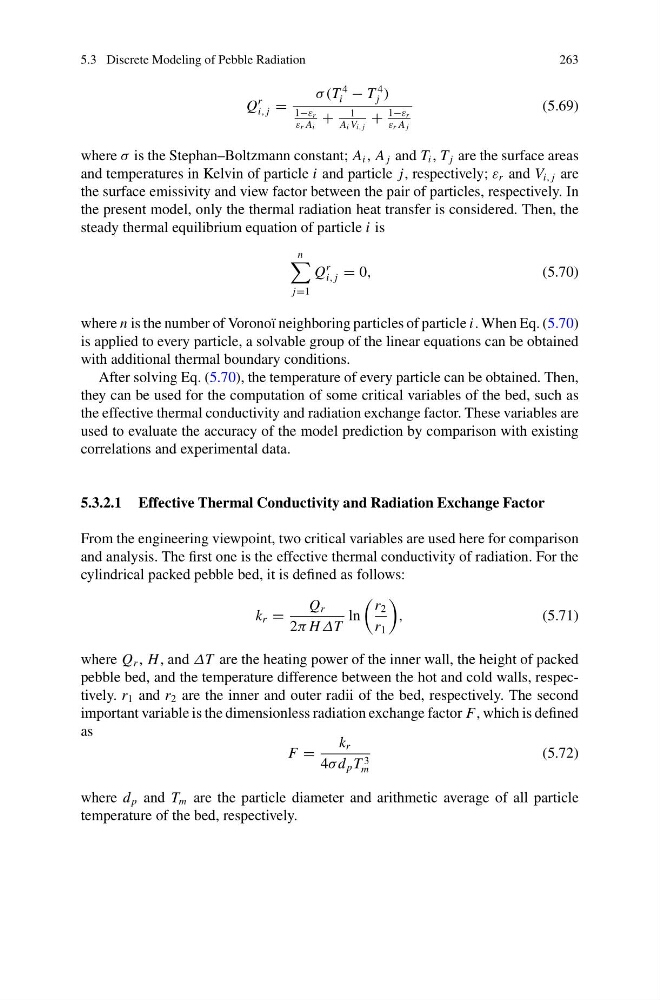
where σ is the Stephan–Boltzmann constant; A i , A j and T i , T j are the surface areas
and temperatures in Kelvin of particle i and particle j, respectively; ε r and V i, j are
the surface emissivity and view factor between the pair of particles, respectively. In
the present model, only the thermal radiation heat transfer is considered. Then, the
steady thermal equilibrium equation of particle i is
n
j=1
Q
r
i, j = 0,
(5.70)
where n is the number of Voronoï neighboring particles of particle i. When Eq. (5.70)
is applied to every particle, a solvable group of the linear equations can be obtained
with additional thermal boundary conditions.
After solving Eq. (5.70), the temperature of every particle can be obtained. Then,
they can be used for the computation of some critical variables of the bed, such as
the effective thermal conductivity and radiation exchange factor. These variables are
used to evaluate the accuracy of the model prediction by comparison with existing
correlations and experimental data.
5.3.2.1 Effective Thermal Conductivity and Radiation Exchange Factor
From the engineering viewpoint, two critical variables are used here for comparison
and analysis. The first one is the effective thermal conductivity of radiation. For the
cylindrical packed pebble bed, it is defined as follows:
k r =
Q r
2π H ΔT
ln
r 2
r 1
,
(5.71)
where Q r , H , and ΔT are the heating power of the inner wall, the height of packed
pebble bed, and the temperature difference between the hot and cold walls, respectively. r 1 and r 2 are the inner and outer radii of the bed, respectively. The second
important variable is the dimensionless radiation exchange factor F, which is defined
as
F =
k r
4σ d p T 3
m
(5.72)
where d p and T m are the particle diameter and arithmetic average of all particle
temperature of the bed, respectively.
263
Q
r
i, j =
σ (T
4
i − T
4
j )
1−ε r
ε r A i
+
1
A i V i, j
+
1−ε r
ε r A j
(5.69)
where σ is the Stephan–Boltzmann constant; A i , A j and T i , T j are the surface areas
and temperatures in Kelvin of particle i and particle j, respectively; ε r and V i, j are
the surface emissivity and view factor between the pair of particles, respectively. In
the present model, only the thermal radiation heat transfer is considered. Then, the
steady thermal equilibrium equation of particle i is
n
j=1
Q
r
i, j = 0,
(5.70)
where n is the number of Voronoï neighboring particles of particle i. When Eq. (5.70)
is applied to every particle, a solvable group of the linear equations can be obtained
with additional thermal boundary conditions.
After solving Eq. (5.70), the temperature of every particle can be obtained. Then,
they can be used for the computation of some critical variables of the bed, such as
the effective thermal conductivity and radiation exchange factor. These variables are
used to evaluate the accuracy of the model prediction by comparison with existing
correlations and experimental data.
5.3.2.1 Effective Thermal Conductivity and Radiation Exchange Factor
From the engineering viewpoint, two critical variables are used here for comparison
and analysis. The first one is the effective thermal conductivity of radiation. For the
cylindrical packed pebble bed, it is defined as follows:
k r =
Q r
2π H ΔT
ln
r 2
r 1
,
(5.71)
where Q r , H , and ΔT are the heating power of the inner wall, the height of packed
pebble bed, and the temperature difference between the hot and cold walls, respectively. r 1 and r 2 are the inner and outer radii of the bed, respectively. The second
important variable is the dimensionless radiation exchange factor F, which is defined
as
F =
k r
4σ d p T 3
m
(5.72)
where d p and T m are the particle diameter and arithmetic average of all particle
temperature of the bed, respectively.