

5.3 Discrete Modeling of Pebble Radiation
265
5.3.2.3 Comparisons
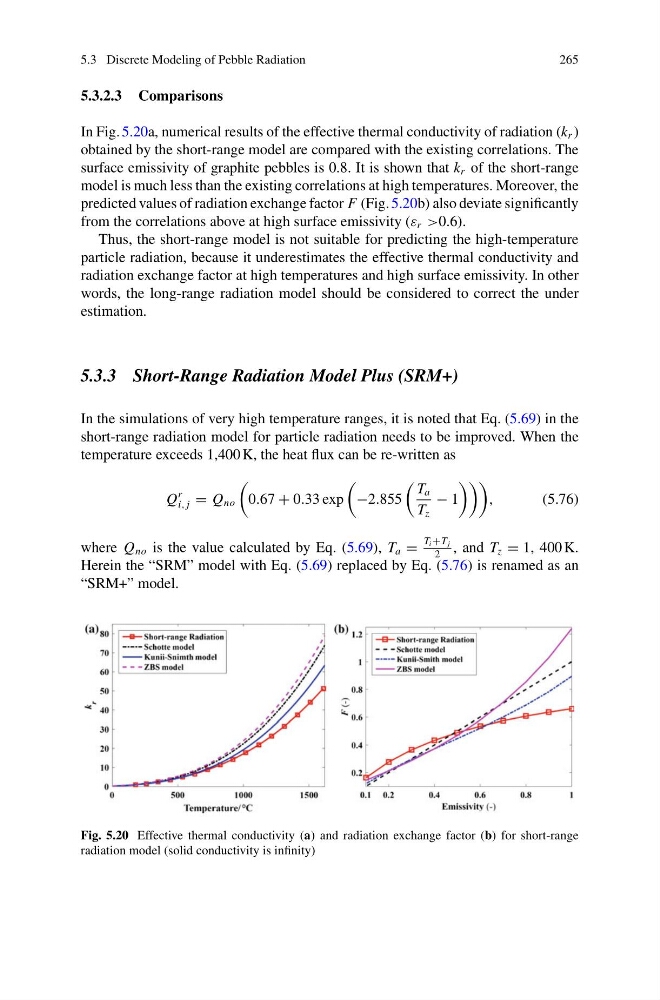
In Fig. 5.20a, numerical results of the effective thermal conductivity of radiation (k r )
obtained by the short-range model are compared with the existing correlations. The
surface emissivity of graphite pebbles is 0.8. It is shown that k r of the short-range
model is much less than the existing correlations at high temperatures. Moreover, the
predicted values of radiation exchange factor F (Fig. 5.20b) also deviate significantly
from the correlations above at high surface emissivity (ε r >0.6).
Thus, the short-range model is not suitable for predicting the high-temperature
particle radiation, because it underestimates the effective thermal conductivity and
radiation exchange factor at high temperatures and high surface emissivity. In other
words, the long-range radiation model should be considered to correct the under
estimation.
5.3.3 Short-Range Radiation Model Plus (SRM+)
In the simulations of very high temperature ranges, it is noted that Eq. (5.69) in the
short-range radiation model for particle radiation needs to be improved. When the
temperature exceeds 1,400 K, the heat flux can be re-written as
Q
r
i, j = Q no
0.67 + 0.33 exp
−2.855
T a
T z
− 1
,
(5.76)
where Q no is the value calculated by Eq. (5.69), T a =
T i +T j
2
, and T z = 1, 400 K.
Herein the “SRM” model with Eq. (5.69) replaced by Eq. (5.76) is renamed as an
“SRM+” model.
Fig. 5.20 Effective thermal conductivity (a) and radiation exchange factor (b) for short-range
radiation model (solid conductivity is infinity)
265
5.3.2.3 Comparisons
In Fig. 5.20a, numerical results of the effective thermal conductivity of radiation (k r )
obtained by the short-range model are compared with the existing correlations. The
surface emissivity of graphite pebbles is 0.8. It is shown that k r of the short-range
model is much less than the existing correlations at high temperatures. Moreover, the
predicted values of radiation exchange factor F (Fig. 5.20b) also deviate significantly
from the correlations above at high surface emissivity (ε r >0.6).
Thus, the short-range model is not suitable for predicting the high-temperature
particle radiation, because it underestimates the effective thermal conductivity and
radiation exchange factor at high temperatures and high surface emissivity. In other
words, the long-range radiation model should be considered to correct the under
estimation.
5.3.3 Short-Range Radiation Model Plus (SRM+)
In the simulations of very high temperature ranges, it is noted that Eq. (5.69) in the
short-range radiation model for particle radiation needs to be improved. When the
temperature exceeds 1,400 K, the heat flux can be re-written as
Q
r
i, j = Q no
0.67 + 0.33 exp
−2.855
T a
T z
− 1
,
(5.76)
where Q no is the value calculated by Eq. (5.69), T a =
T i +T j
2
, and T z = 1, 400 K.
Herein the “SRM” model with Eq. (5.69) replaced by Eq. (5.76) is renamed as an
“SRM+” model.
Fig. 5.20 Effective thermal conductivity (a) and radiation exchange factor (b) for short-range
radiation model (solid conductivity is infinity)