

228
4 Numerical Methods and Simulation for Pebble Flows
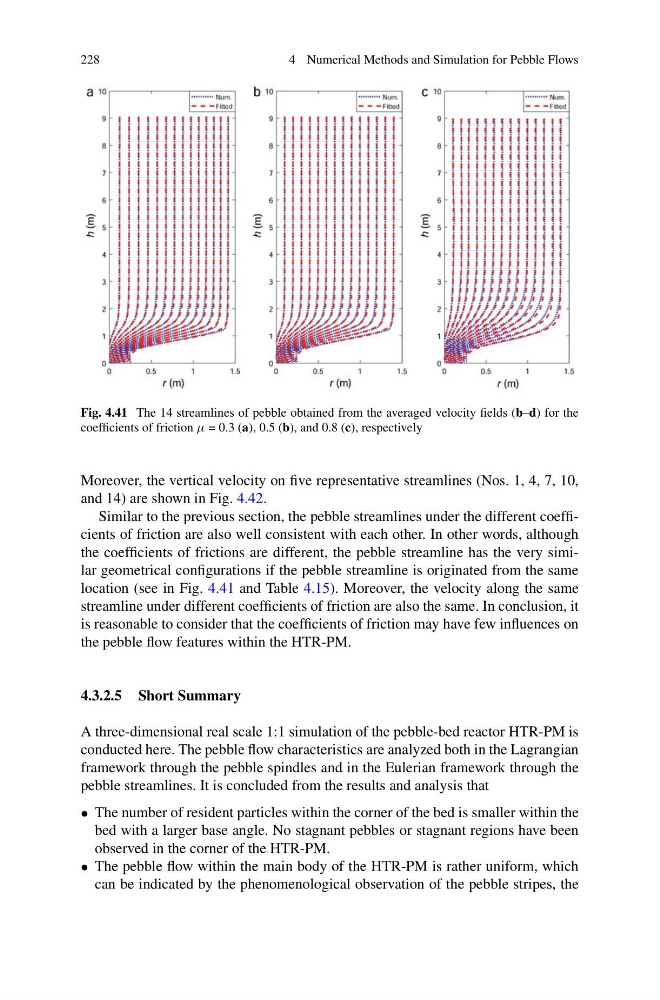
Fig. 4.41 The 14 streamlines of pebble obtained from the averaged velocity fields (b–d) for the
coefficients of friction μ = 0.3 (a), 0.5 (b), and 0.8 (c), respectively
Moreover, the vertical velocity on five representative streamlines (Nos. 1, 4, 7, 10,
and 14) are shown in Fig. 4.42.
Similar to the previous section, the pebble streamlines under the different coefficients of friction are also well consistent with each other. In other words, although
the coefficients of frictions are different, the pebble streamline has the very similar geometrical configurations if the pebble streamline is originated from the same
location (see in Fig. 4.41 and Table 4.15). Moreover, the velocity along the same
streamline under different coefficients of friction are also the same. In conclusion, it
is reasonable to consider that the coefficients of friction may have few influences on
the pebble flow features within the HTR-PM.
4.3.2.5 Short Summary
A three-dimensional real scale 1:1 simulation of the pebble-bed reactor HTR-PM is
conducted here. The pebble flow characteristics are analyzed both in the Lagrangian
framework through the pebble spindles and in the Eulerian framework through the
pebble streamlines. It is concluded from the results and analysis that
• The number of resident particles within the corner of the bed is smaller within the
bed with a larger base angle. No stagnant pebbles or stagnant regions have been
observed in the corner of the HTR-PM.
• The pebble flow within the main body of the HTR-PM is rather uniform, which
can be indicated by the phenomenological observation of the pebble stripes, the
4 Numerical Methods and Simulation for Pebble Flows
Fig. 4.41 The 14 streamlines of pebble obtained from the averaged velocity fields (b–d) for the
coefficients of friction μ = 0.3 (a), 0.5 (b), and 0.8 (c), respectively
Moreover, the vertical velocity on five representative streamlines (Nos. 1, 4, 7, 10,
and 14) are shown in Fig. 4.42.
Similar to the previous section, the pebble streamlines under the different coefficients of friction are also well consistent with each other. In other words, although
the coefficients of frictions are different, the pebble streamline has the very similar geometrical configurations if the pebble streamline is originated from the same
location (see in Fig. 4.41 and Table 4.15). Moreover, the velocity along the same
streamline under different coefficients of friction are also the same. In conclusion, it
is reasonable to consider that the coefficients of friction may have few influences on
the pebble flow features within the HTR-PM.
4.3.2.5 Short Summary
A three-dimensional real scale 1:1 simulation of the pebble-bed reactor HTR-PM is
conducted here. The pebble flow characteristics are analyzed both in the Lagrangian
framework through the pebble spindles and in the Eulerian framework through the
pebble streamlines. It is concluded from the results and analysis that
• The number of resident particles within the corner of the bed is smaller within the
bed with a larger base angle. No stagnant pebbles or stagnant regions have been
observed in the corner of the HTR-PM.
• The pebble flow within the main body of the HTR-PM is rather uniform, which
can be indicated by the phenomenological observation of the pebble stripes, the