

4.3 Three-Dimensional Pebble Flow
211
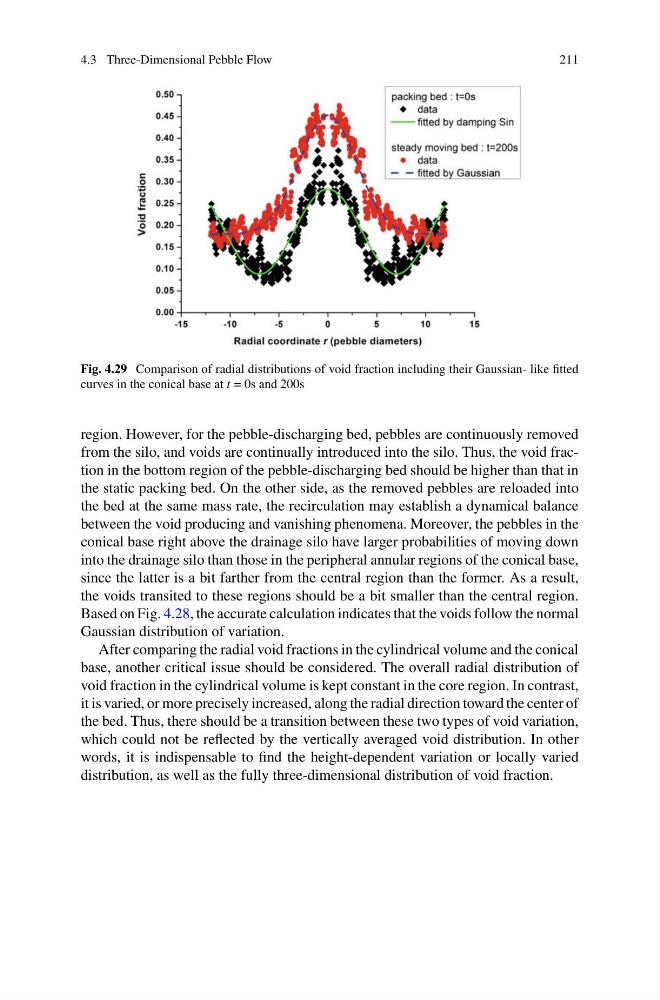
Fig. 4.29 Comparison of radial distributions of void fraction including their Gaussian- like fitted
curves in the conical base at t = 0s and 200s
region. However, for the pebble-discharging bed, pebbles are continuously removed
from the silo, and voids are continually introduced into the silo. Thus, the void fraction in the bottom region of the pebble-discharging bed should be higher than that in
the static packing bed. On the other side, as the removed pebbles are reloaded into
the bed at the same mass rate, the recirculation may establish a dynamical balance
between the void producing and vanishing phenomena. Moreover, the pebbles in the
conical base right above the drainage silo have larger probabilities of moving down
into the drainage silo than those in the peripheral annular regions of the conical base,
since the latter is a bit farther from the central region than the former. As a result,
the voids transited to these regions should be a bit smaller than the central region.
Based on Fig. 4.28, the accurate calculation indicates that the voids follow the normal
Gaussian distribution of variation.
After comparing the radial void fractions in the cylindrical volume and the conical
base, another critical issue should be considered. The overall radial distribution of
void fraction in the cylindrical volume is kept constant in the core region. In contrast,
it is varied, or more precisely increased, along the radial direction toward the center of
the bed. Thus, there should be a transition between these two types of void variation,
which could not be reflected by the vertically averaged void distribution. In other
words, it is indispensable to find the height-dependent variation or locally varied
distribution, as well as the fully three-dimensional distribution of void fraction.
211
Fig. 4.29 Comparison of radial distributions of void fraction including their Gaussian- like fitted
curves in the conical base at t = 0s and 200s
region. However, for the pebble-discharging bed, pebbles are continuously removed
from the silo, and voids are continually introduced into the silo. Thus, the void fraction in the bottom region of the pebble-discharging bed should be higher than that in
the static packing bed. On the other side, as the removed pebbles are reloaded into
the bed at the same mass rate, the recirculation may establish a dynamical balance
between the void producing and vanishing phenomena. Moreover, the pebbles in the
conical base right above the drainage silo have larger probabilities of moving down
into the drainage silo than those in the peripheral annular regions of the conical base,
since the latter is a bit farther from the central region than the former. As a result,
the voids transited to these regions should be a bit smaller than the central region.
Based on Fig. 4.28, the accurate calculation indicates that the voids follow the normal
Gaussian distribution of variation.
After comparing the radial void fractions in the cylindrical volume and the conical
base, another critical issue should be considered. The overall radial distribution of
void fraction in the cylindrical volume is kept constant in the core region. In contrast,
it is varied, or more precisely increased, along the radial direction toward the center of
the bed. Thus, there should be a transition between these two types of void variation,
which could not be reflected by the vertically averaged void distribution. In other
words, it is indispensable to find the height-dependent variation or locally varied
distribution, as well as the fully three-dimensional distribution of void fraction.