

210
4 Numerical Methods and Simulation for Pebble Flows
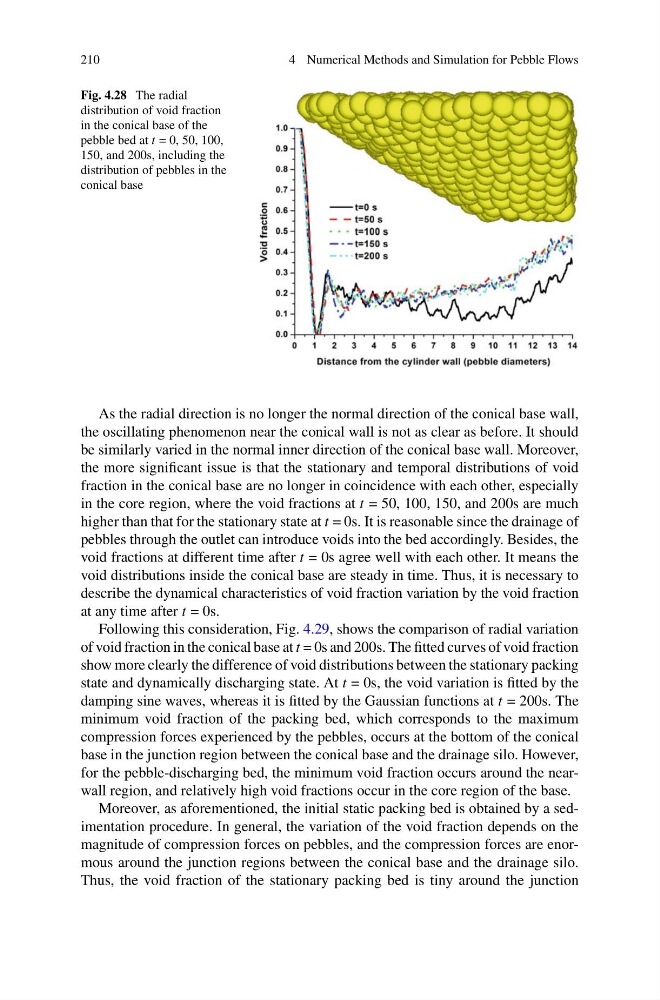
Fig. 4.28 The radial
distribution of void fraction
in the conical base of the
pebble bed at t = 0, 50, 100,
150, and 200s, including the
distribution of pebbles in the
conical base
As the radial direction is no longer the normal direction of the conical base wall,
the oscillating phenomenon near the conical wall is not as clear as before. It should
be similarly varied in the normal inner direction of the conical base wall. Moreover,
the more significant issue is that the stationary and temporal distributions of void
fraction in the conical base are no longer in coincidence with each other, especially
in the core region, where the void fractions at t = 50, 100, 150, and 200s are much
higher than that for the stationary state at t = 0s. It is reasonable since the drainage of
pebbles through the outlet can introduce voids into the bed accordingly. Besides, the
void fractions at different time after t = 0s agree well with each other. It means the
void distributions inside the conical base are steady in time. Thus, it is necessary to
describe the dynamical characteristics of void fraction variation by the void fraction
at any time after t = 0s.
Following this consideration, Fig. 4.29, shows the comparison of radial variation
of void fraction in the conical base at t = 0s and 200s. The fitted curves of void fraction
show more clearly the difference of void distributions between the stationary packing
state and dynamically discharging state. At t = 0s, the void variation is fitted by the
damping sine waves, whereas it is fitted by the Gaussian functions at t = 200s. The
minimum void fraction of the packing bed, which corresponds to the maximum
compression forces experienced by the pebbles, occurs at the bottom of the conical
base in the junction region between the conical base and the drainage silo. However,
for the pebble-discharging bed, the minimum void fraction occurs around the nearwall region, and relatively high void fractions occur in the core region of the base.
Moreover, as aforementioned, the initial static packing bed is obtained by a sedimentation procedure. In general, the variation of the void fraction depends on the
magnitude of compression forces on pebbles, and the compression forces are enormous around the junction regions between the conical base and the drainage silo.
Thus, the void fraction of the stationary packing bed is tiny around the junction
4 Numerical Methods and Simulation for Pebble Flows
Fig. 4.28 The radial
distribution of void fraction
in the conical base of the
pebble bed at t = 0, 50, 100,
150, and 200s, including the
distribution of pebbles in the
conical base
As the radial direction is no longer the normal direction of the conical base wall,
the oscillating phenomenon near the conical wall is not as clear as before. It should
be similarly varied in the normal inner direction of the conical base wall. Moreover,
the more significant issue is that the stationary and temporal distributions of void
fraction in the conical base are no longer in coincidence with each other, especially
in the core region, where the void fractions at t = 50, 100, 150, and 200s are much
higher than that for the stationary state at t = 0s. It is reasonable since the drainage of
pebbles through the outlet can introduce voids into the bed accordingly. Besides, the
void fractions at different time after t = 0s agree well with each other. It means the
void distributions inside the conical base are steady in time. Thus, it is necessary to
describe the dynamical characteristics of void fraction variation by the void fraction
at any time after t = 0s.
Following this consideration, Fig. 4.29, shows the comparison of radial variation
of void fraction in the conical base at t = 0s and 200s. The fitted curves of void fraction
show more clearly the difference of void distributions between the stationary packing
state and dynamically discharging state. At t = 0s, the void variation is fitted by the
damping sine waves, whereas it is fitted by the Gaussian functions at t = 200s. The
minimum void fraction of the packing bed, which corresponds to the maximum
compression forces experienced by the pebbles, occurs at the bottom of the conical
base in the junction region between the conical base and the drainage silo. However,
for the pebble-discharging bed, the minimum void fraction occurs around the nearwall region, and relatively high void fractions occur in the core region of the base.
Moreover, as aforementioned, the initial static packing bed is obtained by a sedimentation procedure. In general, the variation of the void fraction depends on the
magnitude of compression forces on pebbles, and the compression forces are enormous around the junction regions between the conical base and the drainage silo.
Thus, the void fraction of the stationary packing bed is tiny around the junction