

4.3 Three-Dimensional Pebble Flow
209
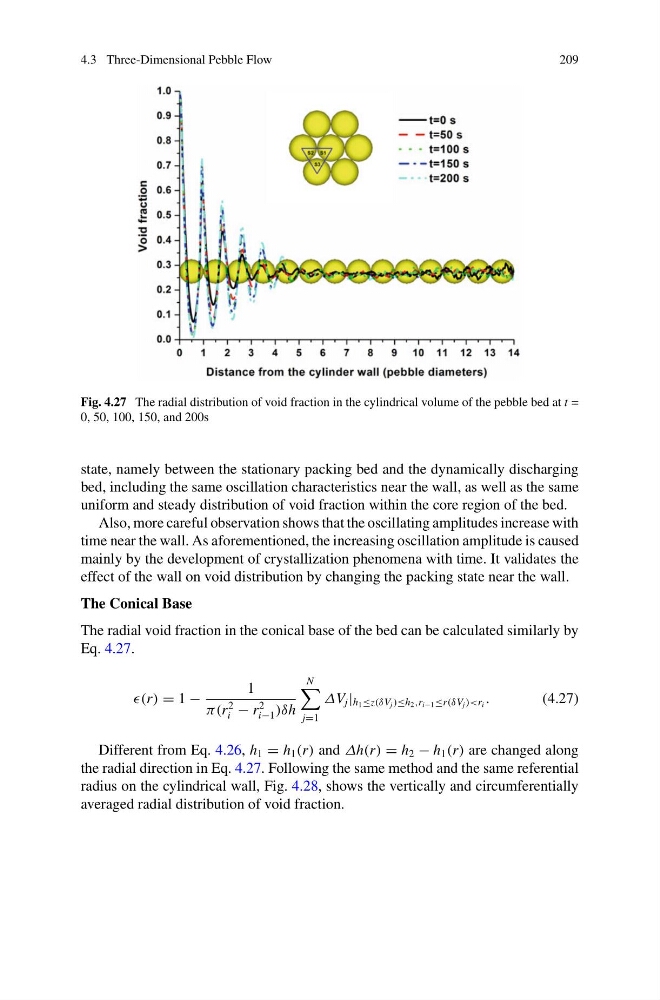
Fig. 4.27 The radial distribution of void fraction in the cylindrical volume of the pebble bed at t =
0, 50, 100, 150, and 200s
state, namely between the stationary packing bed and the dynamically discharging
bed, including the same oscillation characteristics near the wall, as well as the same
uniform and steady distribution of void fraction within the core region of the bed.
Also, more careful observation shows that the oscillating amplitudes increase with
time near the wall. As aforementioned, the increasing oscillation amplitude is caused
mainly by the development of crystallization phenomena with time. It validates the
effect of the wall on void distribution by changing the packing state near the wall.
The Conical Base
The radial void fraction in the conical base of the bed can be calculated similarly by
Eq. 4.27.
(r) = 1 −
1
π(r
2
i − r
2
i−1 )δh
N
j=1
ΔV j | h 1 ≤z(δV j )≤h 2 ,r i−1 ≤r(δV j )
Different from Eq. 4.26, h 1 = h 1 (r) and Δh(r) = h 2 − h 1 (r) are changed along
the radial direction in Eq. 4.27. Following the same method and the same referential
radius on the cylindrical wall, Fig. 4.28, shows the vertically and circumferentially
averaged radial distribution of void fraction.
209
Fig. 4.27 The radial distribution of void fraction in the cylindrical volume of the pebble bed at t =
0, 50, 100, 150, and 200s
state, namely between the stationary packing bed and the dynamically discharging
bed, including the same oscillation characteristics near the wall, as well as the same
uniform and steady distribution of void fraction within the core region of the bed.
Also, more careful observation shows that the oscillating amplitudes increase with
time near the wall. As aforementioned, the increasing oscillation amplitude is caused
mainly by the development of crystallization phenomena with time. It validates the
effect of the wall on void distribution by changing the packing state near the wall.
The Conical Base
The radial void fraction in the conical base of the bed can be calculated similarly by
Eq. 4.27.
(r) = 1 −
1
π(r
2
i − r
2
i−1 )δh
N
j=1
ΔV j | h 1 ≤z(δV j )≤h 2 ,r i−1 ≤r(δV j )
Different from Eq. 4.26, h 1 = h 1 (r) and Δh(r) = h 2 − h 1 (r) are changed along
the radial direction in Eq. 4.27. Following the same method and the same referential
radius on the cylindrical wall, Fig. 4.28, shows the vertically and circumferentially
averaged radial distribution of void fraction.