

4.2 Gravity-Driven Flow Regime Characterization
193
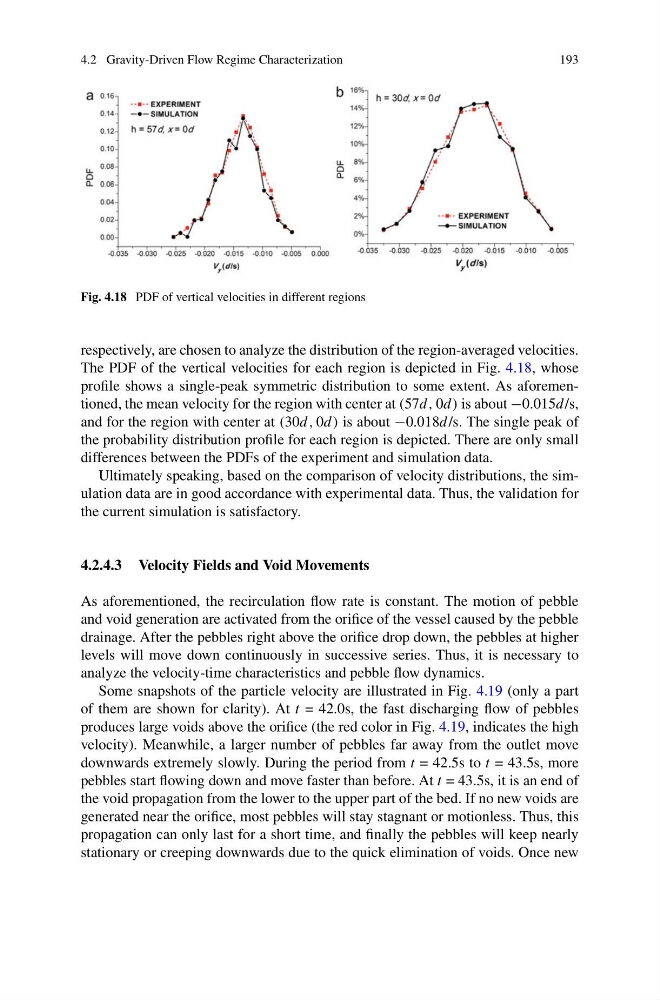
Fig. 4.18 PDF of vertical velocities in different regions
respectively, are chosen to analyze the distribution of the region-averaged velocities.
The PDF of the vertical velocities for each region is depicted in Fig. 4.18, whose
profile shows a single-peak symmetric distribution to some extent. As aforementioned, the mean velocity for the region with center at (57d , 0d ) is about −0.015d /s,
and for the region with center at (30d , 0d ) is about −0.018d /s. The single peak of
the probability distribution profile for each region is depicted. There are only small
differences between the PDFs of the experiment and simulation data.
Ultimately speaking, based on the comparison of velocity distributions, the simulation data are in good accordance with experimental data. Thus, the validation for
the current simulation is satisfactory.
4.2.4.3 Velocity Fields and Void Movements
As aforementioned, the recirculation flow rate is constant. The motion of pebble
and void generation are activated from the orifice of the vessel caused by the pebble
drainage. After the pebbles right above the orifice drop down, the pebbles at higher
levels will move down continuously in successive series. Thus, it is necessary to
analyze the velocity-time characteristics and pebble flow dynamics.
Some snapshots of the particle velocity are illustrated in Fig. 4.19 (only a part
of them are shown for clarity). At t = 42.0s, the fast discharging flow of pebbles
produces large voids above the orifice (the red color in Fig. 4.19, indicates the high
velocity). Meanwhile, a larger number of pebbles far away from the outlet move
downwards extremely slowly. During the period from t = 42.5s to t = 43.5s, more
pebbles start flowing down and move faster than before. At t = 43.5s, it is an end of
the void propagation from the lower to the upper part of the bed. If no new voids are
generated near the orifice, most pebbles will stay stagnant or motionless. Thus, this
propagation can only last for a short time, and finally the pebbles will keep nearly
stationary or creeping downwards due to the quick elimination of voids. Once new
193
Fig. 4.18 PDF of vertical velocities in different regions
respectively, are chosen to analyze the distribution of the region-averaged velocities.
The PDF of the vertical velocities for each region is depicted in Fig. 4.18, whose
profile shows a single-peak symmetric distribution to some extent. As aforementioned, the mean velocity for the region with center at (57d , 0d ) is about −0.015d /s,
and for the region with center at (30d , 0d ) is about −0.018d /s. The single peak of
the probability distribution profile for each region is depicted. There are only small
differences between the PDFs of the experiment and simulation data.
Ultimately speaking, based on the comparison of velocity distributions, the simulation data are in good accordance with experimental data. Thus, the validation for
the current simulation is satisfactory.
4.2.4.3 Velocity Fields and Void Movements
As aforementioned, the recirculation flow rate is constant. The motion of pebble
and void generation are activated from the orifice of the vessel caused by the pebble
drainage. After the pebbles right above the orifice drop down, the pebbles at higher
levels will move down continuously in successive series. Thus, it is necessary to
analyze the velocity-time characteristics and pebble flow dynamics.
Some snapshots of the particle velocity are illustrated in Fig. 4.19 (only a part
of them are shown for clarity). At t = 42.0s, the fast discharging flow of pebbles
produces large voids above the orifice (the red color in Fig. 4.19, indicates the high
velocity). Meanwhile, a larger number of pebbles far away from the outlet move
downwards extremely slowly. During the period from t = 42.5s to t = 43.5s, more
pebbles start flowing down and move faster than before. At t = 43.5s, it is an end of
the void propagation from the lower to the upper part of the bed. If no new voids are
generated near the orifice, most pebbles will stay stagnant or motionless. Thus, this
propagation can only last for a short time, and finally the pebbles will keep nearly
stationary or creeping downwards due to the quick elimination of voids. Once new