

130
3 Experiments in Pebble Bed Heat Transfer
problem in Eq. (3.2), is calculated by interpolation. T2–T5 points are applied as the
Y in Eq. (3.11), to correct the calculated T ( P).
The Inverse Heat Transfer Problems (IHCPs) are generally ill-posed, and the
experimental errors, as well as inappropriate initial value, can result in a failure in the
iteration. Since the LM method is a local optimization algorithm, the S may stop at an
optimal local value rather than an optimal global value representing an actual solution.
The inverse method often generates an incorrect result with an arbitrary initial value.
Consequently, considering the intrinsic physical effect of the thermal diffusivity, an
integration equivalence principle is proposed to determine a proper initial value and
to avoid falling into inauthentic local results. The confirming procedure of quadratic
polynomial is described as follows:
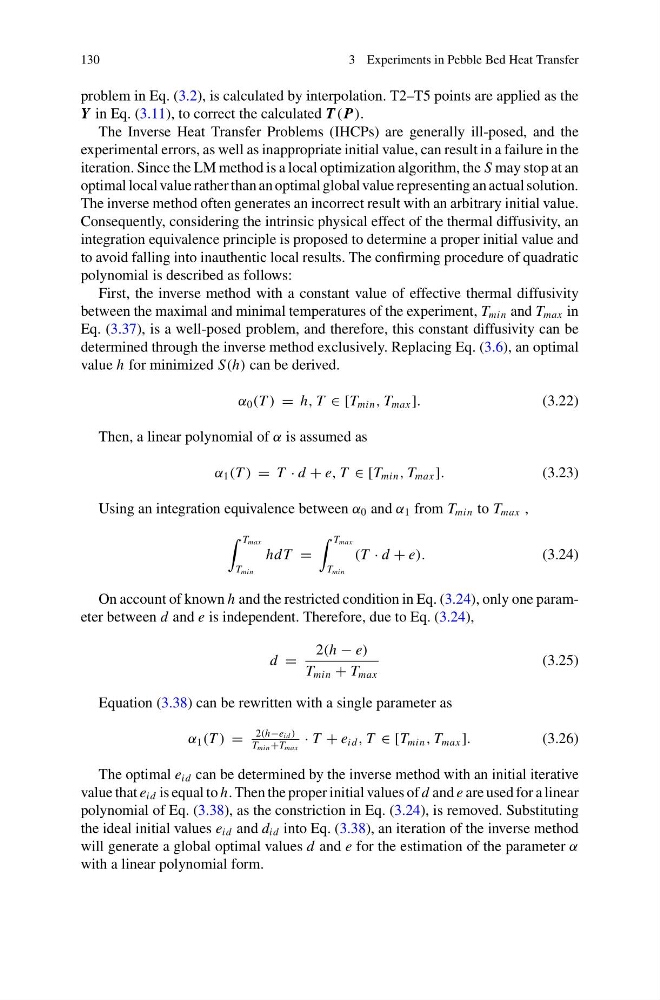
First, the inverse method with a constant value of effective thermal diffusivity
between the maximal and minimal temperatures of the experiment, T min and T max in
Eq. (3.37), is a well-posed problem, and therefore, this constant diffusivity can be
determined through the inverse method exclusively. Replacing Eq. (3.6), an optimal
value h for minimized S(h) can be derived.
α 0 (T ) = h, T ∈ [T min , T max ].
(3.22)
Then, a linear polynomial of α is assumed as
α 1 (T ) = T · d + e, T ∈ [T min , T max ].
(3.23)
Using an integration equivalence between α 0 and α 1 from T min to T max ,
T max
T min
hdT =
T max
T min
(T · d + e).
(3.24)
On account of known h and the restricted condition in Eq. (3.24), only one parameter between d and e is independent. Therefore, due to Eq. (3.24),
d =
2(h − e)
T min + T max
(3.25)
Equation (3.38) can be rewritten with a single parameter as
α 1 (T ) =
2(h−e id )
T min +T max
· T + e id , T ∈ [T min , T max ].
(3.26)
The optimal e id can be determined by the inverse method with an initial iterative
value that e id is equal to h. Then the proper initial values of d and e are used for a linear
polynomial of Eq. (3.38), as the constriction in Eq. (3.24), is removed. Substituting
the ideal initial values e id and d id into Eq. (3.38), an iteration of the inverse method
will generate a global optimal values d and e for the estimation of the parameter α
with a linear polynomial form.
3 Experiments in Pebble Bed Heat Transfer
problem in Eq. (3.2), is calculated by interpolation. T2–T5 points are applied as the
Y in Eq. (3.11), to correct the calculated T ( P).
The Inverse Heat Transfer Problems (IHCPs) are generally ill-posed, and the
experimental errors, as well as inappropriate initial value, can result in a failure in the
iteration. Since the LM method is a local optimization algorithm, the S may stop at an
optimal local value rather than an optimal global value representing an actual solution.
The inverse method often generates an incorrect result with an arbitrary initial value.
Consequently, considering the intrinsic physical effect of the thermal diffusivity, an
integration equivalence principle is proposed to determine a proper initial value and
to avoid falling into inauthentic local results. The confirming procedure of quadratic
polynomial is described as follows:
First, the inverse method with a constant value of effective thermal diffusivity
between the maximal and minimal temperatures of the experiment, T min and T max in
Eq. (3.37), is a well-posed problem, and therefore, this constant diffusivity can be
determined through the inverse method exclusively. Replacing Eq. (3.6), an optimal
value h for minimized S(h) can be derived.
α 0 (T ) = h, T ∈ [T min , T max ].
(3.22)
Then, a linear polynomial of α is assumed as
α 1 (T ) = T · d + e, T ∈ [T min , T max ].
(3.23)
Using an integration equivalence between α 0 and α 1 from T min to T max ,
T max
T min
hdT =
T max
T min
(T · d + e).
(3.24)
On account of known h and the restricted condition in Eq. (3.24), only one parameter between d and e is independent. Therefore, due to Eq. (3.24),
d =
2(h − e)
T min + T max
(3.25)
Equation (3.38) can be rewritten with a single parameter as
α 1 (T ) =
2(h−e id )
T min +T max
· T + e id , T ∈ [T min , T max ].
(3.26)
The optimal e id can be determined by the inverse method with an initial iterative
value that e id is equal to h. Then the proper initial values of d and e are used for a linear
polynomial of Eq. (3.38), as the constriction in Eq. (3.24), is removed. Substituting
the ideal initial values e id and d id into Eq. (3.38), an iteration of the inverse method
will generate a global optimal values d and e for the estimation of the parameter α
with a linear polynomial form.