

3.2 Experimental Facility and Methodology
131
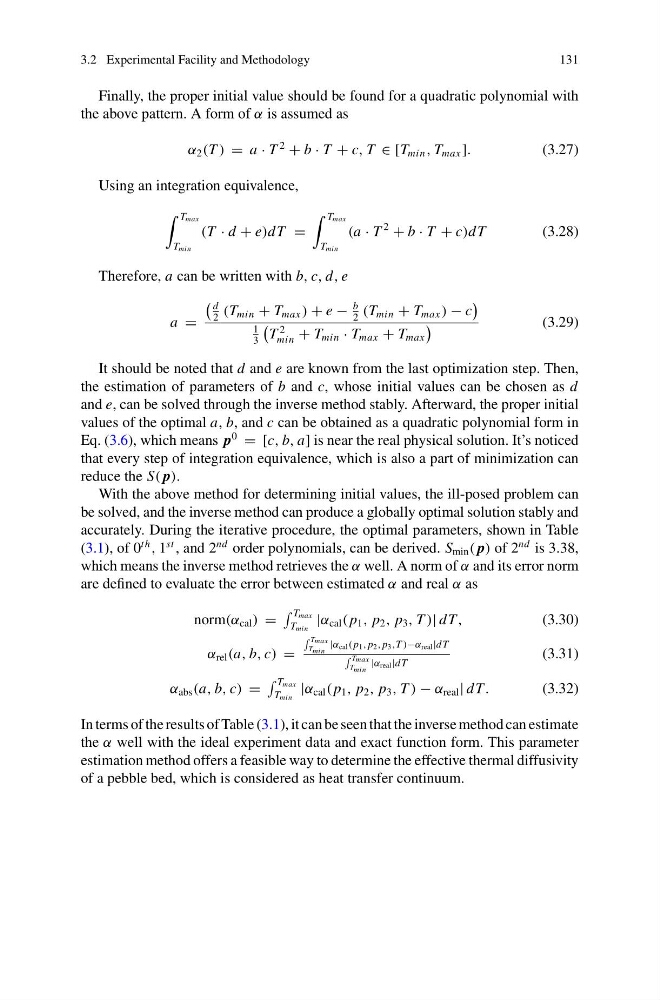
Finally, the proper initial value should be found for a quadratic polynomial with
the above pattern. A form of α is assumed as
α 2 (T ) = a · T
2
+ b · T + c, T ∈ [T min , T max ].
(3.27)
Using an integration equivalence,
T max
T min
(T · d + e)dT =
T max
T min
(a · T
2
+ b · T + c)dT
(3.28)
Therefore, a can be written with b, c, d, e
a =
d
2 (T min + T max ) + e −
b
2 (T min + T max ) − c
1
3
T
2
min + T min · T max + T max
(3.29)
It should be noted that d and e are known from the last optimization step. Then,
the estimation of parameters of b and c, whose initial values can be chosen as d
and e, can be solved through the inverse method stably. Afterward, the proper initial
values of the optimal a, b, and c can be obtained as a quadratic polynomial form in
Eq. (3.6), which means p
0
= [c, b, a] is near the real physical solution. It’s noticed
that every step of integration equivalence, which is also a part of minimization can
reduce the S( p).
With the above method for determining initial values, the ill-posed problem can
be solved, and the inverse method can produce a globally optimal solution stably and
accurately. During the iterative procedure, the optimal parameters, shown in Table
(3.1), of 0
th
, 1
st , and 2
nd order polynomials, can be derived. S min ( p) of 2
nd is 3.38,
which means the inverse method retrieves the α well. A norm of α and its error norm
are defined to evaluate the error between estimated α and real α as
norm(α cal ) =
T max
T min
|α cal ( p 1 , p 2 , p 3 , T )| dT,
(3.30)
α rel (a, b, c) =
Tmax
T min
|α cal ( p 1 , p 2 , p 3 ,T )−α real |dT
Tmax
T min
|α real |dT
(3.31)
α abs (a, b, c) =
T max
T min
|α cal ( p 1 , p 2 , p 3 , T ) − α real | dT.
(3.32)
In terms of the results of Table (3.1), it can be seen that the inverse method can estimate
the α well with the ideal experiment data and exact function form. This parameter
estimation method offers a feasible way to determine the effective thermal diffusivity
of a pebble bed, which is considered as heat transfer continuum.
131
Finally, the proper initial value should be found for a quadratic polynomial with
the above pattern. A form of α is assumed as
α 2 (T ) = a · T
2
+ b · T + c, T ∈ [T min , T max ].
(3.27)
Using an integration equivalence,
T max
T min
(T · d + e)dT =
T max
T min
(a · T
2
+ b · T + c)dT
(3.28)
Therefore, a can be written with b, c, d, e
a =
d
2 (T min + T max ) + e −
b
2 (T min + T max ) − c
1
3
T
2
min + T min · T max + T max
(3.29)
It should be noted that d and e are known from the last optimization step. Then,
the estimation of parameters of b and c, whose initial values can be chosen as d
and e, can be solved through the inverse method stably. Afterward, the proper initial
values of the optimal a, b, and c can be obtained as a quadratic polynomial form in
Eq. (3.6), which means p
0
= [c, b, a] is near the real physical solution. It’s noticed
that every step of integration equivalence, which is also a part of minimization can
reduce the S( p).
With the above method for determining initial values, the ill-posed problem can
be solved, and the inverse method can produce a globally optimal solution stably and
accurately. During the iterative procedure, the optimal parameters, shown in Table
(3.1), of 0
th
, 1
st , and 2
nd order polynomials, can be derived. S min ( p) of 2
nd is 3.38,
which means the inverse method retrieves the α well. A norm of α and its error norm
are defined to evaluate the error between estimated α and real α as
norm(α cal ) =
T max
T min
|α cal ( p 1 , p 2 , p 3 , T )| dT,
(3.30)
α rel (a, b, c) =
Tmax
T min
|α cal ( p 1 , p 2 , p 3 ,T )−α real |dT
Tmax
T min
|α real |dT
(3.31)
α abs (a, b, c) =
T max
T min
|α cal ( p 1 , p 2 , p 3 , T ) − α real | dT.
(3.32)
In terms of the results of Table (3.1), it can be seen that the inverse method can estimate
the α well with the ideal experiment data and exact function form. This parameter
estimation method offers a feasible way to determine the effective thermal diffusivity
of a pebble bed, which is considered as heat transfer continuum.