

2.5 Particle Velocimetry Measurements
107
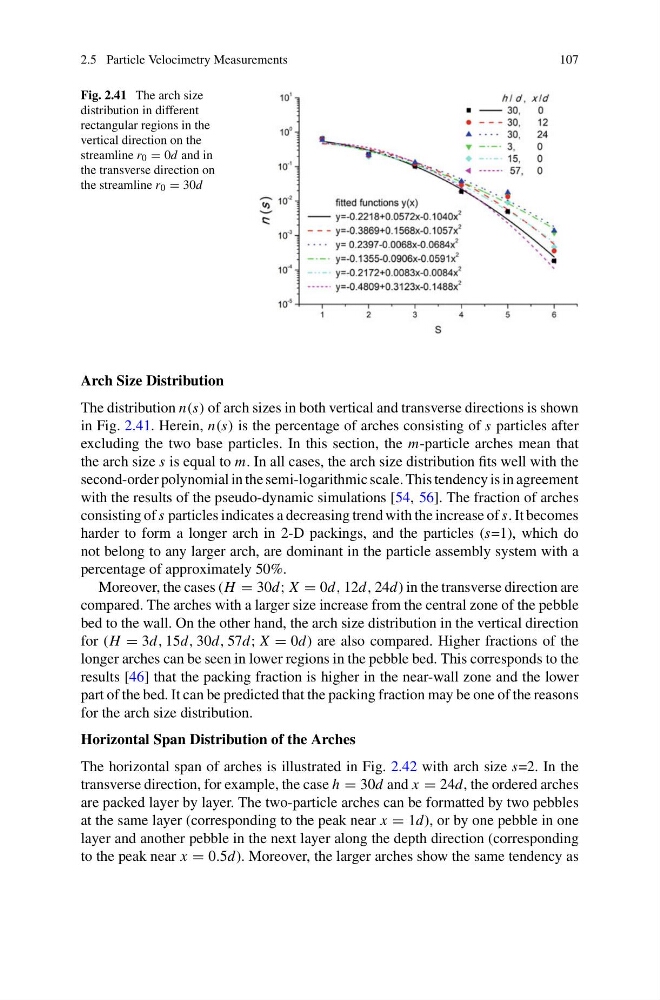
Fig. 2.41 The arch size
distribution in different
rectangular regions in the
vertical direction on the
streamline r 0 = 0d and in
the transverse direction on
the streamline r 0 = 30d
Arch Size Distribution
The distribution n(s) of arch sizes in both vertical and transverse directions is shown
in Fig. 2.41. Herein, n(s) is the percentage of arches consisting of s particles after
excluding the two base particles. In this section, the m-particle arches mean that
the arch size s is equal to m. In all cases, the arch size distribution fits well with the
second-order polynomial in the semi-logarithmic scale. This tendency is in agreement
with the results of the pseudo-dynamic simulations [54, 56]. The fraction of arches
consisting of s particles indicates a decreasing trend with the increase of s. It becomes
harder to form a longer arch in 2-D packings, and the particles (s=1), which do
not belong to any larger arch, are dominant in the particle assembly system with a
percentage of approximately 50%.
Moreover, the cases (H = 30d; X = 0d, 12d, 24d) in the transverse direction are
compared. The arches with a larger size increase from the central zone of the pebble
bed to the wall. On the other hand, the arch size distribution in the vertical direction
for (H = 3d, 15d, 30d, 57d; X = 0d) are also compared. Higher fractions of the
longer arches can be seen in lower regions in the pebble bed. This corresponds to the
results [46] that the packing fraction is higher in the near-wall zone and the lower
part of the bed. It can be predicted that the packing fraction may be one of the reasons
for the arch size distribution.
Horizontal Span Distribution of the Arches
The horizontal span of arches is illustrated in Fig. 2.42 with arch size s=2. In the
transverse direction, for example, the case h = 30d and x = 24d, the ordered arches
are packed layer by layer. The two-particle arches can be formatted by two pebbles
at the same layer (corresponding to the peak near x = 1d), or by one pebble in one
layer and another pebble in the next layer along the depth direction (corresponding
to the peak near x = 0.5d). Moreover, the larger arches show the same tendency as
107
Fig. 2.41 The arch size
distribution in different
rectangular regions in the
vertical direction on the
streamline r 0 = 0d and in
the transverse direction on
the streamline r 0 = 30d
Arch Size Distribution
The distribution n(s) of arch sizes in both vertical and transverse directions is shown
in Fig. 2.41. Herein, n(s) is the percentage of arches consisting of s particles after
excluding the two base particles. In this section, the m-particle arches mean that
the arch size s is equal to m. In all cases, the arch size distribution fits well with the
second-order polynomial in the semi-logarithmic scale. This tendency is in agreement
with the results of the pseudo-dynamic simulations [54, 56]. The fraction of arches
consisting of s particles indicates a decreasing trend with the increase of s. It becomes
harder to form a longer arch in 2-D packings, and the particles (s=1), which do
not belong to any larger arch, are dominant in the particle assembly system with a
percentage of approximately 50%.
Moreover, the cases (H = 30d; X = 0d, 12d, 24d) in the transverse direction are
compared. The arches with a larger size increase from the central zone of the pebble
bed to the wall. On the other hand, the arch size distribution in the vertical direction
for (H = 3d, 15d, 30d, 57d; X = 0d) are also compared. Higher fractions of the
longer arches can be seen in lower regions in the pebble bed. This corresponds to the
results [46] that the packing fraction is higher in the near-wall zone and the lower
part of the bed. It can be predicted that the packing fraction may be one of the reasons
for the arch size distribution.
Horizontal Span Distribution of the Arches
The horizontal span of arches is illustrated in Fig. 2.42 with arch size s=2. In the
transverse direction, for example, the case h = 30d and x = 24d, the ordered arches
are packed layer by layer. The two-particle arches can be formatted by two pebbles
at the same layer (corresponding to the peak near x = 1d), or by one pebble in one
layer and another pebble in the next layer along the depth direction (corresponding
to the peak near x = 0.5d). Moreover, the larger arches show the same tendency as