

3.3 Properties of χ (2)
67
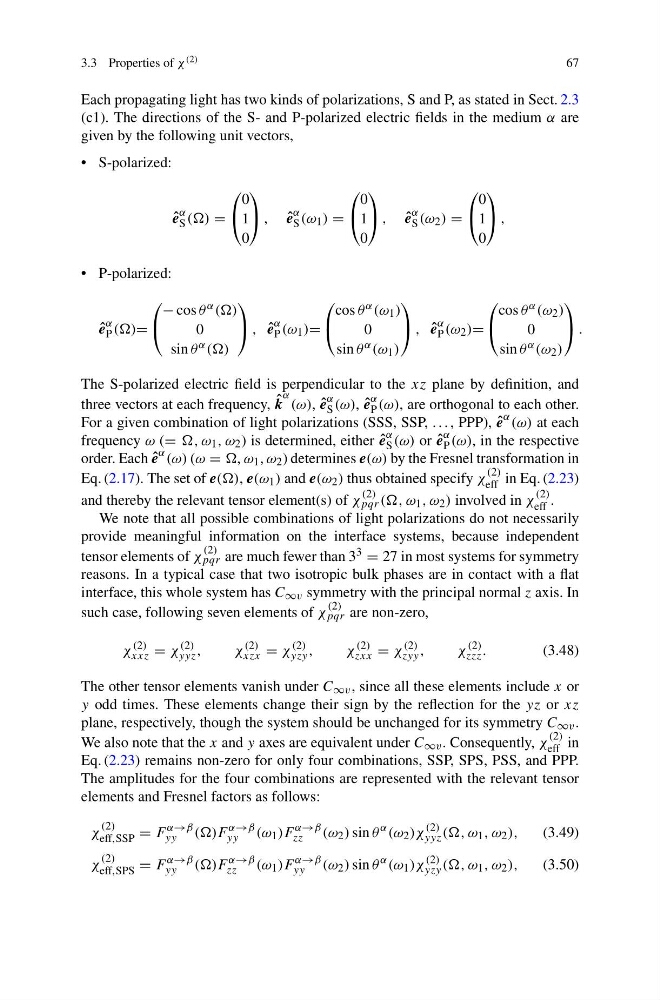
Each propagating light has two kinds of polarizations, S and P, as stated in Sect. 2.3
(c1). The directions of the S- and P-polarized electric fields in the medium α are
given by the following unit vectors,
• S-polarized:
ˆ
e
α
S (() =
⎛
⎝
0
1
0
⎞
⎠ , ˆ
e
α
S (ω 1 ) =
⎛
⎝
0
1
0
⎞
⎠ , ˆ
e
α
S (ω 2 ) =
⎛
⎝
0
1
0
⎞
⎠ ,
• P-polarized:
ˆ
e
α
P (()=
⎛
⎝
− cos θ α (()
0
sin θ α (()
⎞
⎠ , ˆ
e
α
P (ω 1 )=
⎛
⎝
cos θ α (ω 1 )
0
sin θ α (ω 1 )
⎞
⎠ , ˆ
e
α
P (ω 2 )=
⎛
⎝
cos θ α (ω 2 )
0
sin θ α (ω 2 )
⎞
⎠ .
The S-polarized electric field is perpendicular to the xz plane by definition, and
three vectors at each frequency, ˆ
k
α
(ω), ˆ
e
α
S (ω), ˆ
e
α
P (ω), are orthogonal to each other.
For a given combination of light polarizations (SSS, SSP, . . . , PPP), ˆ
e
α (ω) at each
frequency ω (= ω 1 , ω 2 ) is determined, either ˆ
e
α
S (ω) or ˆ
e
α
P (ω), in the respective
order. Each ˆ
e
α (ω) (ω = , ω 1 , ω 2 ) determines e(ω) by the Fresnel transformation in
Eq. (2.17). The set of e((), e(ω 1 ) and e(ω 2 ) thus obtained specify χ
(2)
eff in Eq. (2.23)
and thereby the relevant tensor element(s) of χ
(2)
pqr ((, ω 1 , ω 2 ) involved in χ
(2)
eff .
We note that all possible combinations of light polarizations do not necessarily
provide meaningful information on the interface systems, because independent
tensor elements of χ
(2)
pqr are much fewer than 3 3 = 27 in most systems for symmetry
reasons. In a typical case that two isotropic bulk phases are in contact with a flat
interface, this whole system has C ∞v symmetry with the principal normal z axis. In
such case, following seven elements of χ
(2)
pqr are non-zero,
χ
(2)
xxz = χ
(2)
yyz ,
χ
(2)
xzx = χ
(2)
yzy ,
χ
(2)
zxx = χ
(2)
zyy ,
χ
(2)
zzz .
(3.48)
The other tensor elements vanish under C ∞v , since all these elements include x or
y odd times. These elements change their sign by the reflection for the yz or xz
plane, respectively, though the system should be unchanged for its symmetry C ∞v .
We also note that the x and y axes are equivalent under C ∞v . Consequently, χ
(2)
eff in
Eq. (2.23) remains non-zero for only four combinations, SSP, SPS, PSS, and PPP.
The amplitudes for the four combinations are represented with the relevant tensor
elements and Fresnel factors as follows:
χ
(2)
eff,SSP = F
α→β
yy
(()F
α→β
yy
(ω 1 )F
α→β
zz
(ω 2 ) sin θ
α (ω 2 )χ
(2)
yyz ((, ω 1 , ω 2 ),
(3.49)
χ
(2)
eff,SPS = F
α→β
yy
(()F
α→β
zz
(ω 1 )F
α→β
yy
(ω 2 ) sin θ
α (ω 1 )χ
(2)
yzy ((, ω 1 , ω 2 ),
(3.50)
67
Each propagating light has two kinds of polarizations, S and P, as stated in Sect. 2.3
(c1). The directions of the S- and P-polarized electric fields in the medium α are
given by the following unit vectors,
• S-polarized:
ˆ
e
α
S (() =
⎛
⎝
0
1
0
⎞
⎠ , ˆ
e
α
S (ω 1 ) =
⎛
⎝
0
1
0
⎞
⎠ , ˆ
e
α
S (ω 2 ) =
⎛
⎝
0
1
0
⎞
⎠ ,
• P-polarized:
ˆ
e
α
P (()=
⎛
⎝
− cos θ α (()
0
sin θ α (()
⎞
⎠ , ˆ
e
α
P (ω 1 )=
⎛
⎝
cos θ α (ω 1 )
0
sin θ α (ω 1 )
⎞
⎠ , ˆ
e
α
P (ω 2 )=
⎛
⎝
cos θ α (ω 2 )
0
sin θ α (ω 2 )
⎞
⎠ .
The S-polarized electric field is perpendicular to the xz plane by definition, and
three vectors at each frequency, ˆ
k
α
(ω), ˆ
e
α
S (ω), ˆ
e
α
P (ω), are orthogonal to each other.
For a given combination of light polarizations (SSS, SSP, . . . , PPP), ˆ
e
α (ω) at each
frequency ω (= ω 1 , ω 2 ) is determined, either ˆ
e
α
S (ω) or ˆ
e
α
P (ω), in the respective
order. Each ˆ
e
α (ω) (ω = , ω 1 , ω 2 ) determines e(ω) by the Fresnel transformation in
Eq. (2.17). The set of e((), e(ω 1 ) and e(ω 2 ) thus obtained specify χ
(2)
eff in Eq. (2.23)
and thereby the relevant tensor element(s) of χ
(2)
pqr ((, ω 1 , ω 2 ) involved in χ
(2)
eff .
We note that all possible combinations of light polarizations do not necessarily
provide meaningful information on the interface systems, because independent
tensor elements of χ
(2)
pqr are much fewer than 3 3 = 27 in most systems for symmetry
reasons. In a typical case that two isotropic bulk phases are in contact with a flat
interface, this whole system has C ∞v symmetry with the principal normal z axis. In
such case, following seven elements of χ
(2)
pqr are non-zero,
χ
(2)
xxz = χ
(2)
yyz ,
χ
(2)
xzx = χ
(2)
yzy ,
χ
(2)
zxx = χ
(2)
zyy ,
χ
(2)
zzz .
(3.48)
The other tensor elements vanish under C ∞v , since all these elements include x or
y odd times. These elements change their sign by the reflection for the yz or xz
plane, respectively, though the system should be unchanged for its symmetry C ∞v .
We also note that the x and y axes are equivalent under C ∞v . Consequently, χ
(2)
eff in
Eq. (2.23) remains non-zero for only four combinations, SSP, SPS, PSS, and PPP.
The amplitudes for the four combinations are represented with the relevant tensor
elements and Fresnel factors as follows:
χ
(2)
eff,SSP = F
α→β
yy
(()F
α→β
yy
(ω 1 )F
α→β
zz
(ω 2 ) sin θ
α (ω 2 )χ
(2)
yyz ((, ω 1 , ω 2 ),
(3.49)
χ
(2)
eff,SPS = F
α→β
yy
(()F
α→β
zz
(ω 1 )F
α→β
yy
(ω 2 ) sin θ
α (ω 1 )χ
(2)
yzy ((, ω 1 , ω 2 ),
(3.50)