

68
3 Microscopic Expressions of Nonlinear Polarization
χ
(2)
eff,PSS = F
α→β
zz
(()F
α→β
yy
(ω 1 )F
α→β
yy
(ω 2 ) sin θ
α (()χ
(2)
zyy ((, ω 1 , ω 2 ),
(3.51)
χ
(2)
eff,PPP =
−F
α→β
xx
(()F
α→β
xx
(ω 1 )F
α→β
zz
(ω 2 ) cos θ
α (() cos θ
α (ω 1 ) sin θ
α (ω 2 )χ
(2)
xxz ((,ω 1 ,ω 2 )
−F
α→β
xx
(()F
α→β
zz
(ω 1 )F
α→β
xx
(ω 2 ) cos θ
α (() sin θ
α (ω 1 ) cos θ
α (ω 2 )χ
(2)
xzx ((,ω 1 ,ω 2 )
+F
α→β
zz
(()F
α→β
xx
(ω 1 )F
α→β
xx
(ω 2 ) sin θ
α (() cos θ
α (ω 1 ) cos θ
α (ω 2 )χ
(2)
zxx ((,ω 1 ,ω 2 )
+F
α→β
zz
(()F
α→β
zz
(ω 1 )F
α→β
zz
(ω 2 ) sin θ
α (() sin θ
α (ω 1 ) sin θ
α (ω 2 )χ
(2)
zzz ((,ω 1 ,ω 2 ).
(3.52)
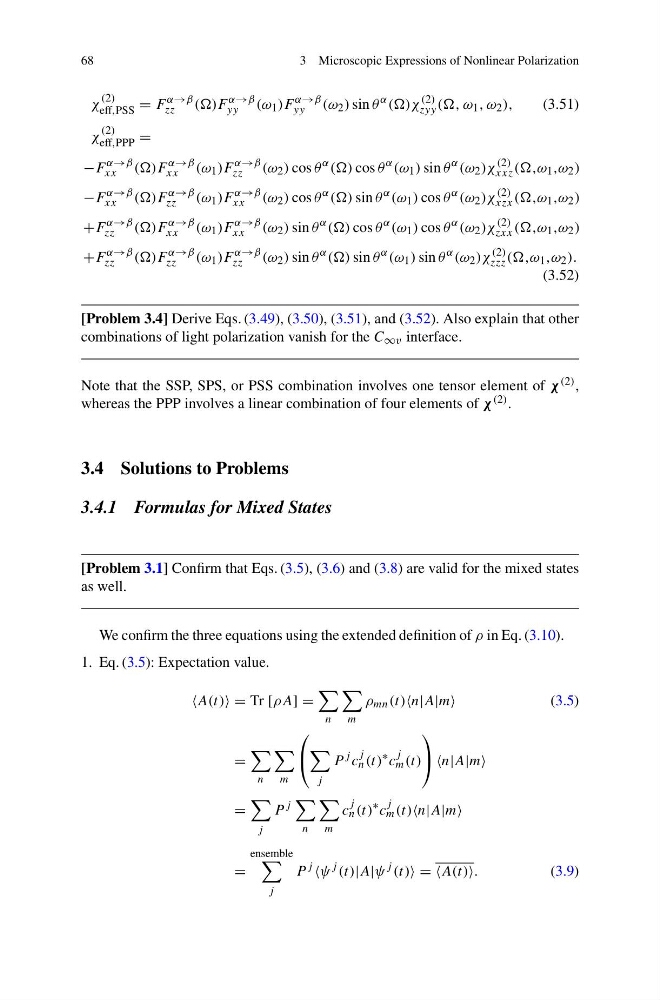
[Problem 3.4] Derive Eqs. (3.49), (3.50), (3.51), and (3.52). Also explain that other
combinations of light polarization vanish for the C ∞v interface.
Note that the SSP, SPS, or PSS combination involves one tensor element of χ (2) ,
whereas the PPP involves a linear combination of four elements of χ (2) .
3.4 Solutions to Problems
3.4.1 Formulas for Mixed States
[Problem 3.1] Confirm that Eqs. (3.5), (3.6) and (3.8) are valid for the mixed states
as well.
We confirm the three equations using the extended definition of ρ in Eq. (3.10).
1. Eq. (3.5): Expectation value.
A(t) = Tr [ρA] =
n
m
ρ mn (t)n|A|m
(3.5)
=
n
m
⎛
⎝
j
P
j c
j
n (t)
∗ c
j
m (t)
⎞
⎠ n|A|m
=
j
P
j
n
m
c
j
n (t)
∗ c
j
m (t)n|A|m
=
ensemble
j
P
j
ψ
j (t)|A|ψ
j (t) = A(t).
(3.9)
3 Microscopic Expressions of Nonlinear Polarization
χ
(2)
eff,PSS = F
α→β
zz
(()F
α→β
yy
(ω 1 )F
α→β
yy
(ω 2 ) sin θ
α (()χ
(2)
zyy ((, ω 1 , ω 2 ),
(3.51)
χ
(2)
eff,PPP =
−F
α→β
xx
(()F
α→β
xx
(ω 1 )F
α→β
zz
(ω 2 ) cos θ
α (() cos θ
α (ω 1 ) sin θ
α (ω 2 )χ
(2)
xxz ((,ω 1 ,ω 2 )
−F
α→β
xx
(()F
α→β
zz
(ω 1 )F
α→β
xx
(ω 2 ) cos θ
α (() sin θ
α (ω 1 ) cos θ
α (ω 2 )χ
(2)
xzx ((,ω 1 ,ω 2 )
+F
α→β
zz
(()F
α→β
xx
(ω 1 )F
α→β
xx
(ω 2 ) sin θ
α (() cos θ
α (ω 1 ) cos θ
α (ω 2 )χ
(2)
zxx ((,ω 1 ,ω 2 )
+F
α→β
zz
(()F
α→β
zz
(ω 1 )F
α→β
zz
(ω 2 ) sin θ
α (() sin θ
α (ω 1 ) sin θ
α (ω 2 )χ
(2)
zzz ((,ω 1 ,ω 2 ).
(3.52)
[Problem 3.4] Derive Eqs. (3.49), (3.50), (3.51), and (3.52). Also explain that other
combinations of light polarization vanish for the C ∞v interface.
Note that the SSP, SPS, or PSS combination involves one tensor element of χ (2) ,
whereas the PPP involves a linear combination of four elements of χ (2) .
3.4 Solutions to Problems
3.4.1 Formulas for Mixed States
[Problem 3.1] Confirm that Eqs. (3.5), (3.6) and (3.8) are valid for the mixed states
as well.
We confirm the three equations using the extended definition of ρ in Eq. (3.10).
1. Eq. (3.5): Expectation value.
A(t) = Tr [ρA] =
n
m
ρ mn (t)n|A|m
(3.5)
=
n
m
⎛
⎝
j
P
j c
j
n (t)
∗ c
j
m (t)
⎞
⎠ n|A|m
=
j
P
j
n
m
c
j
n (t)
∗ c
j
m (t)n|A|m
=
ensemble
j
P
j
ψ
j (t)|A|ψ
j (t) = A(t).
(3.9)