

3.2 Perturbation Forms of Susceptibilities
57
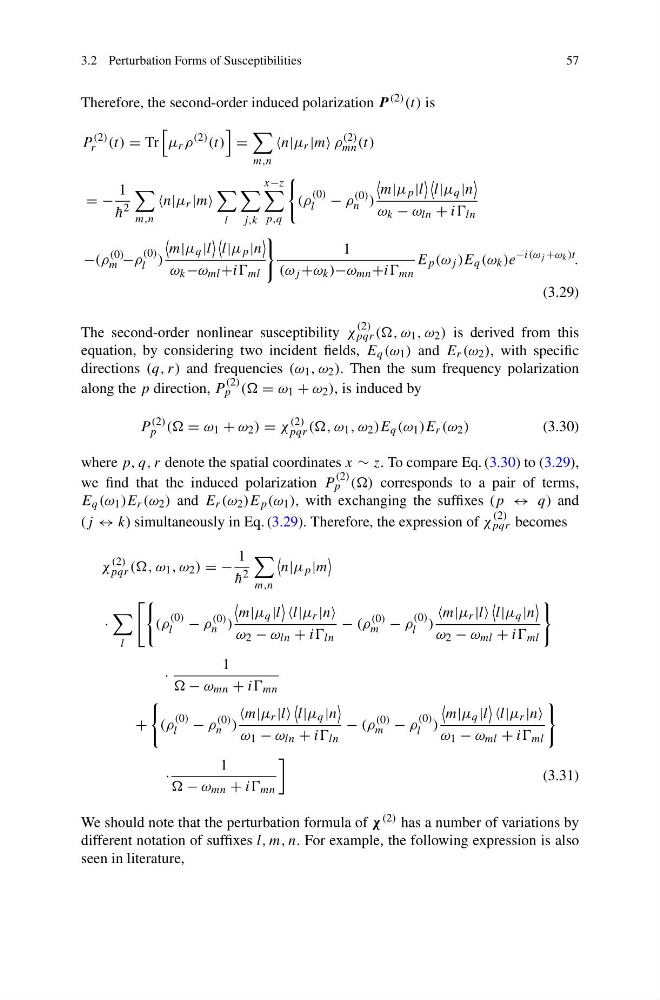
Therefore, the second-order induced polarization P (2) (t) is
P
(2)
r (t) = Tr
μ r ρ
(2) (t)
=
m,n
n|μ r |m ρ
(2)
mn (t)
= −
1
¯
h 2
m,n
n|μ r |m
l
j,k
x−z
p,q
(ρ
(0)
l − ρ
(0)
n )
m|μ p |l
l|μ q |n
ω k − ω ln + ii ln
−(ρ
(0)
m −ρ
(0)
l )
m|μ q |l
l|μ p |n
ω k −ω ml +ii ml
·
1
(ω j +ω k )−ω mn +ii mn
E p (ω j )E q (ω k )e
−i(ω j +ω k )t
.
(3.29)
The second-order nonlinear susceptibility χ
(2)
pqr ((, ω 1 , ω 2 ) is derived from this
equation, by considering two incident fields, E q (ω 1 ) and E r (ω 2 ), with specific
directions (q, r) and frequencies (ω 1 , ω 2 ). Then the sum frequency polarization
along the p direction, P
(2)
p (( = ω 1 + ω 2 ), is induced by
P
(2)
p (( = ω 1 + ω 2 ) = χ
(2)
pqr ((, ω 1 , ω 2 )E q (ω 1 )E r (ω 2 )
(3.30)
where p, q, r denote the spatial coordinates x ∼ z. To compare Eq. (3.30) to (3.29),
we find that the induced polarization P
(2)
p (() corresponds to a pair of terms,
E q (ω 1 )E r (ω 2 ) and E r (ω 2 )E p (ω 1 ), with exchanging the suffixes (p ↔ q) and
(j ↔ k) simultaneously in Eq. (3.29). Therefore, the expression of χ
(2)
pqr becomes
χ
(2)
pqr ((, ω 1 , ω 2 ) = −
1
¯
h 2
m,n
n|μ p |m
·
l
(ρ
(0)
l − ρ
(0)
n )
m|μ q |l
l|μ r |n
ω 2 − ω ln + ii ln
− (ρ
(0)
m − ρ
(0)
l )
m|μ r |l
l|μ q |n
ω 2 − ω ml + ii ml
·
1
− ω mn + ii mn
+
(ρ
(0)
l − ρ
(0)
n )
m|μ r |l
l|μ q |n
ω 1 − ω ln + ii ln
− (ρ
(0)
m − ρ
(0)
l )
m|μ q |l
l|μ r |n
ω 1 − ω ml + ii ml
·
1
− ω mn + ii mn
(3.31)
We should note that the perturbation formula of χ (2) has a number of variations by
different notation of suffixes l, m, n. For example, the following expression is also
seen in literature,
57
Therefore, the second-order induced polarization P (2) (t) is
P
(2)
r (t) = Tr
μ r ρ
(2) (t)
=
m,n
n|μ r |m ρ
(2)
mn (t)
= −
1
¯
h 2
m,n
n|μ r |m
l
j,k
x−z
p,q
(ρ
(0)
l − ρ
(0)
n )
m|μ p |l
l|μ q |n
ω k − ω ln + ii ln
−(ρ
(0)
m −ρ
(0)
l )
m|μ q |l
l|μ p |n
ω k −ω ml +ii ml
·
1
(ω j +ω k )−ω mn +ii mn
E p (ω j )E q (ω k )e
−i(ω j +ω k )t
.
(3.29)
The second-order nonlinear susceptibility χ
(2)
pqr ((, ω 1 , ω 2 ) is derived from this
equation, by considering two incident fields, E q (ω 1 ) and E r (ω 2 ), with specific
directions (q, r) and frequencies (ω 1 , ω 2 ). Then the sum frequency polarization
along the p direction, P
(2)
p (( = ω 1 + ω 2 ), is induced by
P
(2)
p (( = ω 1 + ω 2 ) = χ
(2)
pqr ((, ω 1 , ω 2 )E q (ω 1 )E r (ω 2 )
(3.30)
where p, q, r denote the spatial coordinates x ∼ z. To compare Eq. (3.30) to (3.29),
we find that the induced polarization P
(2)
p (() corresponds to a pair of terms,
E q (ω 1 )E r (ω 2 ) and E r (ω 2 )E p (ω 1 ), with exchanging the suffixes (p ↔ q) and
(j ↔ k) simultaneously in Eq. (3.29). Therefore, the expression of χ
(2)
pqr becomes
χ
(2)
pqr ((, ω 1 , ω 2 ) = −
1
¯
h 2
m,n
n|μ p |m
·
l
(ρ
(0)
l − ρ
(0)
n )
m|μ q |l
l|μ r |n
ω 2 − ω ln + ii ln
− (ρ
(0)
m − ρ
(0)
l )
m|μ r |l
l|μ q |n
ω 2 − ω ml + ii ml
·
1
− ω mn + ii mn
+
(ρ
(0)
l − ρ
(0)
n )
m|μ r |l
l|μ q |n
ω 1 − ω ln + ii ln
− (ρ
(0)
m − ρ
(0)
l )
m|μ q |l
l|μ r |n
ω 1 − ω ml + ii ml
·
1
− ω mn + ii mn
(3.31)
We should note that the perturbation formula of χ (2) has a number of variations by
different notation of suffixes l, m, n. For example, the following expression is also
seen in literature,