

58
3 Microscopic Expressions of Nonlinear Polarization
χ
(2)
pqr ((, ω 1 , ω 2 ) =
1
¯
h 2
g,n,m
ρ
(0)
g
g|μ p |nn|μ q |mm|μ r |g
−ω ng +ii ng
ω 2 −ω mg +ii mg
+
g|μ p |nn|μ r |mm|μ q |g
−ω ng +ii ng
ω 1 −ω mg +ii mg
+
g|μ r |mm|μ q |nn|μ p |g
+ω ng +ii ng
ω 2 +ω mg +ii mg
+
g|μ q |mm|μ r |nn|μ p |g
+ω ng +ii ng
ω 1 +ω mg +ii mg
−
g|μ r |mm|μ p |nn|μ q |g
( − ω nm + ii nm )
1
ω 2 + ω mg + ii mg
+
1
ω 1 − ω ng + ii ng
−
g|μ q |mm|μ p |nn|μ r |g
( − ω nm + ii nm )
1
ω 2 − ω ng + ii ng
+
1
ω 1 + ω mg + ii mg
=
g
ρ
(0)
g χ
(2)
pqr,g ((, ω 1 , ω 2 ).
(3.32)
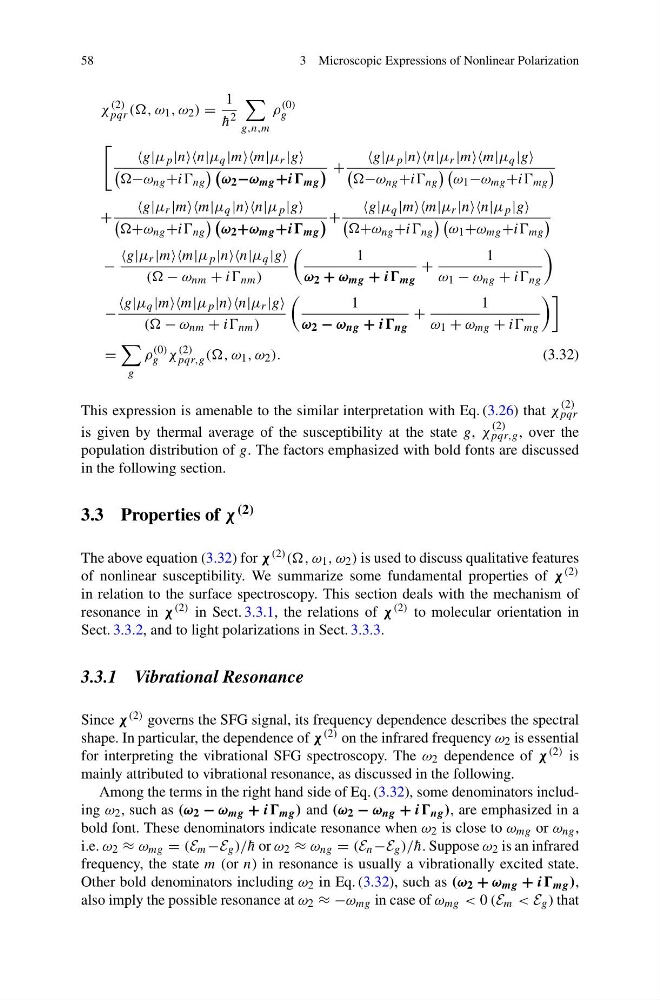
This expression is amenable to the similar interpretation with Eq. (3.26) that χ
(2)
pqr
is given by thermal average of the susceptibility at the state g, χ
(2)
pqr,g , over the
population distribution of g. The factors emphasized with bold fonts are discussed
in the following section.
3.3 Properties of χ (2)
The above equation (3.32) for χ (2) ((, ω 1 , ω 2 ) is used to discuss qualitative features
of nonlinear susceptibility. We summarize some fundamental properties of χ (2)
in relation to the surface spectroscopy. This section deals with the mechanism of
resonance in χ (2) in Sect. 3.3.1, the relations of χ (2) to molecular orientation in
Sect. 3.3.2, and to light polarizations in Sect. 3.3.3.
3.3.1 Vibrational Resonance
Since χ (2) governs the SFG signal, its frequency dependence describes the spectral
shape. In particular, the dependence of χ (2) on the infrared frequency ω 2 is essential
for interpreting the vibrational SFG spectroscopy. The ω 2 dependence of χ (2) is
mainly attributed to vibrational resonance, as discussed in the following.
Among the terms in the right hand side of Eq. (3.32), some denominators including ω 2 , such as (ω 2 − ω mg + ii mg ) and (ω 2 − ω ng + ii ng ), are emphasized in a
bold font. These denominators indicate resonance when ω 2 is close to ω mg or ω ng ,
i.e. ω 2 ≈ ω mg = (E m −E g )/ ¯
h or ω 2 ≈ ω ng = (E n −E g )/ ¯
h. Suppose ω 2 is an infrared
frequency, the state m (or n) in resonance is usually a vibrationally excited state.
Other bold denominators including ω 2 in Eq. (3.32), such as (ω 2 + ω mg + ii mg ),
also imply the possible resonance at ω 2 ≈ −ω mg in case of ω mg < 0 (E m < E g ) that
3 Microscopic Expressions of Nonlinear Polarization
χ
(2)
pqr ((, ω 1 , ω 2 ) =
1
¯
h 2
g,n,m
ρ
(0)
g
g|μ p |nn|μ q |mm|μ r |g
−ω ng +ii ng
ω 2 −ω mg +ii mg
+
g|μ p |nn|μ r |mm|μ q |g
−ω ng +ii ng
ω 1 −ω mg +ii mg
+
g|μ r |mm|μ q |nn|μ p |g
+ω ng +ii ng
ω 2 +ω mg +ii mg
+
g|μ q |mm|μ r |nn|μ p |g
+ω ng +ii ng
ω 1 +ω mg +ii mg
−
g|μ r |mm|μ p |nn|μ q |g
( − ω nm + ii nm )
1
ω 2 + ω mg + ii mg
+
1
ω 1 − ω ng + ii ng
−
g|μ q |mm|μ p |nn|μ r |g
( − ω nm + ii nm )
1
ω 2 − ω ng + ii ng
+
1
ω 1 + ω mg + ii mg
=
g
ρ
(0)
g χ
(2)
pqr,g ((, ω 1 , ω 2 ).
(3.32)
This expression is amenable to the similar interpretation with Eq. (3.26) that χ
(2)
pqr
is given by thermal average of the susceptibility at the state g, χ
(2)
pqr,g , over the
population distribution of g. The factors emphasized with bold fonts are discussed
in the following section.
3.3 Properties of χ (2)
The above equation (3.32) for χ (2) ((, ω 1 , ω 2 ) is used to discuss qualitative features
of nonlinear susceptibility. We summarize some fundamental properties of χ (2)
in relation to the surface spectroscopy. This section deals with the mechanism of
resonance in χ (2) in Sect. 3.3.1, the relations of χ (2) to molecular orientation in
Sect. 3.3.2, and to light polarizations in Sect. 3.3.3.
3.3.1 Vibrational Resonance
Since χ (2) governs the SFG signal, its frequency dependence describes the spectral
shape. In particular, the dependence of χ (2) on the infrared frequency ω 2 is essential
for interpreting the vibrational SFG spectroscopy. The ω 2 dependence of χ (2) is
mainly attributed to vibrational resonance, as discussed in the following.
Among the terms in the right hand side of Eq. (3.32), some denominators including ω 2 , such as (ω 2 − ω mg + ii mg ) and (ω 2 − ω ng + ii ng ), are emphasized in a
bold font. These denominators indicate resonance when ω 2 is close to ω mg or ω ng ,
i.e. ω 2 ≈ ω mg = (E m −E g )/ ¯
h or ω 2 ≈ ω ng = (E n −E g )/ ¯
h. Suppose ω 2 is an infrared
frequency, the state m (or n) in resonance is usually a vibrationally excited state.
Other bold denominators including ω 2 in Eq. (3.32), such as (ω 2 + ω mg + ii mg ),
also imply the possible resonance at ω 2 ≈ −ω mg in case of ω mg < 0 (E m < E g ) that