

36
2 Electrodynamics at Interface
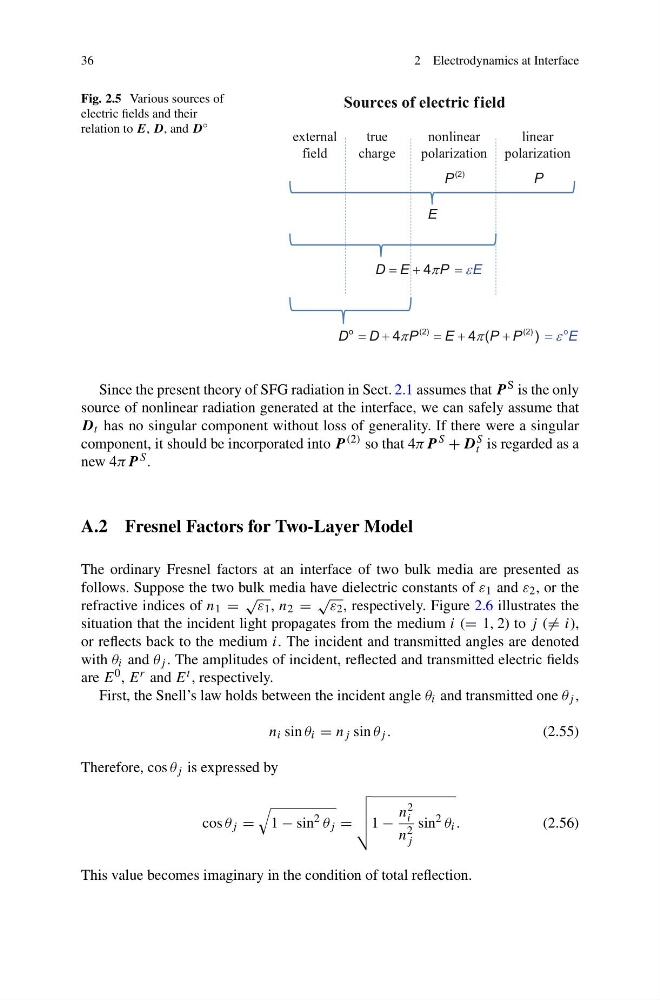
Fig. 2.5 Various sources of
electric fields and their
relation to E, D, and D ◦
external
field
true
charge
nonlinear
polarization
linear
polarization
(2)
P
P
Sources of electric field
E
4
D E
P
E
o
( 2 )
( )
o
2
4
4 (
)
P
D
E
D
P
E
P
Since the present theory of SFG radiation in Sect. 2.1 assumes that P S is the only
source of nonlinear radiation generated at the interface, we can safely assume that
D t has no singular component without loss of generality. If there were a singular
component, it should be incorporated into P (2) so that 4π P S + D S
t is regarded as a
new 4π P S .
A.2 Fresnel Factors for Two-Layer Model
The ordinary Fresnel factors at an interface of two bulk media are presented as
follows. Suppose the two bulk media have dielectric constants of ε 1 and ε 2 , or the
refractive indices of n 1 =
√
ε 1 , n 2 =
√
ε 2 , respectively. Figure 2.6 illustrates the
situation that the incident light propagates from the medium i (= 1, 2) to j ( = i),
or reflects back to the medium i. The incident and transmitted angles are denoted
with θ i and θ j . The amplitudes of incident, reflected and transmitted electric fields
are E 0 , E r and E t , respectively.
First, the Snell’s law holds between the incident angle θ i and transmitted one θ j ,
n i sin θ i = n j sin θ j .
(2.55)
Therefore, cos θ j is expressed by
cos θ j =
1 − sin
2 θ j =
1 −
n 2
i
n 2
j
sin
2 θ i .
(2.56)
This value becomes imaginary in the condition of total reflection.
2 Electrodynamics at Interface
Fig. 2.5 Various sources of
electric fields and their
relation to E, D, and D ◦
external
field
true
charge
nonlinear
polarization
linear
polarization
(2)
P
P
Sources of electric field
E
4
D E
P
E
o
( 2 )
( )
o
2
4
4 (
)
P
D
E
D
P
E
P
Since the present theory of SFG radiation in Sect. 2.1 assumes that P S is the only
source of nonlinear radiation generated at the interface, we can safely assume that
D t has no singular component without loss of generality. If there were a singular
component, it should be incorporated into P (2) so that 4π P S + D S
t is regarded as a
new 4π P S .
A.2 Fresnel Factors for Two-Layer Model
The ordinary Fresnel factors at an interface of two bulk media are presented as
follows. Suppose the two bulk media have dielectric constants of ε 1 and ε 2 , or the
refractive indices of n 1 =
√
ε 1 , n 2 =
√
ε 2 , respectively. Figure 2.6 illustrates the
situation that the incident light propagates from the medium i (= 1, 2) to j ( = i),
or reflects back to the medium i. The incident and transmitted angles are denoted
with θ i and θ j . The amplitudes of incident, reflected and transmitted electric fields
are E 0 , E r and E t , respectively.
First, the Snell’s law holds between the incident angle θ i and transmitted one θ j ,
n i sin θ i = n j sin θ j .
(2.55)
Therefore, cos θ j is expressed by
cos θ j =
1 − sin
2 θ j =
1 −
n 2
i
n 2
j
sin
2 θ i .
(2.56)
This value becomes imaginary in the condition of total reflection.