

22
2 Electrodynamics at Interface
2.2 Response to Incident Lights
In the previous subsection we have discussed the electromagnetic process that
the nonlinear polarization P (2) (r, t) leads to the sum frequency field E i (() by
Eq. (2.19). Next we specify the nonlinear polarization from the incident visible and
infrared fields. The surface polarization P S (() is given using the third-rank tensor
of frequency-dependent nonlinear susceptibility χ (2) ((, ω 1 , ω 2 ) by
P
S (() = χ
(2) ((, ω 1 , ω 2 ) : E(ω 1 )E(ω 2 )
or P
S
p (() =
x∼z
q,r
χ
(2)
pqr ((, ω 1 , ω 2 )E q (ω 1 )E r (ω 2 ) (p, q, r = x ∼ z)
(2.20)
where E(ω 1 ) and E(ω 2 ) denote the amplitudes of the electric fields of visible
and infrared lights, respectively, in the interface. This equation is equivalent to
Eq. (1.4), though Eq. (2.20) implicitly takes account of the phase matching condition
of Eqs. (2.11) and (2.12) along the surface.
Equation (2.20) gives a relation among the interfacial properties, i.e. P S ((),
χ (2) , E(ω 1 ), E(ω 2 ). However, E(ω 1 ) and E(ω 2 ) in Eq. (2.20) indicate the electric
fields inside the interface, which are not amenable to direct experimental measurement. For convenience to interpret experimental measurements, Eq. (2.20) is
modified using the incident electric fields in the bulk media, instead of using E(ω 1 )
and E(ω 2 ), the electric fields inside the interface. This modification is carried out
by the Fresnel transformation in Eqs. (2.17) and (2.18), and the transformed fields
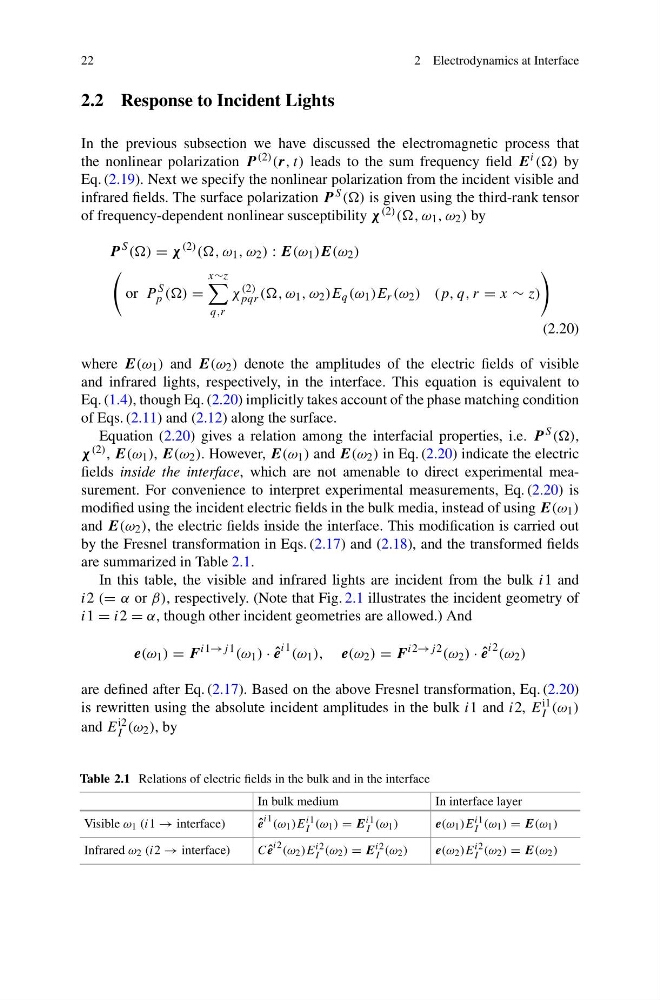
are summarized in Table 2.1.
In this table, the visible and infrared lights are incident from the bulk i1 and
i2 (= α or β), respectively. (Note that Fig. 2.1 illustrates the incident geometry of
i1 = i2 = α, though other incident geometries are allowed.) And
e(ω 1 ) = F
i1→j 1 (ω 1 ) · ˆ
e
i1 (ω 1 ), e(ω 2 ) = F
i2→j 2 (ω 2 ) · ˆ
e
i2 (ω 2 )
are defined after Eq. (2.17). Based on the above Fresnel transformation, Eq. (2.20)
is rewritten using the absolute incident amplitudes in the bulk i1 and i2, E i1
I (ω 1 )
and E i2
I (ω 2 ), by
Table 2.1 Relations of electric fields in the bulk and in the interface
In bulk medium
In interface layer
Visible ω 1 (i1 → interface)
ˆ
e
i1 (ω 1 )E i1
I (ω 1 ) = E i1
I (ω 1 )
e(ω 1 )E i1
I (ω 1 ) = E(ω 1 )
Infrared ω 2 (i2 → interface)
C ˆ
e
i2 (ω 2 )E i2
I (ω 2 ) = E i2
I (ω 2 )
e(ω 2 )E i2
I (ω 2 ) = E(ω 2 )
2 Electrodynamics at Interface
2.2 Response to Incident Lights
In the previous subsection we have discussed the electromagnetic process that
the nonlinear polarization P (2) (r, t) leads to the sum frequency field E i (() by
Eq. (2.19). Next we specify the nonlinear polarization from the incident visible and
infrared fields. The surface polarization P S (() is given using the third-rank tensor
of frequency-dependent nonlinear susceptibility χ (2) ((, ω 1 , ω 2 ) by
P
S (() = χ
(2) ((, ω 1 , ω 2 ) : E(ω 1 )E(ω 2 )
or P
S
p (() =
x∼z
q,r
χ
(2)
pqr ((, ω 1 , ω 2 )E q (ω 1 )E r (ω 2 ) (p, q, r = x ∼ z)
(2.20)
where E(ω 1 ) and E(ω 2 ) denote the amplitudes of the electric fields of visible
and infrared lights, respectively, in the interface. This equation is equivalent to
Eq. (1.4), though Eq. (2.20) implicitly takes account of the phase matching condition
of Eqs. (2.11) and (2.12) along the surface.
Equation (2.20) gives a relation among the interfacial properties, i.e. P S ((),
χ (2) , E(ω 1 ), E(ω 2 ). However, E(ω 1 ) and E(ω 2 ) in Eq. (2.20) indicate the electric
fields inside the interface, which are not amenable to direct experimental measurement. For convenience to interpret experimental measurements, Eq. (2.20) is
modified using the incident electric fields in the bulk media, instead of using E(ω 1 )
and E(ω 2 ), the electric fields inside the interface. This modification is carried out
by the Fresnel transformation in Eqs. (2.17) and (2.18), and the transformed fields
are summarized in Table 2.1.
In this table, the visible and infrared lights are incident from the bulk i1 and
i2 (= α or β), respectively. (Note that Fig. 2.1 illustrates the incident geometry of
i1 = i2 = α, though other incident geometries are allowed.) And
e(ω 1 ) = F
i1→j 1 (ω 1 ) · ˆ
e
i1 (ω 1 ), e(ω 2 ) = F
i2→j 2 (ω 2 ) · ˆ
e
i2 (ω 2 )
are defined after Eq. (2.17). Based on the above Fresnel transformation, Eq. (2.20)
is rewritten using the absolute incident amplitudes in the bulk i1 and i2, E i1
I (ω 1 )
and E i2
I (ω 2 ), by
Table 2.1 Relations of electric fields in the bulk and in the interface
In bulk medium
In interface layer
Visible ω 1 (i1 → interface)
ˆ
e
i1 (ω 1 )E i1
I (ω 1 ) = E i1
I (ω 1 )
e(ω 1 )E i1
I (ω 1 ) = E(ω 1 )
Infrared ω 2 (i2 → interface)
C ˆ
e
i2 (ω 2 )E i2
I (ω 2 ) = E i2
I (ω 2 )
e(ω 2 )E i2
I (ω 2 ) = E(ω 2 )