

2.1 Electromagnetic Fields at Interface
21
F
i→j
=
⎛
⎜
⎜
⎜
⎜
⎜
⎜
⎝
2ε i q j
ε j q i + ε i q j
2q i
q i + q j
2ε i ε j
ε
q i
ε j q i + ε i q j
⎞
⎟
⎟
⎟
⎟
⎟
⎟
⎠
(2.18)
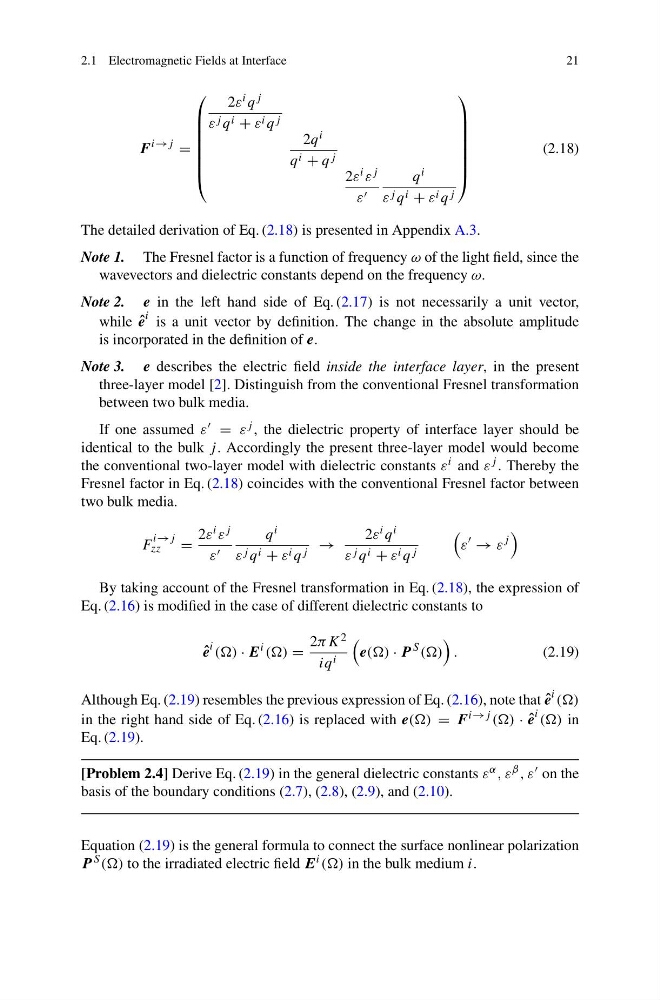
The detailed derivation of Eq. (2.18) is presented in Appendix A.3.
Note 1. The Fresnel factor is a function of frequency ω of the light field, since the
wavevectors and dielectric constants depend on the frequency ω.
Note 2. e in the left hand side of Eq. (2.17) is not necessarily a unit vector,
while ˆ
e
i is a unit vector by definition. The change in the absolute amplitude
is incorporated in the definition of e.
Note 3. e describes the electric field inside the interface layer, in the present
three-layer model [2]. Distinguish from the conventional Fresnel transformation
between two bulk media.
If one assumed ε = ε j , the dielectric property of interface layer should be
identical to the bulk j . Accordingly the present three-layer model would become
the conventional two-layer model with dielectric constants ε i and ε j . Thereby the
Fresnel factor in Eq. (2.18) coincides with the conventional Fresnel factor between
two bulk media.
F
i→j
zz
=
2ε i ε j
ε
q i
ε j q i + ε i q j →
2ε i q i
ε j q i + ε i q j
ε
→ ε
j
By taking account of the Fresnel transformation in Eq. (2.18), the expression of
Eq. (2.16) is modified in the case of different dielectric constants to
ˆ
e
i (() · E
i (() =
2πK 2
iq i
e(() · P
S (()
.
(2.19)
Although Eq. (2.19) resembles the previous expression of Eq. (2.16), note that ˆ
e
i (()
in the right hand side of Eq. (2.16) is replaced with e(() = F i→j (() · ˆ
e
i (() in
Eq. (2.19).
[Problem 2.4] Derive Eq. (2.19) in the general dielectric constants ε α , ε β , ε on the
basis of the boundary conditions (2.7), (2.8), (2.9), and (2.10).
Equation (2.19) is the general formula to connect the surface nonlinear polarization
P S (() to the irradiated electric field E i (() in the bulk medium i.
21
F
i→j
=
⎛
⎜
⎜
⎜
⎜
⎜
⎜
⎝
2ε i q j
ε j q i + ε i q j
2q i
q i + q j
2ε i ε j
ε
q i
ε j q i + ε i q j
⎞
⎟
⎟
⎟
⎟
⎟
⎟
⎠
(2.18)
The detailed derivation of Eq. (2.18) is presented in Appendix A.3.
Note 1. The Fresnel factor is a function of frequency ω of the light field, since the
wavevectors and dielectric constants depend on the frequency ω.
Note 2. e in the left hand side of Eq. (2.17) is not necessarily a unit vector,
while ˆ
e
i is a unit vector by definition. The change in the absolute amplitude
is incorporated in the definition of e.
Note 3. e describes the electric field inside the interface layer, in the present
three-layer model [2]. Distinguish from the conventional Fresnel transformation
between two bulk media.
If one assumed ε = ε j , the dielectric property of interface layer should be
identical to the bulk j . Accordingly the present three-layer model would become
the conventional two-layer model with dielectric constants ε i and ε j . Thereby the
Fresnel factor in Eq. (2.18) coincides with the conventional Fresnel factor between
two bulk media.
F
i→j
zz
=
2ε i ε j
ε
q i
ε j q i + ε i q j →
2ε i q i
ε j q i + ε i q j
ε
→ ε
j
By taking account of the Fresnel transformation in Eq. (2.18), the expression of
Eq. (2.16) is modified in the case of different dielectric constants to
ˆ
e
i (() · E
i (() =
2πK 2
iq i
e(() · P
S (()
.
(2.19)
Although Eq. (2.19) resembles the previous expression of Eq. (2.16), note that ˆ
e
i (()
in the right hand side of Eq. (2.16) is replaced with e(() = F i→j (() · ˆ
e
i (() in
Eq. (2.19).
[Problem 2.4] Derive Eq. (2.19) in the general dielectric constants ε α , ε β , ε on the
basis of the boundary conditions (2.7), (2.8), (2.9), and (2.10).
Equation (2.19) is the general formula to connect the surface nonlinear polarization
P S (() to the irradiated electric field E i (() in the bulk medium i.